 Cara Brown McCormick
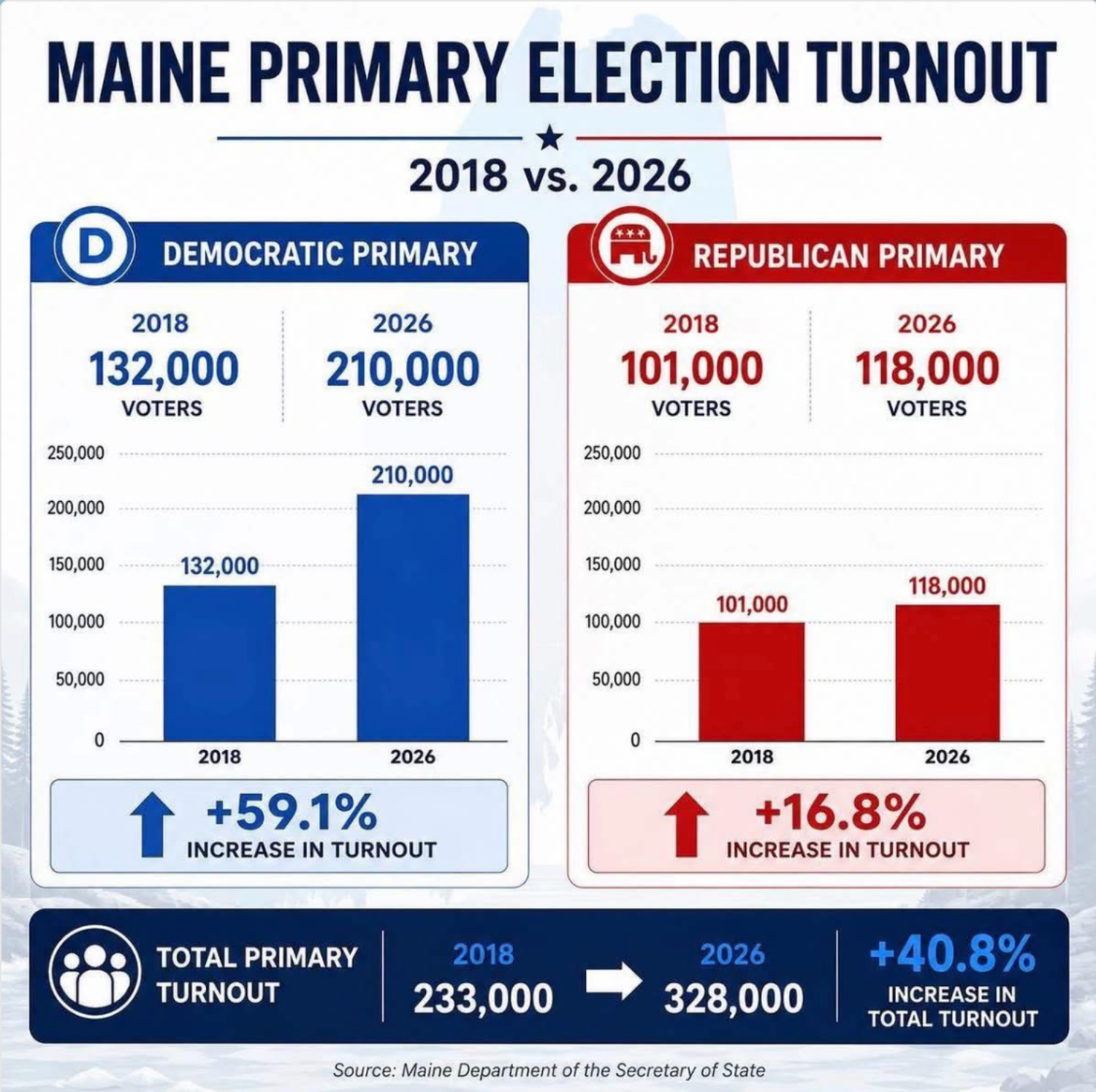
AUGUSTA, Maine – Maine voters turned out in exceptional numbers for the June 9 primary, with some communities running out of ballots and the secretary of state's office delivering extras to Portland, Westbrook, and Kennebunkport.
Election officials are now tabulating ranked-choice results in five races, the ninth time the state has used the system in a statewide contest, with results expected before the Juneteenth holiday on Friday.
LIVESTREAM OF THE RCV TABULATION IN MAINE
The three highest-profile races headed to ranked-choice tabulation are the Democratic and Republican gubernatorial primaries and the Democratic primary for Maine's 2nd Congressional District, all of which ended Election Night without any candidate clearing the 50 percent threshold.
The secretary of state confirmed Tuesday that two legislative Republican primaries will also be included: House District 58, covering communities in Kennebec County, and Senate District 4, encompassing all of Piscataquis County and parts of Penobscot County.
The logistics of the count are as follows: Law enforcement transported paper ballots and encrypted memory sticks under strict chain-of-custody protocols from all 487 municipalities in Maine to the Department of Public Safety headquarters in Augusta, where the process is being conducted on computers not connected to the internet.
Towns with precinct scanners sent encrypted flash drives; roughly 155 smaller towns, most with 500 or fewer residents, sent paper ballots that are being run through tabulator machines on site. Any ballot a machine cannot read, whether crumpled, stained, or otherwise damaged, is hand-counted by staff.
Once all ballot data is uploaded and cross-checked, running the actual ranked-choice count takes just minutes.
The process is being overseen by Chief Deputy Secretary of State Kate McBrien, who is standing in because Secretary of State Shenna Bellows is a candidate in the Democratic gubernatorial primary and has fully recused herself from all tabulation activity.
McBrien is joined by Deputy Secretary of State Julie Flynn, the longest-serving elections official in the country, and Maine Director of Elections Heidi Peckham. The tabulation is open to the public and is being livestreamed on the secretary of state's YouTube page. Campaign representatives from several campaigns are observing in person.
The secretary of state's office makes the formal determination to proceed with ranked-choice tabulation when no candidate achieves a majority based on initial, unofficial municipal results.
Tabulation proceeds in rounds: the lowest-ranked candidate is eliminated, that candidate's votes are redistributed to voters' next ranked choices, and the process repeats until one candidate holds more than 50 percent.
Under state law, only a candidate who received one of the top three rankings at the end of the second-to-last round may request a recount, a process in which representatives of each candidate and secretary of state staff manually review every paper ballot.
Results will be announced this Friday, and by law the official results will be posted within 20 days of the election.
Maine voters approved ranked choice voting in 2016, watched the legislature try to repeal it, and came back in 2018 to reaffirm it by a wider margin in a People's Veto campaign.
None of the eight statewide elections conducted under ranked choice voting before this one produced the chaos opponents predicted.
What it has produced, at least in this cycle, is something notable even by Maine's standards. Three of the five Democratic gubernatorial candidates, former House Speaker Hannah Pingree, former Senate President Troy Jackson, and Secretary of State Bellows, ran coordinated campaigns encouraging their supporters to rank the others second and third rather than competing for every available vote.
On the Republican side, candidate David Jones, a longtime opponent of ranked choice voting, stood at the State House with an oversized cardboard ballot before the primary and walked voters through how to fill it out fully.
"The Maine Democrats gave us Ranked Choice Voting," Jones said. "Today, we are going to beat them at their own game."
The numbers heading into the count reflect how open the Democratic gubernatorial race is.
Former Maine CDC Director Nirav Shah leads with nearly 27 percent of first-choice votes, followed by Pingree at 23 percent, Jackson at 21 percent, and Bellows at just under 21 percent. Businessman Angus King III, at around 8 percent, will be eliminated first, with his voters' second choices redistributed among the remaining field. Only about 13,000 votes separate the top four candidates in a primary that drew more than 210,000 voters.
On the Republican side, Bobby Charles holds a lead of more than 20,000 votes, making him the clear frontrunner, though the ranked-choice process will have the final word. Charles has attempted to preemptively discredit the proceedings, posting fundraising calls on social media urging supporters to help "stop the Shenna steal," a reference to Bellows, who has recused herself from the tabulation entirely.
The 2nd District Democratic race is the tightest of the three major contests, with Joe Baldacci, Matt Dunlap, and Jordan Wood separated by about 2,000 votes after the first round. Paige Loud placed fourth and will be eliminated first. Under a traditional plurality system, one of those three would already have been declared the winner. Under ranked choice voting, the outcome will turn on which candidate has built the broadest coalition.