
 Shawn Griffiths
WASHINGTON, D.C. — In his address to the nation Thursday, President Donald Trump once again demanded that congressional Republicans pass the SAVE America Act. However, one member of his party has stood out for her defiance—US Sen. Lisa Murkowski (Alaska).
Murkowski made her position unmistakable in a Wall Street Journal op-ed.
“While I support the bill’s core tenets … I remain opposed to it,” Murkowski wrote.
 Cara Brown McCormick
She does not object to the core principle of the legislation. Specifically, that only citizens should vote. She does not reject voter ID either. However, she spoke to the specifics of the bill, and how this is not simply about keeping noncitizens from voting.
It is about how the bill’s sweeping federal requirements, compressed implementation schedule, and restrictions on mail voting would create serious barriers for eligible Alaska citizens.
“As written, the SAVE America Act isn’t a simple fix to safeguard elections, as proponents claim," she wrote. "It would impose costly new barriers and prevent some, perhaps many, from voting, while also creating chaos before the November elections.”
At a time when control of Congress has turned nearly every major vote into a national partisan battle, Murkowski’s rejection of the SAVE America Act stands out because her stated reasoning is not about which party benefits. It is about how the bill would affect the Alaskans she represents.
It is a notable example of how Alaska’s nonpartisan election system gives elected officials more room to answer to voters rather than party leaders.
Murkowski: The Bill Does Not Work for Alaska
The SAVE America Act would require people registering to vote in federal elections to provide documentary proof of US citizenship. Currently, voters have to swear on penalty of perjury that they are a citizen.
Thus, the bill shifts the burden of proof from the government to the individual.
The Senate version also includes stricter identification requirements for voting in person and new restrictions affecting mail ballots. But Murkowski argues that the bill’s supporters are ignoring the practical consequences of it.
Specifically, in a state like Alaska.
Alaska allows voters to register to vote through an online portal. The SAVE America Act would effectively do away with online voter registration of any kind because voters would have to present citizenship documents directly to elected officials.
This, Murkowski said, would not be as big of an issue in many states—but in Alaska, it would make it all but impossible for many lawful citizens to register.
“Alaska has only six election offices where that requirement could clearly be met,” she wrote. “Six places in a state more than twice the size of Texas, where roughly 80% of our communities, and about 20% of our population, aren’t connected by road.”
Reaching an election office for many voters would require an expensive flight, favorable weather, and hours of travel.
“Say you are an 18-year-old living in Savoonga, on a remote island in the Bering Sea, who wants to register to vote for the first time. If the SAVE America Act passed, your only option would be to buy a ticket on Bering Air to Nome, which runs about $780 round-trip. A night at the Aurora Inn would be more than $300. So, not counting food and local transportation, it would cost more than $1,000 just to register to vote.”
For a fisherman in Unalaska, located on the Aleutian Islands, the round-trip ticket alone would cost $1,500, according to Murkowski.
She has also raised concerns about tribal identification cards that may not contain the expiration dates, photographs, or other information demanded under the SAVE America Act. Further, only about half of the state’s electorate has a passport.
For women who have changed her last name after marriage, they may have to “wait one to two months to receive certified copies of their vital records.”
Then, there is the issue of mail-in voting. Murkowski noted that more than 50,000 Alaskans voted absentee in 2024, It is not merely a convenience for many rural, military, elderly, and disabled residents in Alaska—it’s a necessity.
“I have expressed my concerns with the SAVE America Act for months. I filed several amendments when it came to the Senate floor. No effort has been made to correct its flaws,” she wrote.
Trump Turns the Bill into a Loyalty Test
President Trump addressed the nation on July 16 to discuss the 2020 elections, declassified documents about foreign interference, and claimed more than 200,000 noncitizens were on voter rolls across the country—among other things.
All of this he used to call on Congress once again to pass the SAVE America Act. “Congress must pass the SAVE America Act,” he said, before urging Americans to call their representatives and demand its passage “without delay.”
He renewed his demand for documentary proof of citizenship, photo identification and a nationwide prohibition on most mail voting.
For Trump, this isn't just about election security. It is a loyalty test. In the past, he has threatened to withhold endorsements from Republicans who opposed it and his signature from any other bill sent to his desk.
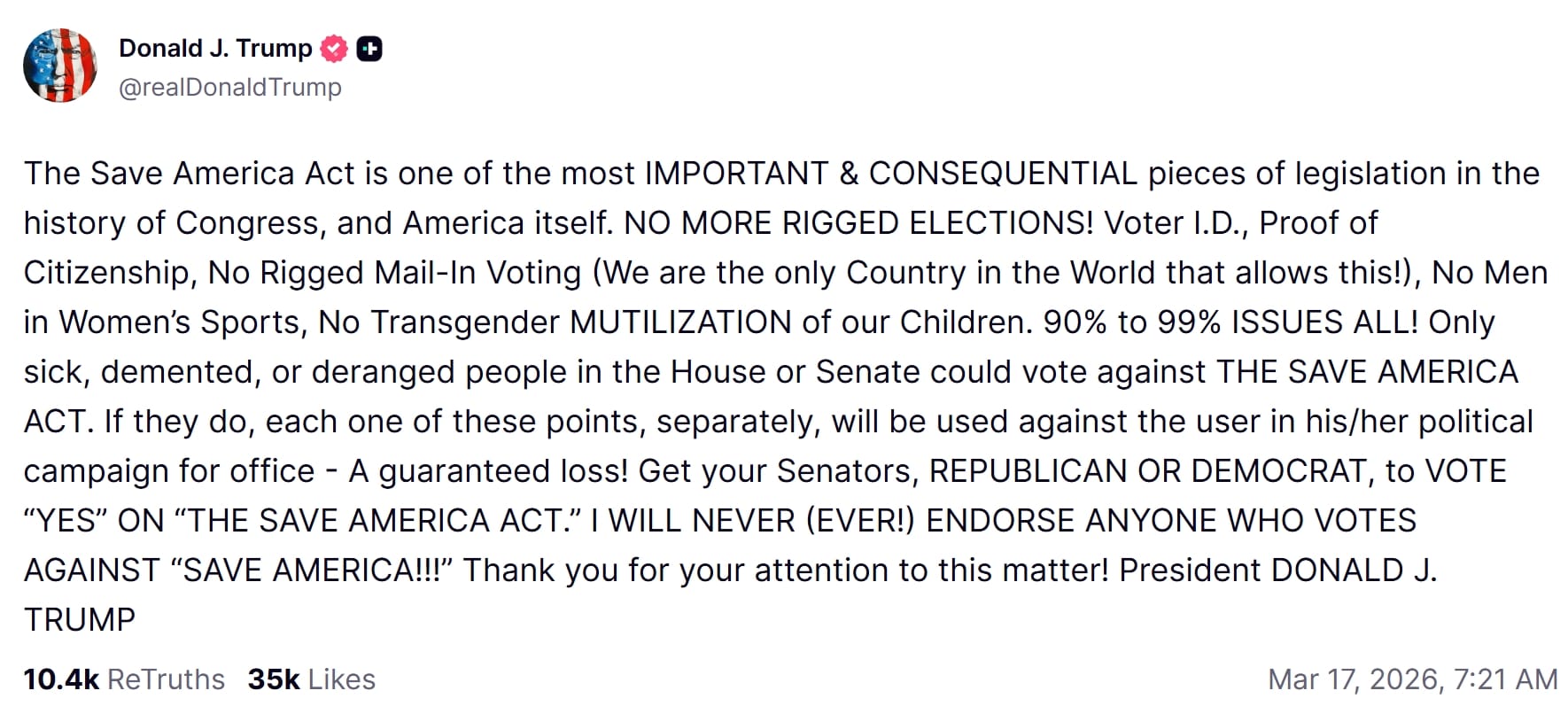
The president has also called on Republican lawmakers who stall or oppose his agenda to be “primaried,” endorsing challengers who emerge in otherwise safe Republican districts that will be more loyal to him.
Three Republican incumbents in Congress have lost their seats in 2026 to a Trump-backed challenger in their primaries. Not because of the SAVE America Act, but because Trump was dissatisfied with them for other reasons:
- US Sen. Bill Cassidy of Louisiana, who lost to a candidate recruited by Trump;
- US Rep. Thomas Massie of Kentucky, who has long been targeted by Trump; and
- Sen. John Cornyn of Texas, who lost a primary runoff after Trump endorsed Texas Attorney General Ken Paxton.
This isn’t a new phenomenon in American politics.
Primaries are often weaponized by a political party or ideological movement to keep lawmakers in line, and while it often works, Murkowski wasn't afraid to pen her op-ed in the Wall Street Journal.
She is the only sitting Republican in Congress who has made her opposition to the SAVE America Act unambiguous.
To understand why, look at how elections are now conducted in Alaska.
Murkowski is no longer elected under a partisan primary system. Her political future is not solely in the hands of party leaders and/or a small group of highly motivated partisan or ideological voters with a vendetta.
Her political future rests with all Alaska voters.
Murkowski’s Seat Would Be Filled by a Trump Loyalist If Not for Nonpartisan Primaries
In most states, a Republican senator who openly defies a Republican president risks being challenged in a low-turnout party primary.
The threat does not have to be explicit. Lawmakers understand that angering the party’s leadership, activists, or aligned-special interest groups can cost them endorsements, campaign money, and the voters who dominate closed primaries.
Alaska changed that calculation.
After voters passed Ballot Measure 2 in 2020, every candidate for state and federal office appears on the same nonpartisan ballot, regardless of party—and, every eligible voter can vote for any candidate they want in each race.
The four candidates who receive the most votes in the primary advance to the general election. Voters then use ranked choice voting to determine the winner.
These reforms moved Alaska away from a party-nominated system that locked out 60% of the electorate registered independent of a political party. So, even before primary election day, minority rule was a guarantee.
The new system not only allows the independent majority to participate in critical taxpayer-funded elections, but lets them pick any candidate they want. They can choose a Republican in one race and a Democrat or Independent in the next.
Trump cannot simply threaten Murkowski with being primaried. He and/or the party can back another campaign, but candidates won’t only be competing for a narrow slice of Republican voters. They have to reach beyond their base support.
This distinction was tested in 2022.
Trump-backed Kelly Tshibaka, who attacked Murkowski from the right and received the Alaska Republican Party’s endorsement, ran to unseat the incumbent. It is believed that if Alaska still used closed primaries, she would have knocked Murkowski out before the general election.
“Our key findings were: We don’t think Murkowski would have won if it were not for Top 4, at least when compared to a closed primary system,” said Dr. Christian R. Grose, a Political Science professor at the University of Southern California, in a 2024 IVN interview.
 Shawn Griffiths
Instead, both candidates advanced from the nonpartisan primary.
In the ranked choice general election, Murkowski built a broader coalition that included Republicans, independents, and voters who initially supported Democratic candidate Pat Chesbro.
Murkowski ultimately defeated Tshibaka 53.7% to 46.3%.
At the time, Trump called Alaska’s elections “a total rigged deal” and potentially “crooked as hell.” On Murkowski, Trump said, “She knew she could not win a straight-up election”—suggesting again that Alaska’s system is crooked.
He did not offer any anecdotal evidence for these claims.
Murkowski knows first-hand how easy it is to be ousted by her party under a partisan primary system. In 2010, she lost the Republican primary and then won the general election through an extraordinary write-in campaign.
She has long demonstrated an unusual ability to survive outside normal party structures. But Alaska’s current system means she no longer needs to pull off a historic feat simply to let Alaska voters judge her record at the ballot box.
In April, Trump ramped up his attacks on Alaska’s nonpartisan elections. He urged Alaskans to repeal the system in November, calling ranked choice voting in particular “disastrous” and “very fraudulent.”
The repeal effort has his “complete and total support.”
Republican leaders and aligned special interest groups are attempting for the second time to repeal voter-approved reform. They failed to pass a repeal measure in 2024 in a true nail-biter, 49.9%-50.1%.
On the subject of Alaska elections, Trump has mostly focused on ranked choice voting. However, he has explicitly endorsed closed primaries. For example, in 2022, he declared that “only Republicans” should vote in Republican primaries.
Notably, a 2025 peer reviewed study by political scientists Todd Donovan, Caroline Tolbert and Nathan Micatka compared Alaska’s final partisan midterm primary in 2018 with its first Top Four primary in 2022.
They found:
- Overall primary turnout increased.
- The largest proportional increases were among political independents, younger voters and liberals.
- Participation also increased to some extent among ideological moderates.
- The primary electorate consequently became less dominated by traditional party voters.
Alaska is already seeing how a more inclusive and inviting process shifts candidate and lawmaker incentives.
Under a conventional party-primary system, a lawmaker’s immediate concern may be whether the president, party committee, or aligned organization will support a primary challenger. This incentivizes loyalty to these groups above everything else.
Under Alaska’s system, the more important question is whether the lawmaker can assemble a majority coalition among all voters in both the primary and in November. The incentive shifts to broader accountability.
The system does not mean Murkowski does not have to defend her stance on the SAVE America Act to Alaska Republicans who support Trump. But she can also make her case to rural residents who depend on mail voting.
She can speak to the concerns of Alaska Native communities whose tribal identification may not meet federal requirements, eligible voters who may find registration more cumbersome (or even impossible), and independent voters who do not take instructions from either party.
Alaska’s election system ensures the final decision about who represents the state in Congress belongs not to Trump, not to Republican Party officials and not to a small partisan-primary electorate — but to Alaska voters.
Where the SAVE America Act Stands
As of July 20, the SAVE America Act has not passed Congress and according to Senate Majority Leader John Thune (R-South Dakota), it has no clear path through the upper chamber.
The House approved its version of the bill in February. The Senate voted 51-48 in March to begin considering the measure, with Murkowski voting against proceeding. Debate later stopped without a final passage vote.
There was an attempt to add the bill to a budget reconciliation package in June, but it failed 48-50 in June. Murkowski was joined in opposition by Republican Sens. Susan Collins, Mitch McConnell, and Thom Tillis.
House Republicans are now exploring alternate routes, including attaching SAVE Act provisions to spending legislation. This approach, however, faces the Senate’s 60-vote threshold unless Republican senators agree to weaken or eliminate the filibuster.
Trump has demanded the Senate scrap the filibuster entirely, but there is not currently enough Republican support for that either. In other words, the bill is alive as a political demand but stalled as a bill.