 Mike Madrid
Latino voters are not behaving like swing voters. They are behaving like alienated voters. They punished Republicans for scapegoating them in 2018. They punished Democrats for economic incompetence in 2024. They are now punishing Republicans again for the cruelty and chaos of Trump's second term.
It’s clear to anyone watching that Latinos are now the largest swing group in America moving by historic margins between Democrats and Republicans, punishing whichever party is in power.
What’s even more obvious is that this is a clear rejection of partisan allegiances. We’re not witnessing a realignment of partisan voting behavior—we’re watching a dealignment away from both parties by epic proportions.
Two new data points published this month confirm the pattern and add something to it. The deeper story is not who is getting the Latino vote. It is whether the system lets them vote at all without first joining a club they no longer believe in.
A new poll of New York City Democrats found that only 40% of registered Democrats describe themselves as proud members of the party. A statistically equivalent 38% said they registered Democratic for one reason: to vote in the primary, which in most NYC districts is the only election that decides anything.
The Latino crosstab is the headline. Just one in three Latino Democrats in New York City, 33%, actually consider themselves Democrats. That is the lowest share of any racial or ethnic group surveyed.
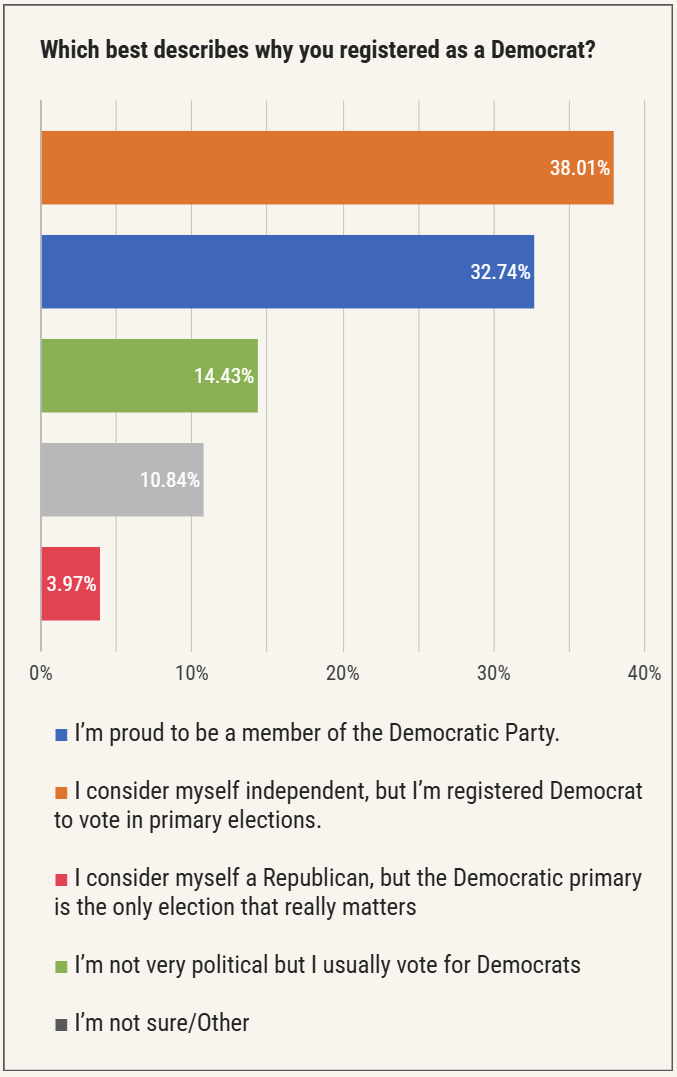
Among Latino Democrats, the largest single group, 39%, said they are really independents who registered with the party to gain access to the ballot.
This is what closed primaries produce. They do not produce loyalty. They produce compliance. Latino voters in New York are doing what the rules force them to do. They are not endorsing the party in the process.
California does not have this problem in the same form because California does not have closed party primaries.
Under the nonpartisan Top Two system passed by voters in 2010, every voter receives the same ballot. Every candidate appears on it. Voters do not have to register with a party to participate, and no party gets to decide whose vote counts.
The 2026 primary data shows the consequence.
According to Political Data Inc.'s California ballot tracker, as of June 15, Latino turnout in the June primary climbed from 19% in 2022 to 26% in 2026. That 7-point gain is the largest of any ethnic group in the state.
The Latino share of all returned ballots also rose considerably, bolstering the overall 2026 primary turnout—which the secretary of state's unofficial count places at 40.7% of the registered voting population (up from 33% in 2022).
In a state where Latinos are not required to belong to a party in order to vote, they are participating near the highest rate I have seen in three decades of doing this work.
A late-May Independent Voter Project poll of 1,189 California Latino registered voters found that only 22% want to eliminate the nonpartisan primary and return to a closed system. A majority, 53%, want to keep it or expand it.
 Shawn Griffiths
The national picture is consistent. A new NBC News poll released June 15 found 64% of Latino voters disapprove of the job President Trump is doing. Anyone reading that as a return to the Democratic Party is about to make the same mistake the Republican Party made in 2024.
Latino voters are not punishing Trump because he is a Republican. They are punishing him because his tariffs raised the cost of lumber and drywall in an industry that employs 1-in-5 Latino men, and because his mass deportation campaign turned churches and schoolyards into staging grounds.
They reacted to what those policies did to their families and their paychecks. They are not swinging. They are fleeing.
The Democratic Party has spent a generation assuming demographic change would deliver the Latino vote on a schedule. It will not. Class is now a stronger predictor than ethnicity for how Latino voters move politically, and the Democratic coalition has drifted away from working-class concerns at exactly the moment Latinos became the fastest-growing share of the working class.
The Republican Party has spent the same generation assuming cultural affinity would eventually deliver a permanent center-right coalition. It will not, at least not while the party is openly hostile to immigrants and indifferent to grocery prices.
The result is what the data now shows in plain English. In closed-primary states like New York, Latino voters register Democratic because they have to, then tell pollsters they are not really Democrats.
In open-primary states like California, they show up in larger numbers and refuse to commit in advance.
The current effort to repeal California's Top Two primary moves in exactly the wrong direction. It would return California to the system New York still uses. It would shrink the share of Latino voters whose ballots actually decide elections.
 Shawn Griffiths
The party that is self-aware enough to learn this lesson first will dominate American politics for the next generation.
What I would add now is that the lesson is not only about messaging or candidate quality. It is about the rules. New York's data shows what happens when the system controls the voter. California's data shows what happens when the voter controls the system.
Both parties are losing their hold on the Latino vote. The question is whether the rules will continue to allow the political parties to disguise that fact.