
 IVN Editorial Board
SAN DIEGO, Calif. - A new Independent Voter Project poll conducted in the final week of May found that despite an effort by Democratic and Republican operatives to repeal the Top Two open primary, a majority of Latino voters are not sour on the nonpartisan system.
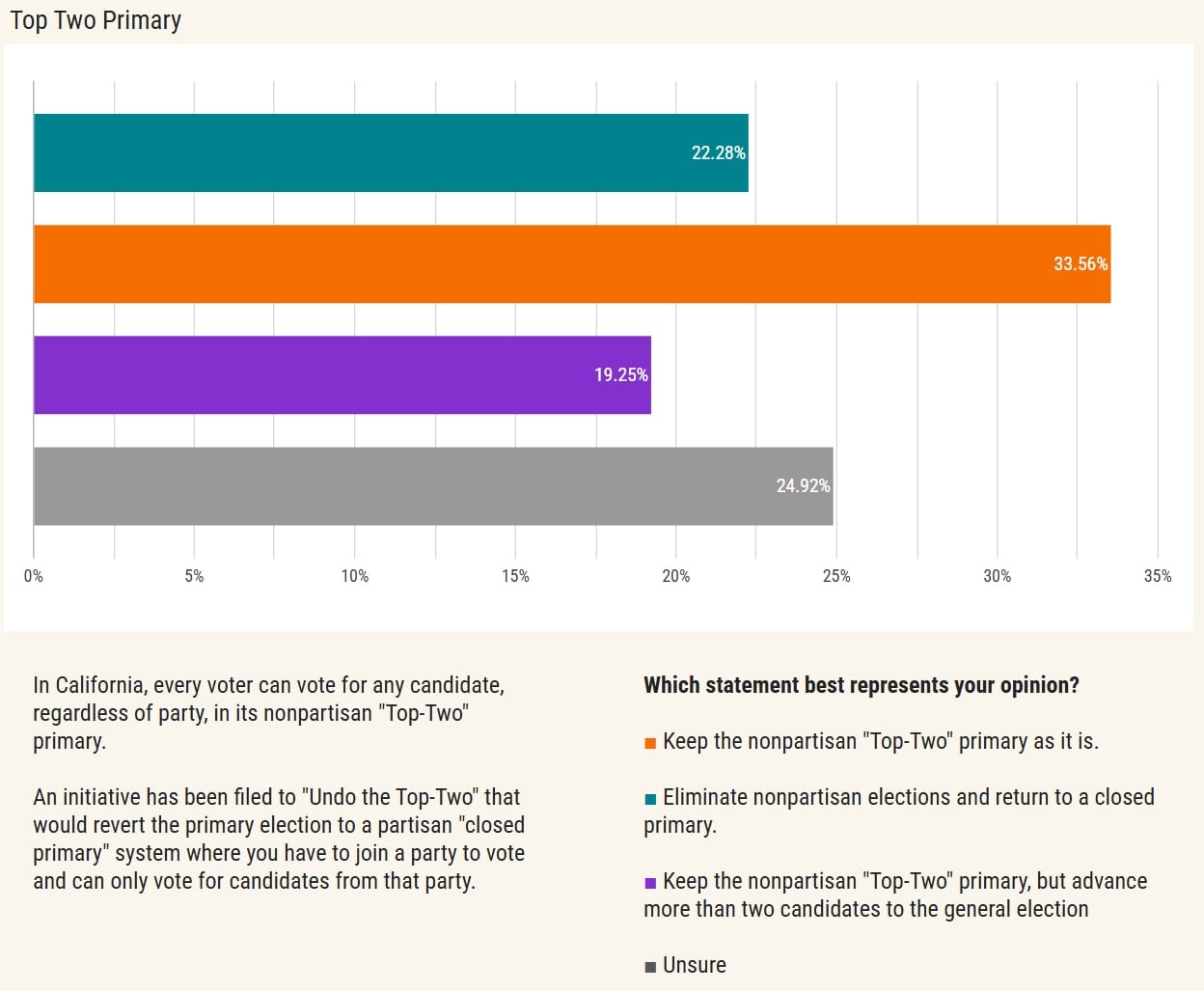
In fact, a majority 53% either want to keep the system as is (33.56%) or want to modify it to advance more than two candidates to the general election (19.25%). Only 22% said they want California to eliminate nonpartisan primaries and go back to a closed primary system.
About a quarter of respondents said they were “Unsure.”
Prior to the passage of Proposition 14 in 2010 by a majority of Californians, the state used a primary system that allowed the parties to choose who could participate in these taxpayer-funded elections. They decided whose vote mattered.
Today, all voters can participate in the primary and choose any candidate they want because of the Top Two system.
 Independent Voter Project
IVP polled 1,189 verified registered Latino and Hispanic voters whose voter files indicate that they are likely general election voters. It has a margin of error of ±2.9 percentage points at a 95% confidence level
The results show that the percentage of Latinos who want to eliminate ‘Top Two’ is not far off from the general voting population, but still noticeably less.
A Capitol Weekly poll found that 29% of California voters said they wanted to eliminate 'Top Two.' More Californians at-large wanted to modify (49%) and fewer wanted to keep the system as is (21%) compared to Latinos surveyed.
When asked what they like about Top Two, 66% said its best feature is that "nonpartisan voters can vote in the primary for candidates from any party," according to Capital Weekly.
In the end, both polls point to the same conclusion: Most voters, whether looking at the electorate as a whole or Latino voters specifically, do not want to return to a system that restricts voter choice and locks out 7 million independent voters.
Research into Latino voters reveals why. A third of this group is registered No Party Preference or independent of the two major parties. But even among those who pick a party, many do not follow a strict ideology or partisan line.
Shawn Griffiths
The nonpartisan primary system has also helped shape the California Legislature in a way that has increased Latino representation. Latinos make up about 40% of the population and under Top Two their representation has increased to a third of the legislature.
Democratic consultant Steve Maviglio filed paperwork on May 8 with the California secretary of state to repeal Proposition 14. He was quickly joined by Republican operatives and politicians like Ron Nehring, former GOP chair, and MAGA-aligned Assemblymember Carl DeMaio.
DeMaio's group, Reform California, even offered to contribute funds and help with the signature gathering operation for the initiative.
More Choice California launched to lead the opposition against Top Two repeal. This cross-partisan group of reformers is also proposing an update to the nonpartisan system by expanding the number of general election candidates to 4 and using ranked choice ballots.
The goal is not to go backward, but protect independent voter rights and give voters more options in November elections.
On The Governor’s Race: Latino Voters Want Becerra – And It Is Not Even Close
IVP also surveyed Latino voters on who they preferred in the 2026 California governor’s race days before the June 2 primary. They were asked to provide their preferred candidate as well as their second choice.
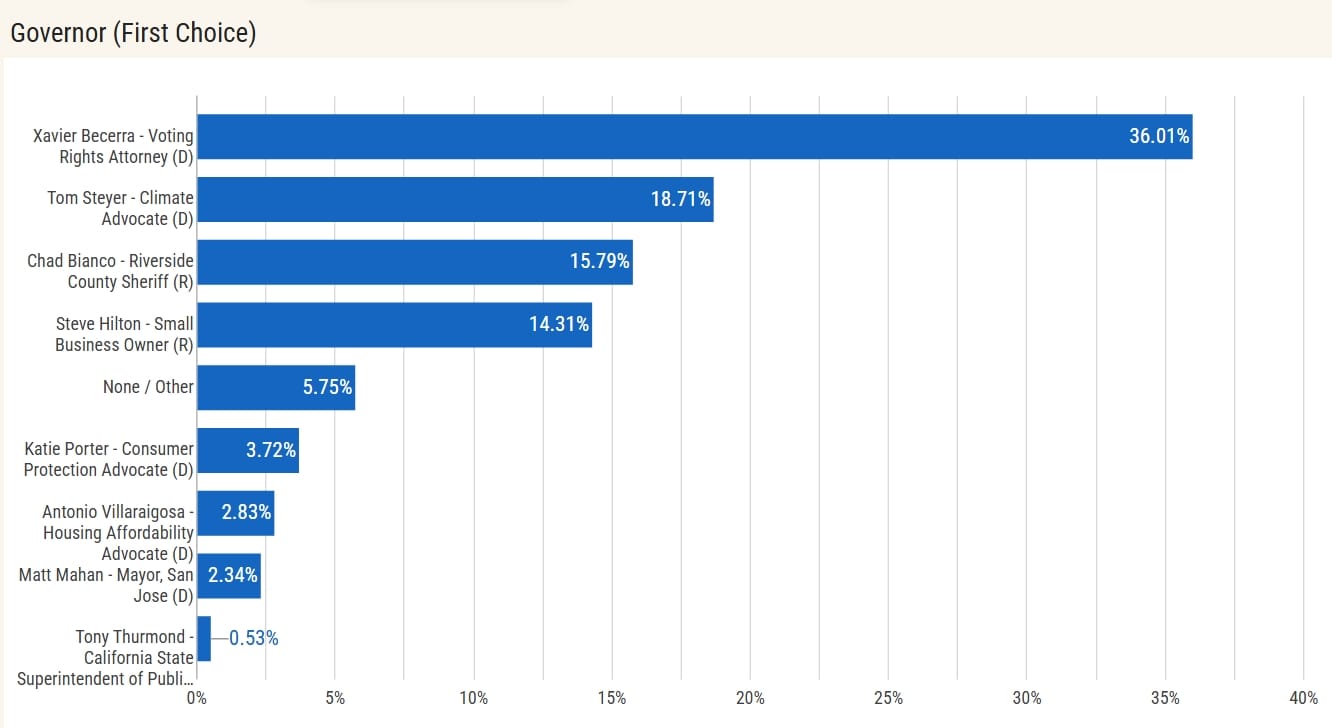
The results: Xavier Becerra had a commanding lead over every other candidate in the race—36% named the former US Health and Human Services secretary as their first choice. What’s more, voters were more likely not to have a second favorite.
The next highest polling candidate was Tom Steyer at 18.71%.
It is important to note that the IVP poll was modeled to reflect likely general election voters. There are people who took the survey who may regularly vote in November, but may not cast a ballot in June.
In the last gubernatorial contest in 2022, a third of the registered electorate participated in the primary, and among Latino voters—there was a significant turnout gap.
However, as IVN Editor Shawn Griffiths noted, if Latino voters participate in the primary, they will be the most powerful voting bloc. They represent not only 40% of the population, but more than 90% of growth in eligible voters statewide.
The IVP poll also highlights where the incentive is for Latino voters to participate in the primary. More than a third said they would vote for Becerra, but of those voters — nearly 30% selected “None/Other” as their second choice.
Here are the second-choice selections among Becerra voters:
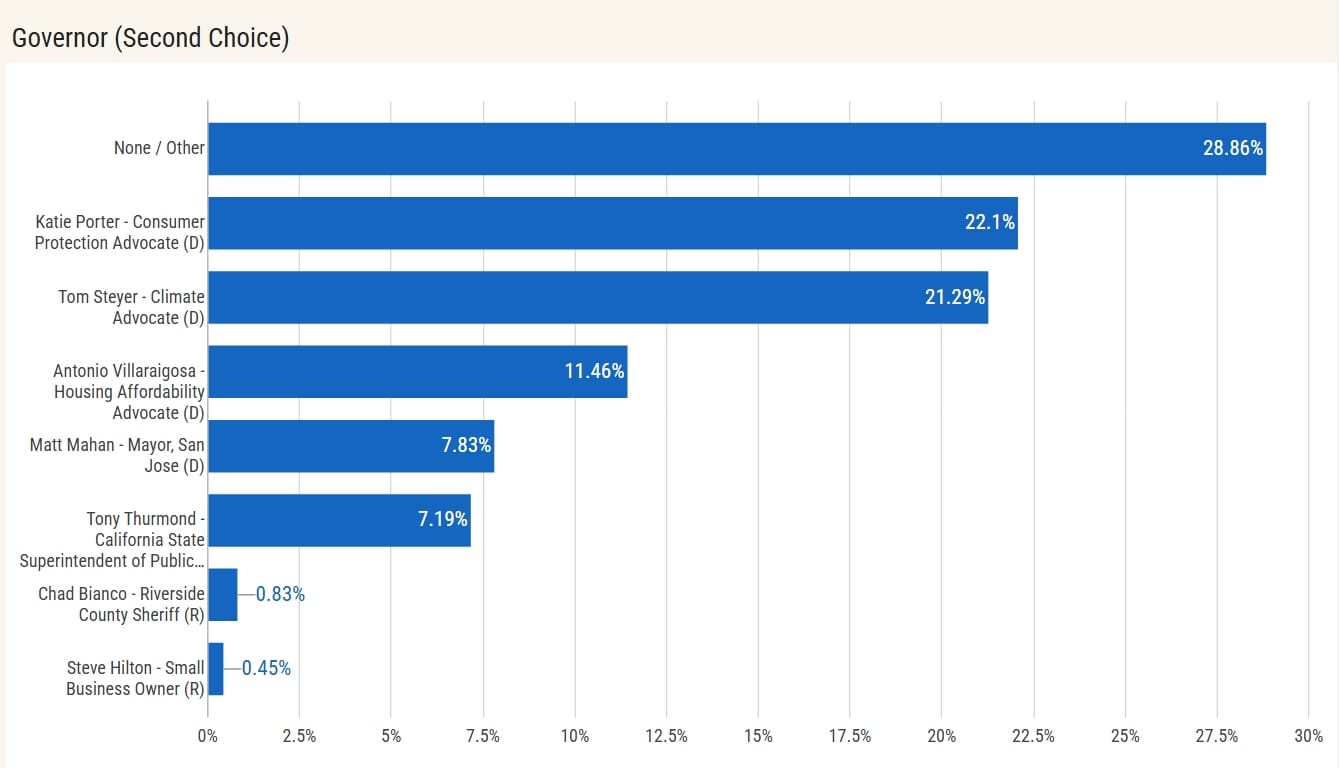
This doesn’t mean they wouldn’t vote for another candidate if Becerra doesn’t advance to the general election. However, if they want their voice to matter most, especially if they only prefer one candidate, they need to vote in the primary.
The same applies to every voter, regardless of which candidate they prefer most.
In California, every voter gets the same primary ballot. They can vote for whomever they want in each race. They don’t need anyone’s permission to do it, nor do they have to wait for private political parties to choose for them.
Methodology and Reliability
The IVP 2026 California Latino Primary Survey was conducted May 26–28, 2026, among 1,189 screened and verified California registered voters of Hispanic background. The sample was drawn directly from L2's California voter file. All respondents were verified registered voters matched back to that file. Eligibility was restricted to Hispanic California voters who participated in at least two of the last four general elections.
This documented participation threshold served as the turnout model for the survey, anchored in verified voting history rather than self-reported voting intent. Eligibility was restricted to Hispanic California voters who participated in at least two of the last four general elections. This documented participation threshold served as the turnout model for the survey, anchored in verified voting history rather than self-reported voting intent.
Respondents were reached via MMS outreach using verified cell phone records matched to the voter file. The survey was fielded in both English and Spanish, with the message and survey form delivered in the language matching the household's primary language as recorded by L2. All responses were validated against the source file. Duplicate submissions and unmatched records were excluded prior to analysis.
After applying the high-propensity screen, the dataset was weighted by age, gender, household language, and party registration to approximate the demographic composition of California's Hispanic 2-of-4 voter universe. The modeled electorate consists of 57.1% Democrats, 24.4% Republicans, and 18.6% independent voters, and is 50.2% English-language / 49.8% Spanish-language by household.
The unweighted sample composition is Democrats n=724, Republicans n=284, and independent registrants n=197.
For purposes of this survey, IVP defines independent voters to include all voters not registered as Democrats or Republicans, including No Party Preference registrants, American Independent Party voters, and all other minor party registrants. American Independent Party registrants are treated as independent for all analytical purposes, consistent with California's nonpartisan primary structure.
In practical terms, this turnout model represents the general-election electorate of California's Hispanic 2-of-4 voters, not the primary electorate. Primary turnout among California Latino voters is meaningfully smaller, older, and more partisan than the general electorate this poll is modeled on. A material change in turnout composition between the primary and the general, particularly among independent and younger Latino voters, would alter projected ballot dynamics.
The overall margin of error is ±2.9 percentage points at the 95% confidence level, adjusted for the design effect introduced by weighting using Kish's effective sample size of 1,159 (a design effect of 1.03, reflecting an unusually well-pre-balanced sample). Subgroup margins of error are wider: ±3.7 points for Democrats, ±5.9 points for Republicans, and ±7.1 points for independent voters.
As with all voter-file-based online samples, the margin of error reflects sampling precision within the modeled electorate and should be interpreted as an estimate rather than a guarantee of representativeness.
The survey instrument covered the California Governor's race (first and second choice), party trust, intent to vote in the 2026 primary, and a question on the Top-Two nonpartisan primary system versus a return to closed partisan primaries. All results reported reflect weighted percentages unless otherwise noted.
This poll should be understood as a structural model of California's Hispanic general-election electorate. It is not a forecast of primary outcomes, and material changes in the composition of the turnout would alter the topline results.