
 Michael Feinstein
Editor's Note: This op-ed was written by Michael Feinstein, a Green Party candidate for California secretary of state. IVN is an open platform that welcomes all perspectives from anyone who wants to submit an article, op-ed, or letter to the editor, including candidates. As long as it adheres to our etiquette, we will publish it.
With our country’s democracy in severe crisis, incredibly, there are no secretary of state candidate forums nor debates scheduled between us—even though the race to elect California’s chief elections official would be an ideal place to discuss the electoral systems we use to choose our public representatives.
What we do have between us, are our candidate statements in the statewide Official Voter Information Guide that go to over 25 million votes, and our individual campaign websites. What we each say and don’t say in those places speaks volumes about our visions for democracy in our state.
This is my critique of your statements and platforms. (My statement and platform are in these links.)
Don Wagner, Republican
Wagner says he wants to protect what he calls ‘a fundamental right’ of every eligible voter to participate in our democracy. But in his candidate statement, he offers nothing that might suggest protecting or enhancing the ability of eligible voters to participate.
Instead, Wagner focuses on restricting mail-in voting and requiring voter ID at the polls—steps known to decrease participation and disenfranchise voters (I explain why in the appendix below), while also sewing unsubstantiated doubt about the validity of election results.
Wagner is a member of a political party, the Republicans, that in California has become mostly impotent under the state’s jungle primary/top two election system. Rather than their veiled attempt to use voter suppression tactics to depress their opponents’ vote, Wagner and state Republicans would do well to embrace multi-seat proportional representation elections for the state legislature (and ranked-choice voting for statewide office.)
Proportional representation elections would give Republicans a clear seat at the table of our democracy, reflecting the actual support for their ideas among voters across the state.
By contrast, under California’s current winner-take-all system, Republicans at best hope to win a small number of state legislative seats in a few parts of the state, subject to how single-seat district lines are drawn.
And now, amidst a bitter national redistricting fight going on between states and parties, even the current limited number of Republican opportunity seats in California is uncertain.
 Shawn Griffiths
Proposition 50—passed by California voters in November 2025—suspended the congressional districts drawn by the state’s independent Citizens Redistricting Commission until 2032, in order to give Democrats an additional five seat advantage at Republicans’ expense.
After 2032, no one knows what will happen, with no end in sight to our nation’s internecine redistricting battles.
If the California Republicans were to commit to proportional representation, they could join with large numbers of non-affiliated voters, minor party members, and many Democrats to form a meaningful coalition for electoral system change.
And, help bring about a viable multi-party democracy for our state that would be far more inclusive and representative than what we have under single-seat, winner-take-all elections—whether the nomination-by-party system we had before or the jungle primary version we have today.
That is what makes Wagner’s voter suppression-based campaign so disappointing. With no proposals to improve political representation for Californians in his candidate statement (nor on his campaign website) it will likely leave the limited two-candidate Fall campaign between Wagner and incumbent Shirley Weber void of meaningful debate about fuller representation in our democracy.
Shirley Weber, Democrat
Weber's candidate statement focuses on her well-known, long-time support for voting rights.
The historical struggle for the right to vote for all citizens—which should be a given in this country—has been long, cruel and difficult. Today, important gains of the past are increasingly under threat.
In this environment, to have a strong voting rights advocate as secretary of state is a major asset for California.
Shawn Griffiths
But ‘voting rights’ must mean more than just being able to vote. It must also mean the right to vote for and elect candidates who represent your views—and to win representation in proportion that your views are held in society.
That’s why a discussion of electoral systems should be front and center in the secretary of state campaign. But Weber does not address representation in her candidate statement nor in her campaign website priorities.
In her candidate statement, Weber concludes by saying that we all should be able to register and vote, regardless of our political differences. But she doesn’t address whether those political differences—and the political constituencies that hold them—each merit representation themselves, even when they don’t make up a political majority within a district.
As our state’s incumbent chief elections official, Weber should be challenged whether she questions or accepts the limited and incomplete representation that inherently comes from our state’s exclusive reliance upon single-seat district, winner-take-all elections.
Even though she is a member of a political party that disproportionately benefits from its duopoly status, ideally Weber would put aside partisan interests and support moving to a system where all points of views and constituencies gain representation in proportion to their support within the electorate.
Gary Blenner, Green
My third opponent, Gary Blenner, is a fellow Green Party member and a respected colleague. Between us, we share a strong commitment to basic Green electoral reforms like proportional representation, ranked-choice voting and public financing of elections.
We are supportive of each others’ campaigns and have even coordinated on messaging against the Republicans' voter suppression voter ID ballot measure.
A benefit of there being two Greens running in the secretary of state race is the need for electoral reform in our state is so pressing—and the size and the population of our state is so large—that having two Greens running will enable us to reach more voters.
Additionally, by state law, the votes for both of us will be combined towards reaching the 2% in a statewide race needed to automatically extend the Green Party’s statewide ballot status for the next four years. So rather than vote-splitting, our campaigns are complementary.
However, because of the high $25 per-word cost for the candidate statements in the Voter Information Guide, and his desire to spend some of his limited funds on TV and social media ads, Blenner was only able to devote 36 words to policy in his statement, compared to the full 250-word statements Weber, Wagner and I were able to afford.
Rather than this being a demerit against Blenner, this should be seen as a voters rights issue, where candidate statements in the Voter Guide should be free or have a de minimis cost, because all voters should be entitled to a basic floor of information about all the candidates before them.
The Debate We Should Be Having
The 2026 governor’s race has laid bare one of the several fault lines within California’s jungle primary top two system: it is not designed well for—and breaks down—when there are multiple strong candidates.
It is absurd that under top two, the two gubernatorial candidates that will advance to the November general election may each receive 25% or less of the primary election vote (and even those totals will be driven in part by lesser-evilism.) That absurdity should be more than dispositive that it’s time for change.
The question is ‘change to what?’
Some want to return California to the previous system, where all ballot qualified parties nominated a candidate to appear on the general election ballot. Secretary Weber is one of them. In 2022, she told CalMatters that top two had been a failure, and that a return to multiple party-nominated candidates and independents on the general election ballot would be preferable.
To her credit, among the many problems in practice that have arisen from top two, Weber has said that one of the primary reasons she is opposed to top-two is because it keeps minor party candidates out of the general election campaign.
She is right about that (which makes her silence about proportional representation particularly vexing, because if she cares about minor party voices, why not about minor party representation?)
The jungle primary has been devastating for California’s ballot qualified minor parties—and the voters that support them.
Not only has top two virtually eliminated minor party candidates from the general election ballot. But even the threshold to qualify for the primary election ballot has been raised so high for minor party candidates (compared to under the previous system) that few even make it that far—in effect, disappearing minor parties from California’s political landscape. For Greens, party suppression is voter suppression.
Yet top two came about in part because many voters were especially frustrated with the major party options that came out of the previous system, often feeling there was no one to vote for in the general elections that represented their views. This sentiment has manifested in many ways, including in the drop in the percentage of voters who register in the state’s two major parties, from 84% in 1996 to 70% today.
Part of that frustration came from the fact that in order to protect incumbents (and thus limit voters ability to choose new representatives), the legislature was drawing the legislative districts under which they would run, until in 2008 and 2010, voters passed independent redistricting plans for the state legislature and California’s congressional delegation.
But top two also promised to separately address that frustration by eliminating party primaries, and combining together all candidates from all parties (and all independents) into a jungle primary, then limiting general election choices to only two.
But in many cases—often because of the limited and often unrepresentative options that come out of jungle primaries—this has simply shifted which voters have no one to vote for that they identify in the general election.
To address this, some top two supporters would like to keep the jungle primary, but then expand the number of general election choices arising out of it to a ‘top four’ or ‘top five’ — and use ranked-choice voting (RCV) both in the general election to eliminate vote-splitting and ensure a majority winner and in the primary to arrive at the top ‘x’ candidates who would advance.
Shawn Griffiths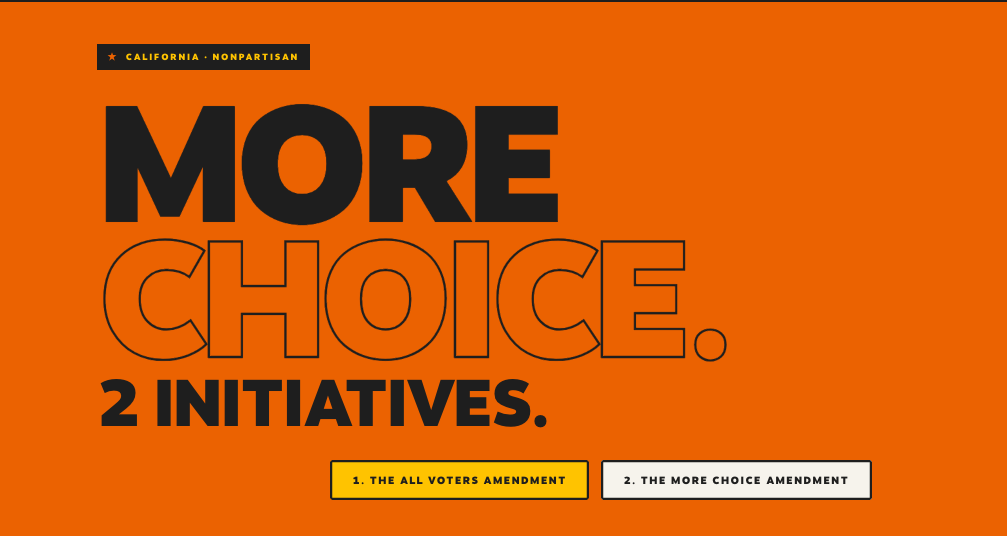
This would be a significant improvement over the current two top system, in terms of having more options in the general election, while simultaneously empowering voters to express their preferences over multiple candidates and still arrive at a majority winner via RCV.
Use of RCV would also greatly improve the nomination-by-party system by eliminating the ‘spoiler’ and the ‘lesser-of-evils’ dynamic in the general election, while ensuring a majority winner—even when several parties place nominees on the general election ballot.
But neither of these address what we Greens—and many others—think is the root problem underlying California’s substantial democratic deficit: the state’s singular reliance upon single-seat, winne'r-take-all districts to elect its state and federal legislative representatives.
If we’ve learned anything from our current national fight over redistricting, it’s that however we draw single-district lines, it’s going to favor some voters over others, depending upon which voters are grouped together with which others; and because its winner-take-all, large pluralities of voters will still receive no representation.
It must be questioned why we accept this in such a multi-layered and diverse state as California, when systems of proportional representation could give all of that diversity its own seat at the table.
But debate over proportional representation will be mostly absent going forward in this year’s secretary of state contest because top two will likely eliminate the two Greens in this race from a place on the general election ballot, when more voters will be paying attention.
There is little likelihood that even many lesser changes to top two will be meaningfully debated, as Weber’s victory over Wagner November is generally seen as a given, and therefore the race will likely receive minimal media coverage and feature no formal candidate debates.
Who loses in this process? The public.
Next Steps for California’s Democracy
Instead of a vigorous public dialogue (via this year’s secretary of state campaign) about options to improve our democracy, what is likely to occur going forward is that competing groups that want to either return to the nomination-by-party system or modify top-two will each seek to raise money to qualify their own ballot measure for 2028.
Then we will have to debate up-or-down on their terms, instead out of reform flowing out of a broadly inclusive public process that considers all options first.
That lack of an inclusive process is what happened the last time major electoral system reform was considered, after the 2008-2009 effort (which I was deeply involved in) to hold a Constitutional Convention to consider electoral reform stalled.
Instead California’s top-two elections system was placed on the June 2010 ballot by the state legislature, as part of a February 3, 2009 2 a.m. state budget deal—but without any formal and inclusive public hearings leading up to it during that legislative session that could have better identified all of the problems with top two that have become apparent over the years, and improved what the legislature eventually put on the ballot — maybe even including some of the improvements jungle primary supporters today are advocating.
Independent Voter Project
Instead — in significant part based upon a highly contested and significantly incomplete (if not misleading) ballot title and summary, top two in its flawed form was passed in June 2010 by the voters with 53.7%—hardly a broad mandate for systemic change.
If top two is repealed and replaced, what process will lead to its replacement? Before these new ballot measure qualification efforts gain steam, since the State Legislature did not exercise proper legislative hearing due diligence when it put top two on the June 2010 ballot, why not respond to the Green Party’s request made in June 2021:
“that the California State Assembly Committee on Elections and the State Senate Standing Committee on Elections and Constitutional Amendments convene a public inquiry process, to include public hearings around the state, to review California’s top two experiment and alternatives to it — including proportional representation for the state legislature and ranked choice voting for single-seat, statewide office…and review to see how top two has functioned in practice, and whether claims made for it in the official ballot statement and in the ballot arguments have borne out.”
Wouldn’t that be a refreshing way to consider next steps for our democracy?
Appendix: The Voter Suppression Voter ID measure
I unconditionally oppose the ‘California Voter Identification and Voter List Maintenance Requirements Initiative.’ Worse than being a solution in search of a problem, the measure is a thinly veiled attempt to disenfranchise voters, and to sew doubt about our election results by implying people are voting who should not be—when the empirical record says they are not.
(1) Republican secretary of state candidate Don Wagner is a champion of this initiative and advocates new voter ID requirements at the polls. But California elections are already incredibly secure, and necessary identification is already required when a person first registers to vote. There is no evidence of widespread noncitizen voting that would justify additional ID requirements at the polls—nor the time and expense required from already underfunded county election offices to gather and process this information.
(2) Wagner also seeks to restrict mail-in voting and suggests the time it takes California to count all ballots is an embarrassment. The reason that it takes the time to count the ballots that it does in California is a result of California making it easier to vote—including by the widespread use of mail-in ballots—and to ensure the integrity of each voter’s ballot. This is a good thing!
To make it easier to vote, beginning in 2020, California started mailing ballots to all registered voters that can be returned by mail, left at a ballot box or delivered in person at the polls. Mail ballots require additional verification steps, so they can take longer to tabulate than ballots cast in person that are fed into a scanner at the precinct polling place or voter center. This extra time is a public policy choice in favor of enabling greater voter participation.
California also allows mail ballots to either be turned in by election day at polling place or drop box; or if postmarked by election day, as long as it arrives no later than seven days afterward—all in the spirit of making it easier to vote by Election Day. Legally cast, but later arriving ballots also mean later processing. But is this such a bad thing, if it means thousands more voters were able to vote that might not have otherwise?
Counties also have varying levels of staffing or resources that can impact how quickly the work is done. My campaign’s stance is that we should ensure a more standard level of support for county registrar of voters offices, to have a more level playing field for our democracy, regardless of where you live in the state. But when counties are understaffed because they're underfunded, we can’t complain if counting of all ballots takes longer.
Finally, we give voters several days to address any problems that may have arise with their ballot. This also can add time to the vote count—but if it means ensuring these voters' voices are heard, it is worth it.
(3) Restricting vote-by-mail and imposing new barriers to voting as Wagner suggests risks disenfranchising thousands of eligible voters—seniors, working families, communities of color, people with disabilities, people who have experienced a name change and/or move around a lot - and more.
It could also wrongfully flag naturalized citizens, and create new ways to challenge election results.
At best, this excessive voter ID strategy is a solution in search of a problem that distracts us from the need to achieve broader and deeper representation in our democracy. At worst, it a thinly veiled attempt to disenfranchise voters, and to sew doubt about our election results—all to affect who gains power, compared to who would be elected if all voices are heard and counted.