Jeremy Gruber
Editor's Note: The following is an exclusive series on IVN from the better elections group Open Primaries. The content originated from the group's weekly newsletter, "Primary Buzz."
The Alabama Republican Party has added closed primaries—requiring voters to register with a party before participating—to its official party platform.
The move follows an unsuccessful effort in the state legislature this year to require party registration for primary voting. The proposal passed the House but stalled in the Senate amid concerns about the impact on independent voters.
But some Republicans are pushing back against the party line.
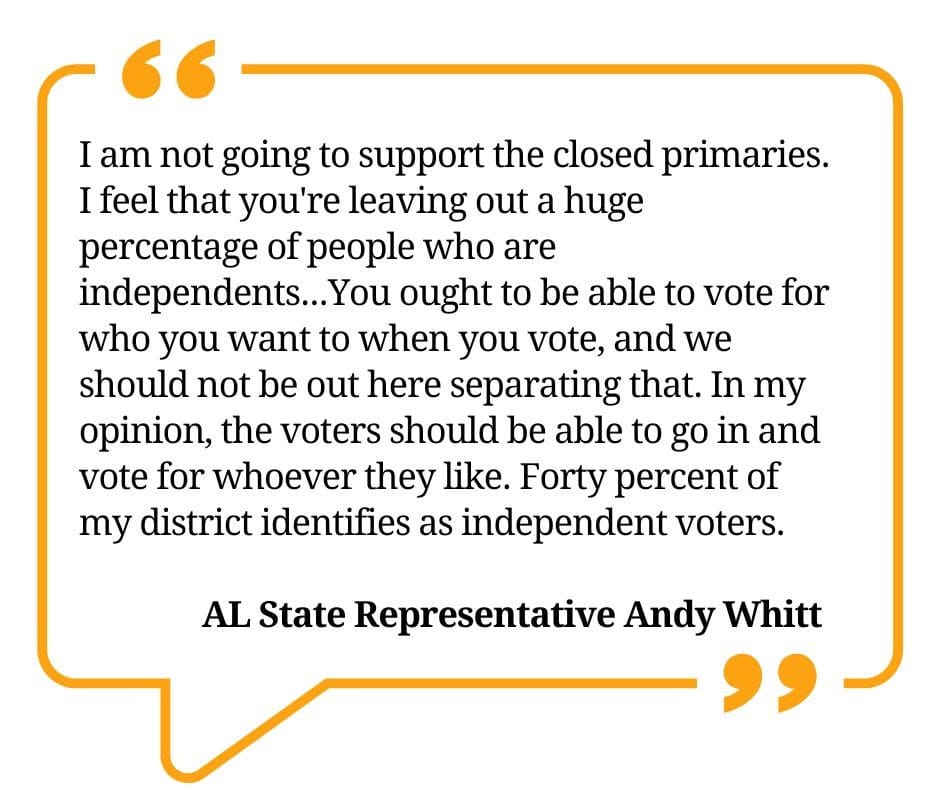
State Representatives Andy Whitt and Phillip Rigsby publicly opposed closing primaries, citing the large number of independent voters in their districts.
The party’s decision comes as Republican organizations in other states pursue similar efforts. The South Carolina Republican Party is currently seeking through litigation to restrict participation in its primaries and limit voting to registered party members.
What We're Talking About
Latino Independents are Changing the Game
In 2016, Open Primaries partnered with civil rights attorney Danny Ortega to conduct a deep dive exploration into the growth of the Latino electorate in Arizona. A key finding was that 81% of Latino voters believe it is important to be independent from both major parties.
Ten years later, veteran political strategist Mike Madrid lays out precisely how the Independent Latino Mindset is reshaping California politics - and provoking shadowy political operatives to push for closed primaries.
Read Mike Madrid’s editorial in the Sacramento Bee
It’s a groundbreaking analysis that shows the relationship between the rise of independents - especially Latino independents - and efforts to prevent them from voting.
California’s recent gubernatorial primary showed what happens when this emerging electorate has a voice. 41% of voters turned out - compare that to 9% in closed primary New York - the highest turnout for a gubernatorial primary in state history. Driving that turnout were two growing groups: Latino voters and independents.
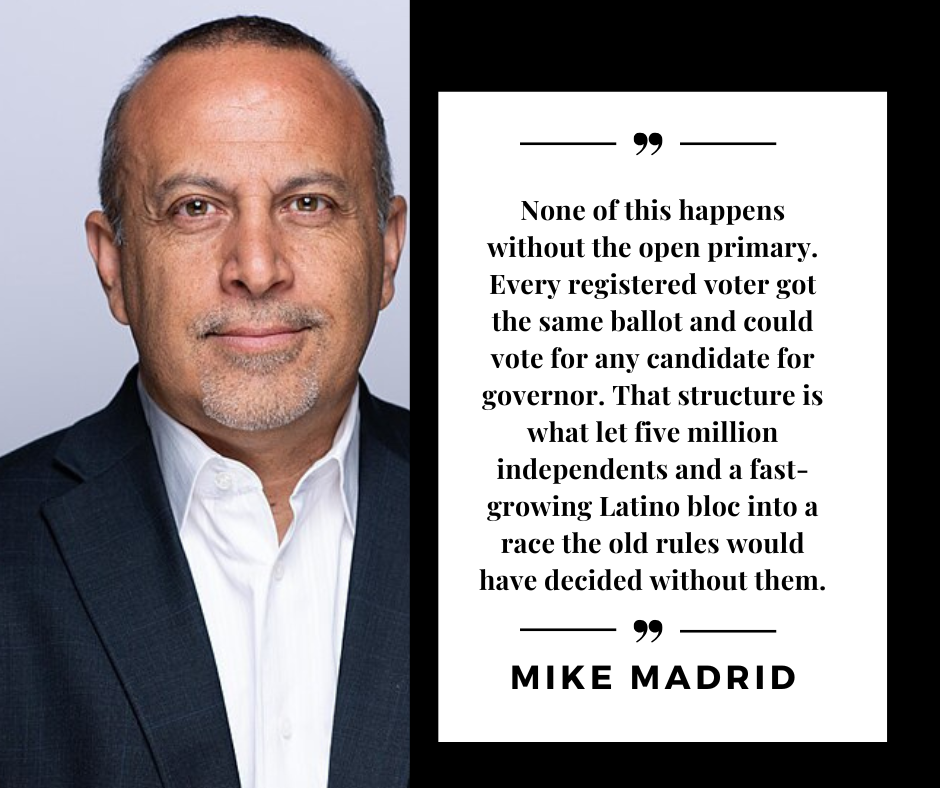
They call California a blue state. But independent voter registration has surged 50% since 2022, and Latino independent turnout jumped from roughly 11.8% in 2022 to nearly 16.5% this year — a 40% increase, far outpacing overall turnout growth. “Blue” does not capture what is happening in the Golden State.
As Latino voters continue moving beyond old party categories, the question is whether our democracy will adapt to include them - or whether political insiders will try to close the door just as these voters are flexing their muscles.


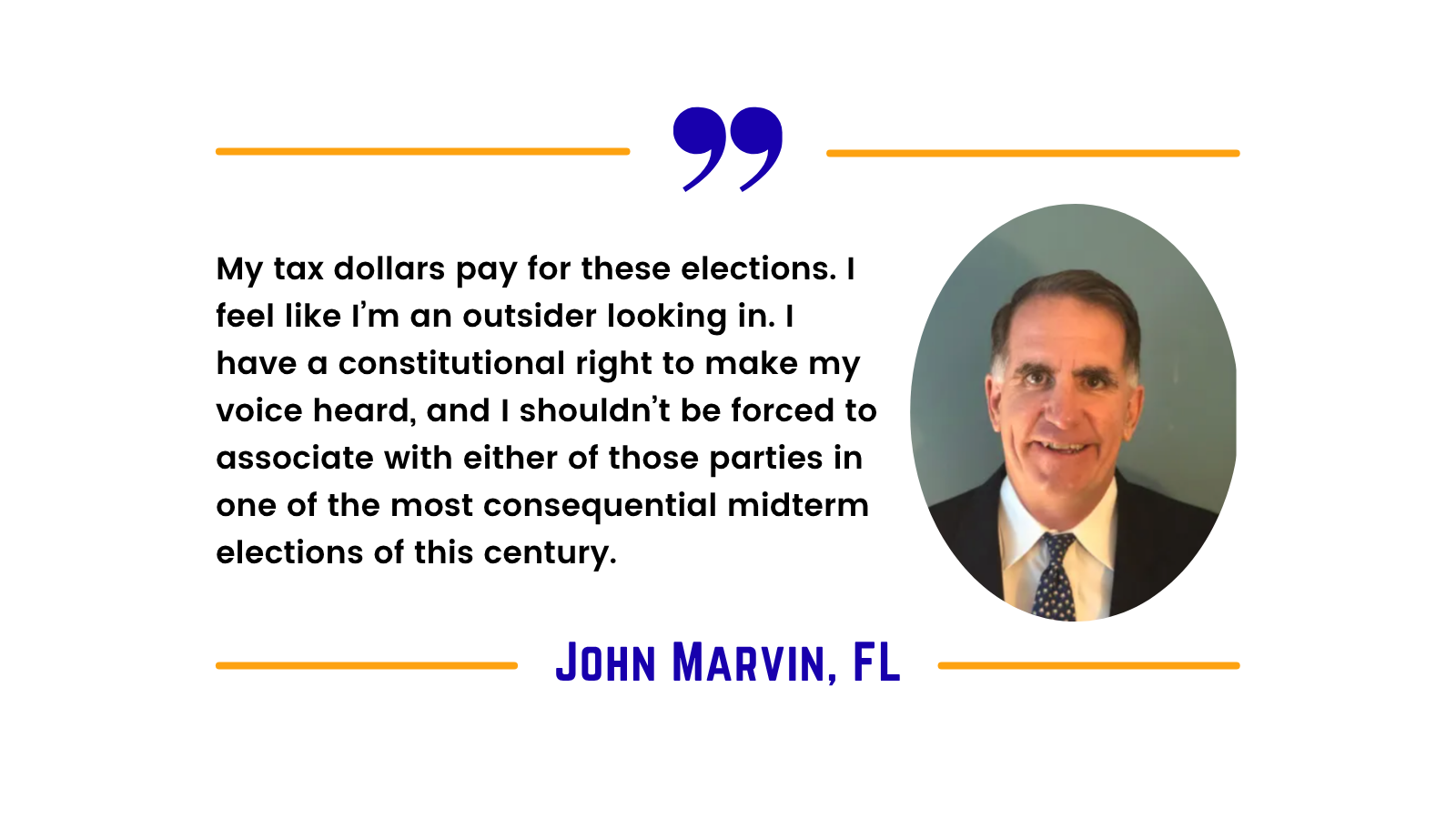
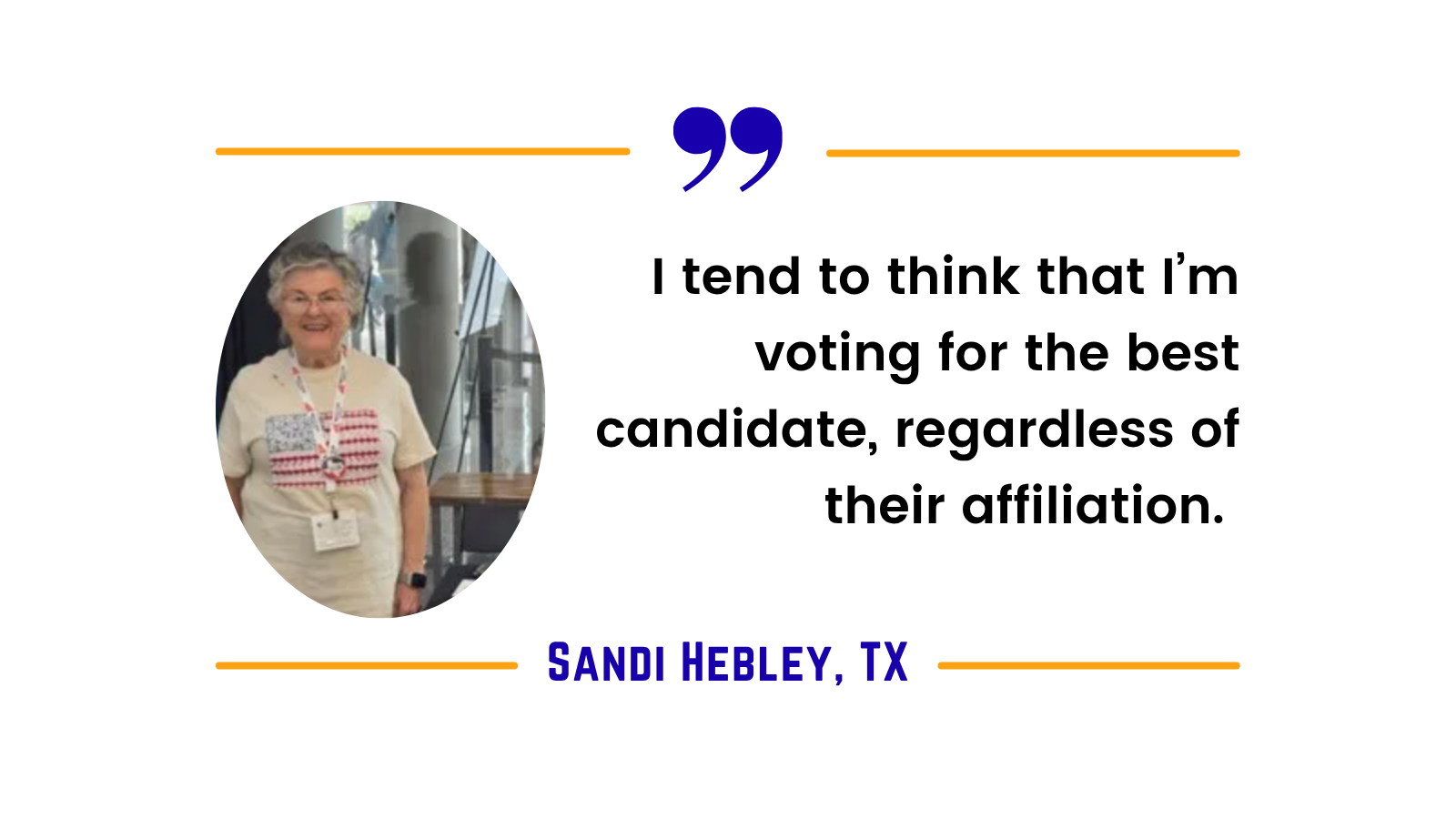
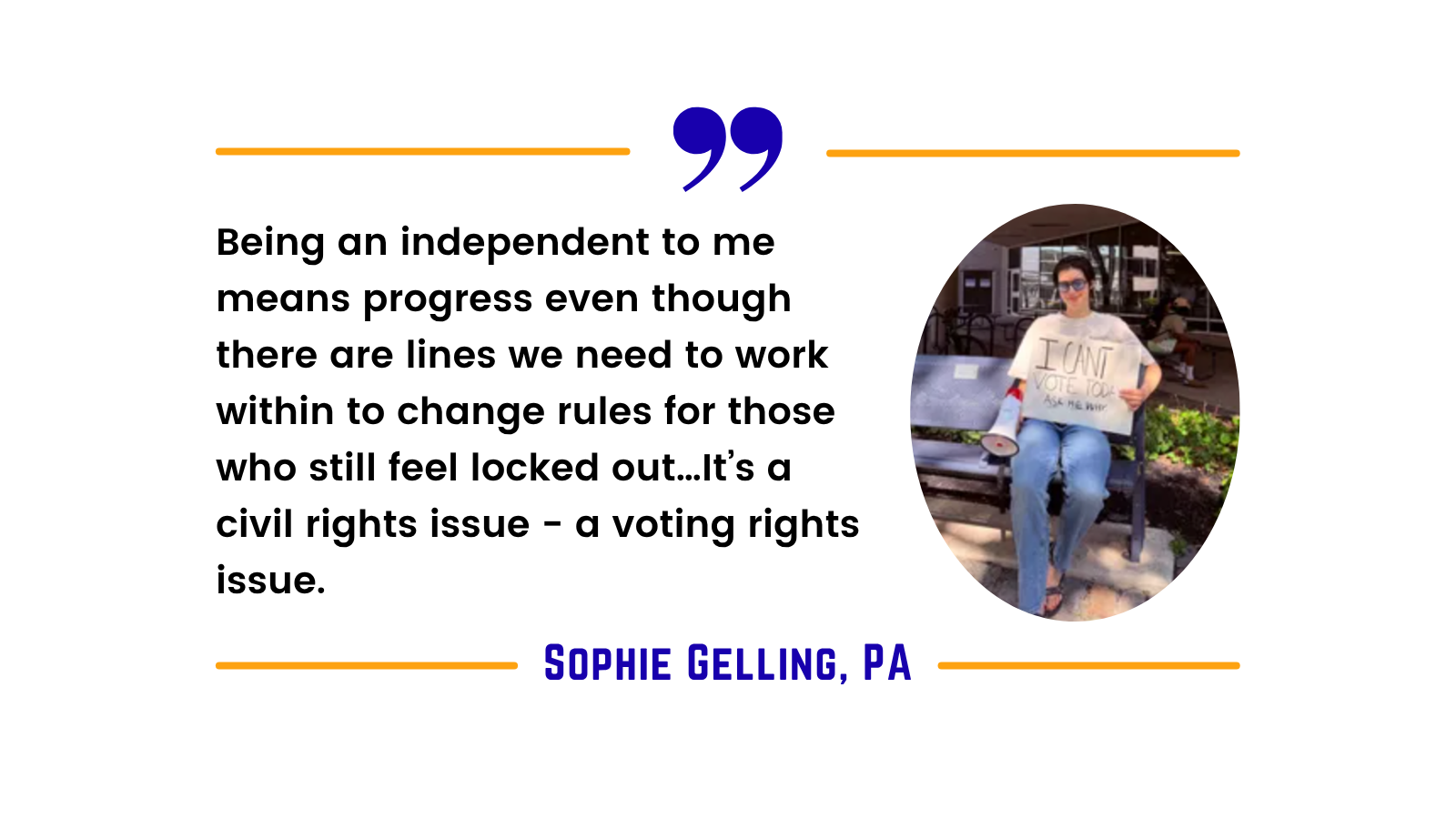
Last Saturday, USA Today published a major piece profiling three independent voters as well as Open Primaries President John Opdycke. Kudos to USA Today for being curious about who independent voters are and for spending some time with Open Primaries leaders John Marvin from Florida, Sandi Hebley from Texas, and Sophie Gelling from Pennsylvania.
USA Today: Independent voters in 3 key states reveal what moves needle for them
Meet three independent voters weighing their options in key races in the upcoming midterm elections.
Campaign Updates
NYC’s Closed Primary System Faces a Reckoning

New York City’s closed primary system is facing its biggest challenge in decades, because a growing number of voters and media outlets are asking a simple question:
Why should anyone have to join a political party they don’t believe in just to vote?
On the latest IVN Podcast, I discussed a new IVN/Open Primaries poll (add link to the poll here) that exposed a stunning reality: four out of ten registered Democrats in New York City do not actually consider themselves Democrats.
They registered with the party because the system gave them no other way to participate. Among Latino voters, the disconnect is even greater, roughly two out of three registered Latino Democrats do not identify with the party they are enrolled in.
As I explained, this reveals “the big lie” behind closed primaries: they are not simply about protecting parties. They often force voters into political identities they do not share in order to participate in publicly funded elections.
And those elections determine who runs New York City.
In his AMNY op-ed, “Meet us Mayor Mamdani: The case for opening primaries to NYC independent voters,” I challenged Mayor Zohran Mamdani’s support for the current system and issued an invitation: Meet us. Listen to us. Let us vote.
Independent voters are not a political abstraction. They are 1.2 million New Yorkers, one in four voters, including more than half a million Black, Latino, and Asian New Yorkers. They represent 54% of the city’s independent voters and a majority of Gen Z and millennial voters.
Over the past year, hundreds of independent New Yorkers testified before Charter Revision Commissions, asking for nothing more radical than the right to participate in elections that determine their leaders. While efforts to place open primaries before voters this year were blocked, the movement continues, with a citizen-led effort advancing toward a 2027 ballot vote.
The debate has now drawn national attention. In the Wall Street Journal, Howard Husock criticized New York City leaders for blocking a public vote on open primaries, arguing that the closed system excludes more than one million independent voters from the elections that effectively decide who governs the city. Husock highlighted the contradiction of leaders who champion expanding democracy while preventing voters from deciding whether to end political exclusion.
The question facing New York is simple: should public elections belong to all voters or only those willing to join a political party?
Independent Movement
Manchins’ Bet on Independents
Former Senator Joe Manchin and daughter Heather Manchin, founder of Americans Together, have launched the Independent Leadership Council, a new effort to recruit, mentor, and support independent candidates for Congress across the country. The new effort is the result of joining the Independent Center with Americans Together.
Senator Manchin says the goal isn't to create a third party, but to help elect leaders who can work with either party-and challenge both when necessary. With independent candidates running competitive races from California to Montana, Idaho, Iowa, and Alaska, the initiative reflects a growing belief that America's 47% independent majority deserves stronger representation.
Manchin also pointed to one of the biggest barriers facing that movement: closed primaries, arguing they allow ideological factions to "hijack the system" by excluding millions of independent voters from the elections that matter most.
The independent movement is growing-and so is the case for opening America's democracy.
What We're Reading
Closed Primaries Don't Protect Parties. They Corrupt Them
Defenders of closed primaries argue that political parties should decide who participates in choosing their nominees.
But America's closed primary system produces the exact opposite result.
Across the country, millions of voters are joining political parties they don't actually support-not out of conviction, but because it's the only way to vote in the elections that matter. Instead of protecting parties, closed primaries dilute them with coerced members.
As Open Primaries President John Opdycke wrote this week in the Fulcrum, if parties truly want membership made up of genuine believers, they should embrace open and nonpartisan primaries. Then party registration would mean what it ought to mean: a voluntary expression of political conviction, not a government-imposed prerequisite for participating in democracy.
As he notes:

And ICYMI: check out Froma Harrop’s syndicated column Closed primaries are driving America crazy, quoting Opdycke.
Fast Takes
- Baltimore Sun: Redistricting madness show why we need open primaries.
- Washington Post: All ten Congressional seats in WA are competitive because of top two primaries.
- Tucson Sentinel: Open AZ primaries to increase independent voter participation.
- Dakota Free Press: Runoff suggest superiority of open primary.
- CT Insider: Most Connecticut voters can’t vote in the primaries.
In Case You Missed It
Missouri Voters Defend Their Right to Direct Democracy
Missouri voters delivered a decisive message: they will not surrender their power to decide the future of their state.
By an overwhelming 60-point margin, voters rejected Amendment 4, a proposal that would have made citizen-led ballot initiatives among the hardest in the nation to pass. The measure would have required future constitutional amendments to win not only a statewide majority, but also support from a majority of voters in each of Missouri’s eight congressional districts.
Critics warned that the change would have allowed a small number of voters in a handful of districts to override the will of millions of Missourians.
The victory is also a major boost for the Respect Missouri Voters Coalition, which is working to place an initiative on the ballot this November to make the state’s initiative process more open, accessible, and fair. By rejecting efforts to restrict direct democracy, Missouri voters have strengthened the case for reforms that protect — rather than limit — the people’s ability to participate.
Activities/Events
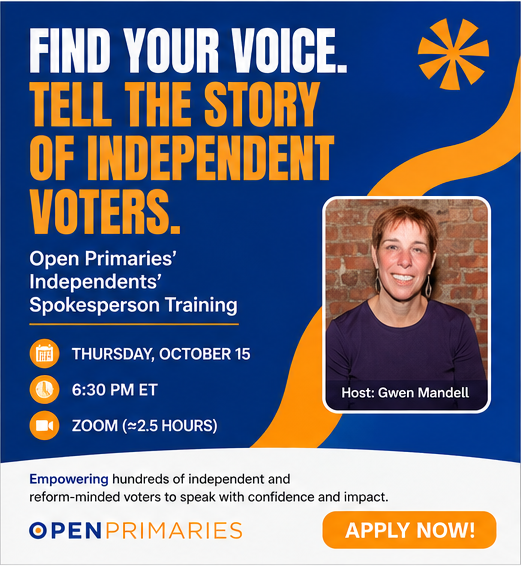
Become a Stronger Voice for Independent Voters
Independent voters are the largest and fastest-growing group in American politics—but too often their voices go unheard.
Open Primaries Independents' Spokesperson Training is designed to help independent and reform-minded Americans communicate with confidence, tell their stories effectively, and become stronger advocates for open, inclusive elections.
Join us on Thursday, October 15 at 6:30 PM ET for an engaging Zoom training featuring storytelling, communications coaching, and practical tools you can use immediately.
Applications are now open, but space is limited.