 Irwin Nowick
It has now been 6 weeks since the Supreme Court struck down the President’s executive order on birthright citizenship in Trump v. Barbara, 609 U.S. ___ (2026). Polling done since the opinion was issued shows 63 % support the Court’s opinion. The reason for this is I said is immigration is a very personal issue and the Court made clear that the rule is simple: If you are born on US soil you are a citizen unless you are within 4 narrow exceptions—two of which [the main being Native Americans who were collectively naturalized in 1924 and include DHS Secretary Mark Wayne Mullin] do not exist anymore.
 Irwin Nowick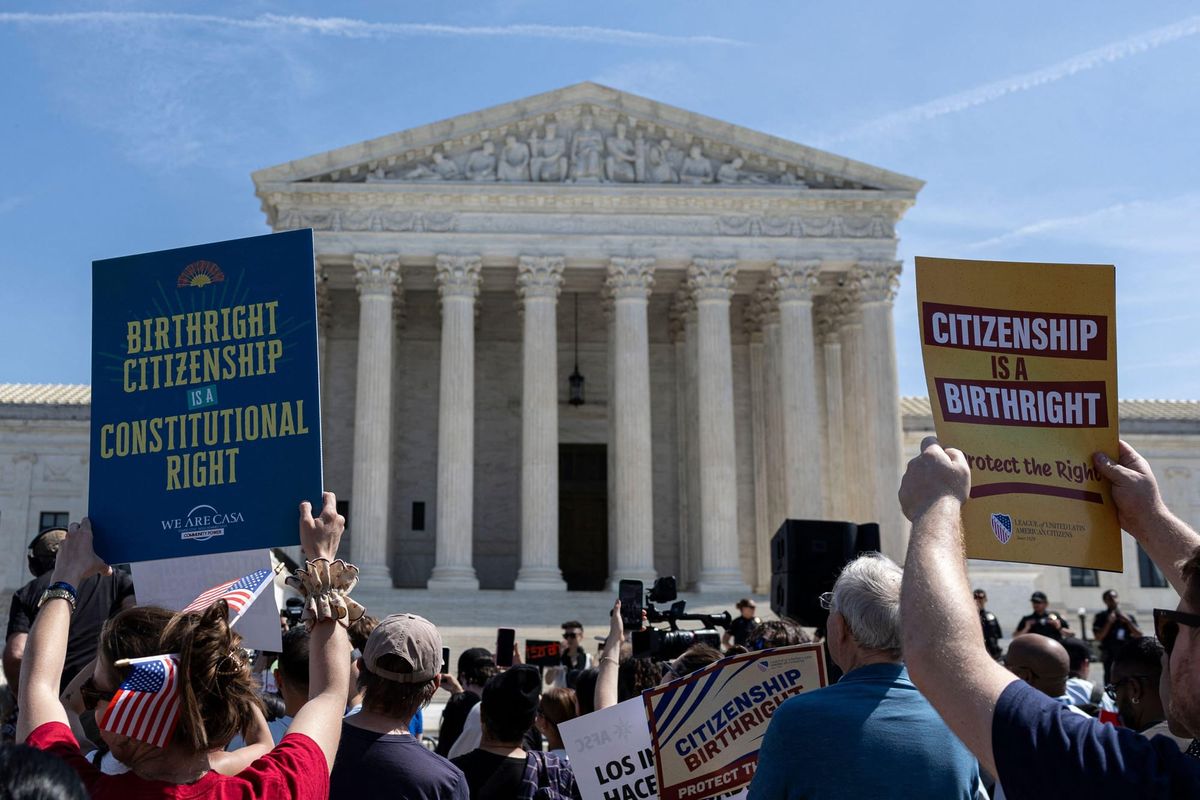
The view of voters is that sleeper cells, birth tourism, and the like can be dealt with without making massive changes. Data points to the fact that of the 3.5 million babies born in the US a year maybe 20,000 are born to persons Trump claims he wants to get at—almost exclusively offspring of tourists. Moreover, if this was such an issue why did Trump make the order prospective affecting only kids yet to be born?
While there were murmurings about Congressional actions based on Justice Kavanaugh’s concurrence-dissent [which was internally inconsistent and displeased the person who facilitated his appointment to the Court, to wit the Chief Justice], and the President stated that he would seek a rehearing he did not do so.
Instead, working with his new legal counsel Will Scharf, who is a little more “operational” than former attorneys, he drafted a new Executive Order aka EO 2.0 which purports to work within the Court’s ruling as to the exemptions from birthright citizenship.
EO 2.0 has several substantive parts. EO 2.0 does not protect kids of Green Card holders which undermined the entirety of the first Executive Order. Rather, EO 2.0 applies where neither parent is a US Citizen and one additional factor is present. That avoids the whole issue of kids born to citizens in areas under military occupation temporarily. As such, in that regard it only affects kids born where both parents are non-citizens and additional factors are present.
As to the policy behind Birthright Citizenship as Justice Kavanaugh noted in footnote 7 of his concurrence in Trump v. Barbara, there are a number of legitimate concerns about the Doctrine as understood in the United States. However, as Chief Justice noted in Trump v. Barbara, putting aside the 4 exceptions (one of which was mooted by Congress), a decision was made to put into the Constitution to make citizens kids born on US soil to parents who were citizens or were not citizens without elaborate procedures.
While a case could be made that the general British System adopted in 1981 is better, the existence of a written constitution takes various policy changes off the table as Justice Scalia noted in District of Columbia v. Heller, 554 U.S. 570, 636 (2008). As I said before, the 14th Amendment was collective naturalization which Congress could do assuming the States agreed via ratification. In the case of statutory naturalization, that can be restricted as to persons yet-to-be borne by Congress passing a bill. In the case of the Constitution, that can be changed but by a laborious process.
And, as I said before, because there is no general procedure to naturalize children born to non-citizens born on US soil, Executive Order 1 created an anomaly whereby the parents naturalize, foreign born children are derivatively naturalized when the parents naturalize, and the kid born on US soil is stateless. While it would be preferable for the parents to wait to have kids until they are citizens as was the case in my family, not everyone is as intelligent as my grandparents or Justice Alito’s grandparents.
Part 1 of EO 2.0 goes after mothers who come to the United States to give birth on US soil to take advantage of the Court’s ruling. As I said before, the easiest way to stop non-citizens from having kids on US soil while not citizens is to prevent the entry of people into the United States. In that regard, the US DOJ filed charges against naturalization fraud.
And as I said before, whatever one may say as to the President’s policies, no one disputes that a person who is not a US Citizen has no right to be in the United States. To that end the State Department created a task force to address this on the front end.
At the same time, as the Supreme Court has held, people who are US Citizens have a constitutional right to enter the United States to have kids protected under the 14th Amendment without a lot of rigmarole. While this portion of the order received some grumblings, it is legally defensible. In fact, in a New York Times article, DHS officials on condition of anonymity stated that this was a call to enforce existing law.
The second part of the order seeks to deny automatic citizenship to four categories of children born to non-citizen parents who would otherwise be protected by the 14th Amendment based on the Administration’s view of the parameters of Trump v. Barbara.
There 4 Categories are as follows:
- Category 1: Either parent of that person is an alien enemy, defined to include any member of a designated Foreign Terrorist Organization under 8 U.S.C. 1189 or Specially Designated Global Terrorist, consistent with the International Emergency Economic Powers Act, 50 U.S.C. 1701 et seq., and Executive Order 13224 of September 23, 2001 (Blocking Property and Prohibiting Transactions With Persons Who Commit, Threaten to Commit, or Support Terrorism), as amended.
- Category 2: Either parent of that person is a foreign government employee, defined to include: (i) ambassadors; (ii) persons employed by a foreign embassy or consulate who are nationals of that foreign country; (iii) persons employed by a foreign government in an official capacity; and (iv) persons employed by an international organization that possess international-organization immunity;
- Category 3: Parent of that person engaged in a commercial transaction to purchase or access birthright citizenship for the person, or engaged in fraudulent activity to obtain citizenship, to include: (i) when the parent(s) of the person engage in a commercial transaction to ensure that the person’s mother is present in the United States, or a territory of the United States, to give birth; or (ii) when the parent(s) engage in a commercial transaction with a surrogate present in the United States, or a territory of the United States, to give birth.
- Category 4: The person is born in a territory or territorial waters of the United States where citizenship is not conferred by Federal statute.
The order has a severability clause.
There is a potential two-edged sword—particularly in prosecuting terrorist “evil doers,“ as President Bush the 2nd referred to them in terms of two parts of the order. The United States Supreme Court has repeatedly held that the fact that birthright citizenship exists protects the child and has no bearing on the parent.
At a recent belated funeral-celebration of life, an attendee who read my prior postings remarked that there are a group of attorneys who specialize in assisting persons who were born to parents on non-immigrant visas or even immigrant visas who wish to expatriate for a series of reasons.
Persons often want to expatriate primarily related to taxation. While in theory unilateral expatriation is constitutionally guaranteed, it is not made easy. For one, two sections of the Internal Revenue Code include so-called exit taxes. While Congress does clearly have the power to tax, it is subject to constitutional restrictions.
In my view, exit taxes are constitutionally dubious unless assets are sold or otherwise liquidated that generate income as they are in effect “direct taxes,” though this has never been litigated.
As the Supreme Court noted in Moore v. United States, 602 U.S. 572 (2024) the Constitution prohibits un-apportioned direct taxes which are really property taxes. That is why so-called “wealth taxes” are unconstitutional. That, in turn, gets into a discussion of whether the expatriation tax is a direct tax and whether expatriation is a taxable event absent something akin to liquidation of assets.
Moore was supposed to decide if “realization” was a constitutional requirement in order to avoid apportionment and thus be an “income tax” within the meaning of the 16th Amendment. It so happened in Moore that given the arguments made by Moore's counsel, the case turned into not “realization” but “attribution”.
Secondly, for all the concerns of a sleeper cell candidate which was raised by Justice Alito, while the Supreme Court has never directly ruled that only US Citizens can be prosecuted for treason, dual citizens can be as I noted in reference to Kawakita v. United States, 343 U.S. 717 (1952). Kawakita was convicted of treason and sentenced to death for war crimes. He was born in the US to Japanese Citizens who could not be naturalized.
In 2011 when Joe Lieberman and Scott Brown had a denaturalization proposal, the late Lindsey Graham, for all his oddities but knew his stuff, stated, “Why are we taking the death penalty off the table?” Treason is a capital offense.
Putting aside Kawita, the issue has arisen in the past in terms of enemy combatants, military commissions, and the like. It suffices to say Congress under its express powers under Clause 10 of Section 8 of Article I of the Constitution to define and punish offenses against the law of nations, of which the law of war is a part, has allowed persons who are US citizens to be tried in some manner for violations of the Laws of War. The Supreme Court has noted that US citizenship of an enemy belligerent does not relieve him or her from the consequences of belligerency which is unlawful because it violates the law of war.
And, citizens who associate themselves with the military arm of an enemy government and with its aid, guidance and direction enter the United States bent on hostile acts are “enemy belligerents” within the meaning of the Hague Convention and the law of war. Moreover, Clause 11 of Section 8 authorizes Congress to make rules as to “captures on land and sea”.
Putting aside the Law of War situation, the Government has in fact refused to recognize expatriation as occurring in cases wherein the Government sought to prosecute US Citizens for criminal acts committed outside the United States in other places against non-citizens such as sex tourism. The Courts have upheld this under Congress’s “law of nation’s” Foreign Commerce Clause powers, assuming that Congress exercised the power.
It suffices to say that any such person can be dealt with.
In terms of each of the four categories, after some initial review the ACLU filed a "motion to clarify the preliminary injunction" in Barbara v. Trump while another group is seeking to revive an antecedent lawsuit. In my view, parts of Executive Order 2 are valid, while others may not be.
I do believe that given my discussion with Civil Procedure legal experts, the Class Actions have to be modified in the sense that they have to be narrowed down. There are likely various procedural obstacles to using these earlier cases to challenge the new executive order and either new actions filed or substantial amendments.
In fact, in Trump v. Barabra, the ACLU wants the remand process to the District Court in New Hampshire speeded up so it can get a modification order.
First, in terms of Category 1, as to children born invaders-alien enemies-Evil Doers, as I noted above this is a two-edged sword. In Trump v. Barbara, the Court did not really address this but this involves where the child is born to non-citizens who are part of an occupying force while the territory is in occupation, so the territory is not under US Control.
As Justice Story noted in United States v. Rice, [17 U.S. 128 (1819) wherein during the War of 1812, the port of Castine, Maine, was captured by the British forces and during its occupation the British Government exercised civil and military authority over the people, established custom-houses and collected duties on goods] the area was not subject to US jurisdiction and albeit temporarily not part of the United States.
The general rule of International Law is that during foreign occupation persons who were citizens of the territory [and ergo their offspring] prior to the moment of occupation do not forfeit their citizenship. Forfeiture only occurs after a peace treaty and lands are exchanged.
While Justice Story’s concurrence-dissent in Inglis v. Trustees of Sailor's Snug Harbor, 28 U.S. 99 (1830) raised certain questions about this issue, Executive Order 2.0 in effect treats them as citizens even though born outside US Control, albeit temporarily. I believe that the Executive Order 2 was correct because the effect of treating them otherwise would in effect denaturalize without consent in violation of the spirit of Afroyim v. Rusk.
Putting aside the enemy combatant-treason doctrine, which applies to citizens as noted above and the ability to punish misconduct by US Citizens committed abroad, internment of enemy aliens during times of war has been allowed by federal statute since 1798 and has not been questioned. It occurred to German citizens in World War I and World War II by the United States. However, as far as can be ascertained, the children of German Nationals who were US Citizens were not interned.
In terms of Japanese nationals and their children, during World War II, about 120,000 people of Japanese descent were forcibly relocated and incarcerated in ten concentration camps in the United States, operated by the War Relocation Authority. About two-thirds were US citizens. About 127,000 Japanese Americans then lived in the continental US, of which about 112,000 lived on the West Coast. About 80,000 were citizens. In Hawaii, where more than 150,000 Japanese Americans comprised more than one-third of the territory's population, only 1,200 to 1,800 were incarcerated.
Many of the children who were concededly US citizens were part of the Beloved “Go for Broke” 442nd Regimental Combat Team or were part of the 100th Infantry Battalion. The 100th was made up of Nisei who were originally members of the Hawaii National Guard. Many 442nd members visited their family in the camps which made for great photos.
While there was an attempt in effect to denaturalize these US born citizens [Rachel E. Rosenbloom, Litigating Birthright Citizenship In The Shadow Of World War II: The Continuing Relevance Of A Forgotten Case, 31 Michigan Journal of Race & Law 1 (forthcoming 2026), Northeastern University School of Law Research Paper No. 511Last revised: 28 Jun 2026] no one disputed that the children born in the camps were US citizens.
In fact, the internment of US Citizens of Japanese dissent is now viewed as it should be: a national disgrace.
It was upheld by the Supreme Court in part in Korematsu v. United States, 323 U.S. 214 (1944). Korematsu dealt with entering into a prohibited area not per se forced relocation though that was the effect. In Ex parte Mitsuye Endo, 323 U.S. 283 (1944) which was decided the same day as Korematsu, the Court unanimously ruled that the US government could not continue to detain a citizen who was "concededly loyal" to the United States.
Although the Court did not touch on the constitutionality of the exclusion of people of Japanese ancestry from the West Coast, which it had found not to violate citizens' rights in Korematsu, the Endo ruling nonetheless led to the reopening of the West Coast to Japanese Americans after their incarceration in camps across the U.S. interior during World War II.
In 2018, the Supreme Court overruled Korematsu in Trump v. Hawaii, 585 U.S. 667 (2018). Chief Justice Roberts' majority opinion [really unanimous on this point] stated that "Korematsu was gravely wrong the day it was decided, has been overruled in the court of history, and—to be clear—'has no place in law under the Constitution' (quoting Justice Jackson’s Korematsu dissent).” (585 U.S. at 710.) Scholars disagreed about whether this constituted "an actual overturning of Korematsu or merely disapproving dictum" until Students for Fair Admissions, Inc. v. President and Fellows of Harvard College [600 U. S. 181 (2023)] confirmed Trump v. Hawaii "overruled" Korematsu. (600 U.S. at 206-207 fn. 3.)
Given how Americans feel about veterans and the feeling of shame over the internment, Donald Trump of multiple deferments vs. the 442nd – 100th Battalion is a Republican loser.
The Supreme Court has avoided the application of the Alien Enemies Act [“AEA”] [which applies not just in wartime but where there is an invasion or predatory incursion is perpetrated, attempted, or threatened against the territory of the United States by any foreign nation or government] in terms of who it applies to in terms of non-state actors during times of peace as shown by the litigation in A.A.R.P. v. Trump, 605 U.S. 91 (2025) (detainees with pending habeas petitions facing removal under Alien Enemies Act faced "an imminent threat of severe, irreparable harm").
AARP v. Trump, which became W.M.M. v. Trump, arose from Trump signing a presidential proclamation invoking the AEA seeking to fast track the removal of members of the Venezuelan gang, Tren de Aragua, who were purportedly invading the United States under the direction of the government of Venezuela and directed the deportation of certain Venezuelan citizens who had been determined to be part of Tren de Aragua.
Since that time, the US effected regime changes in Venezuela and the new President is a Trump ally so it is hardly the case that the Venezuelan Government is now sending invaders into the US.
The history of the litigation is set forth at length in the 5th Circuit’s published order today in W.M.M. v. Trump, ____F.4th ____ (5th Cir. 2026) and the panel opinion on remand from the Supreme Court in W.M.M. v. Trump, 154 F.4th 207 (5th Cir. 2025). The Supreme Court had specifically asked the 5th Circuit to answer two questions: (1) whether the named petitioners’ claims that the President violated the AEA warrant a preliminary injunction and (2) whether the President’s Proclamation violates due process as to a putative class.
Justice Kavanaugh wanted the Court to grant certiorari and hear the case on the merits but that was a non-starter. The Supreme Court expressly held that the government could remove the named petitioners and putative class under other laws. (A.A.R.P. v. Trump, 605 U.S. 91, 98–99 (2025).)
After the Supreme Court remanded the case to the Fifth Circuit, the case was assigned to Judges Leslie Southwick [a Bush The Younger appointee]. Andrew Oldham [a Trump appointee], and Irma Carrillo Ramirez [a Biden appointee]. The panel heard oral arguments on June 30, 2025, and questioned both sides in the case about whether the president's proclamation was reviewable and what notice must be provided to the detainees.
On September 2, 2025, the panel ruled 2–1 that Trump's use of the Alien Enemies Act was unlawful, and issued a preliminary injunction. The opinion, written by Southwick and joined by Carrillo Ramirez, found that there had been neither an invasion nor a predatory incursion such as to invoke the AEA [though the panel did note that no one was challenging the statute’s validity itself] therefore the AEA was likely "improperly invoked."
The panel also ruled that 7 days notice was sufficient to address due process concerns. (W.M.M. v. Trump, 154 F.4th 207 (5th Cir. 2025).) The government then asked that the 5th Circuit rehear the case en banc, and on September 30, it agreed to do so and vacated the panel's preliminary injunction. (W.M.M. v. Trump, 154 F.4th 319 (5th Cir. 2025).)
On January 22, 2026, the Court heard the case En Banc and no ruling was issued until today. The Court held in a published opinion/order today that the case was moot because after oral argument before the En Banc court, the government had removed all three named petitioners under the Immigration and Nationality Act—that is, not the AEA and no one disputed the removal was legal so the case was declared Moot.
Justices Ho and Oldham wanted to decide the merits in terms of how the AEA applied and to whom but there were no takers as federal courts are not moot courts. What this suggests is that the Government rather than litigating thorny issues got what it wanted which was removal and decided to make this go away.
Moreover, in so far as there was a willingness to continue the current litigation the Fifth Circuit shut that today in two related published orders. First, the Court denied without prejudice class action status because the new class representatives were not in fact purportedly removable under the AEA so they did not represent any class. And any Class representative was not entitled to proceed pseudonymously on appeal, as well as for the sealing of their unredacted motion to add class representatives. The government does not oppose either motion – to likely keep the issue alive – the Fifth Circuit did.
As shown in W.M.M. litigation there is not much present judicial appetite to litigate how and when the AEA applies in peacetime as to the aliens. While certain judges and law professors may, the judges who decide these issues do not. Given that reality, the real question is whether anyone actually has standing to assert the rights of children of alien enemies-terrorists-evil doers other than such children if they even know they are.
The members of these groups who are not US Citizens may be designated Evil Doers and are not allowed in the US, but as far as I can tell these groups do not publish membership lists. To identify members of such groups requires a substantial amount of effort and someone labeled a member of the group can challenge that designation in a judicial proceeding.
It suffices to say that the number of AEA offspring children born on US soil to The Evil Doers is likely nil. In almost all cases, given who the parents are, they are either likely to kill the child or abandon them. Such children who are abandoned would be treated as foundlings placed into foster care and in effect naturalized.
If such children of Evil Doers were challenged on their citizenship, it would be many years from now and would likely be litigated in an 8 USC 1503 action where the Government would challenge their citizenship under EO 2. Under the rules governing such actions, once the child is born on US soil the burden shifts to the Government to show why they are not citizens. (See: Perez v. Brownell. The Supreme Court explained that the judicial hearing in a § 1503 action "is a trial de novo in which the individual need makes only a prima facie case establishing his citizenship by birth or naturalization." 356 U.S. 44, 47 n.2 (1958), overruled on other grounds by Afroyim v. Rusk, 387 U.S. 253 (1967).)
The Perez Court faced a circumstance where the government agency had denied the plaintiff's citizenship based on the plaintiff's supposed act of expatriation. The Court held that the government "must prove the act of expatriation on which the denial was based by clear, unequivocal, and convincing evidence which does not leave the issue in doubt." Id. (citing cases). The reason is that a person claiming US citizenship from birth has constitutional protections under the Fourteenth Amendment that may not extend to a person petitioning for naturalization. (See, e.g., Afroyim, 387 U.S. at 267-68 (citizens have a constitutional right to remain citizens); United States v. Kairys, 782 F.3d 1374, 1383 (7th Cir. 1986) (the protections described in Afroyim apply "only to acts committed after citizenship").)
The Government would then have to prove that that child is the offspring of a defined Evil Doer who likely is dead. The First Category is an issue if it arises many years from now.
As to Category 2, the children of “diplomats,” assuming that the parents have diplomatic immunity, that part of the order is valid. It is true that they could expatriate [not really discussed] but it is an after-birth event. As I indicated there is a procedure—and this would have had to be made across the board to be consistent had EO 1 gone through— whereby kids of diplomats can naturalize. There have been cases where kids thought they were citizens (and were told so), but had diplomatic parents. (See: Moncada v. Blinken, 680 F.Supp.3d 1190 (C.D. Cal. 2023).) In fact, in other cases, persons served in the military but were deported because they did not know their status and this occurred under the Biden Administration.
Three, as to the products of birth tourism, this could turn into an internal Republican food fight. Surrogacy is an accepted legal practice in most US States. Surrogacy can take two forms. The first form is to have the child and many-many years down the road have the child seek entry into the United States as a citizen. This does not benefit the mother because she has no rights of admission into the United States.
The main form of surrogacy is an arrangement whereby a woman gets pregnant and gives birth on behalf of another person or couple who will become the child's legal parents after birth. People pursue surrogacy for a variety of reasons such as infertility, dangers or undesirable factors of pregnancy, or when pregnancy is a medical impossibility. The Catholic Church is in theory opposed to surrogacy though I know of cases where practicing Catholics use fertility treatments to have kids where the child is fertilized by the father using the mother’s eggs and is planted in a third party who actually births the child. Those children have been baptized and no one has been refused communion because of it. My religion is split on the subject but the Jewish Women I know disapprove of the practice—until they use it.
In 2000, the United States enacted a law making it easier for foreign-born children adopted by U.S. citizens to become American citizens. This was encouraged by many “pro-life” groups.
The United States Supreme Court in 1957 held that a child born to a non-citizen who was born in the United States precisely so the child could be born in the United States was a 14th Amendment Citizen. (United States ex rel. Hintopoulos v. Shaughnessy, 353 U. S. 72, 73 (1957).) In oral argument in Trump v. Barbara, Chief Justice Roberts asked if Birth Tourism affected the legal analysis before the court and the answer was a non-answer. Justice Sotomayer asked if the Government wanted Hintopoulos overruled and the answer was No.
In my view, to quote my late mother “kids do not get to pick their parents and the sins of the father should not be inflicted on the children.” That is why the Constitution prohibits “corruption of the blood” as a punishment for treason. Assuming that kids are born here to persons who should not be here, you still have the reality of the kid. Justice Barrett, who is a practicing Catholic and a Mom and therefore thinks like any Mom and has two adopted children, raised the issue of it being about the kid—not the parent. Some people who want to bait her on the citizenship issue [primarily members of my faith, unfortunately] do not understand her. As to the surrogacy question, this would likely be viewed as akin to rape and incest exceptions to abortion prohibitions.
To paraphrase Henry Hyde, the fact that the child was conceived illegally should not result in the child’s execution.
In many cases the kid will be adopted. And, often they may become citizens under the Foundling Provisions in any event. In my view, the way to handle this is to create a process akin to children born abroad and diplomat kids where they are formally naturalized—only in this case a procedure exists to naturalize the child when placed into foster care and particularly so when adopted.
As to Category 4, that is really a reaffirmation of the Doctrine of The Insular Cases. The Insular Cases are really a series of decisions on when inhabitants of territories acquired by treaty or conquest are treated as citizens. Prior to the Spanish-American War, acquisition treaties of their own terms collectively naturalized inhabitants as Citizens if they chose to do so—a power that the Supreme Court held repeatedly Congress had to do.
As Chief Justice Roberts noted in Trump v. Barbara, a person can be a birthright citizen without being born in a State, citing The Slaughterhouse Cases. ([83 U.S. 36, 74 (1873)]. 609 U.S.at __.)
In the treaty settling the Spanish-American War, it left to Congress the determination of governance and citizenship. The term "insular" refers to the territories that were islands administered by the War Department's Bureau of Insular Affairs. Today, the legal rulings outlined in the Insular Cases continue to govern the United States' territories of Puerto Rico, Guam, American Samoa, the US Virgin Islands, and the Commonwealth of the Northern Mariana Islands.
The Court established the landmark doctrine of territorial incorporation. This doctrine is the legal principle that makes distinctions on where the Constitution applies in regards to non-contiguous territories of the United States.
Incorporated territories are those that the United States Congress deems on a path to statehood, and where the Constitution is applied fully. Alaska and Hawaii were former incorporated territories that are now admitted into the statehood. On the contrary, unincorporated territories are not on track to statehood, and thus, effectively allowed for the Constitution to apply differently. It so happened that, except with respect to American Samoa, Congress in effect granted citizenship and full constitutional rights to residents of Puerto Rico, Guam, the US Virgin Islands, and the Commonwealth of the Northern Mariana Islands.
As to the Philippines, while governed by the US from 1898 until 1946, for a series of reasons Filipinos were not granted citizenship or collectively naturalized, though military members were and as a result their kids born in the US are fully protected under even the narrow view of the 14th Amendment.
No one is challenging Category 4 given the precedent of the Insular Cases and the fact that it only applies to residents of American Samoa.