
 Shawn Griffiths
The Independent Voter Project (IVP) released a new poll this week that shows a seismic shift in the California governor’s race. But on Reddit, it also hit a nerve for many voters calling for ranked-choice elections.
 IVN Editorial Board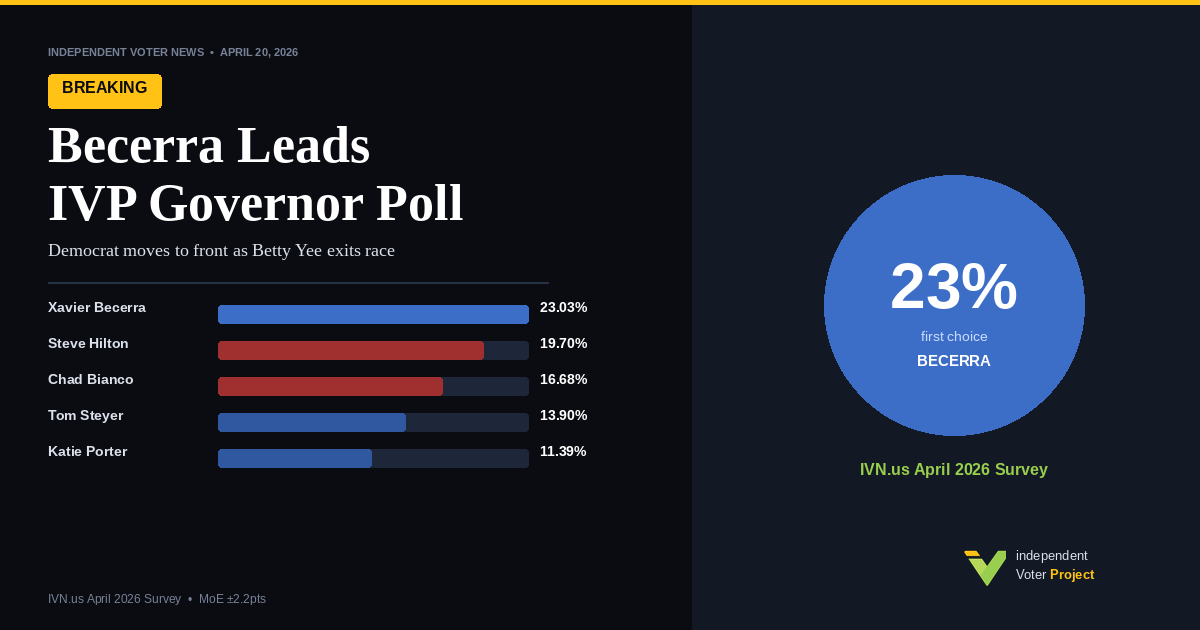
Following the release of the poll, which now shows Xavier Becerra in the lead, Becerra started to get more media attention. While his bump to the front-runner spot surprised many, IVP already knew it was coming.
This is because its polling goes further than most when examining voter preferences and found in February that Becerra was the second choice for many Eric Swalwell voters. Now, Swalwell is out.
The results were posted on the California subreddit, which has since received thousands of upvotes and more than 800 comments. Of course, many people want to talk about the candidate standings, but the IVP poll also sparked a much deeper conversation.
It got people talking about voting reform. Specifically, a desire for ranked choice voting.
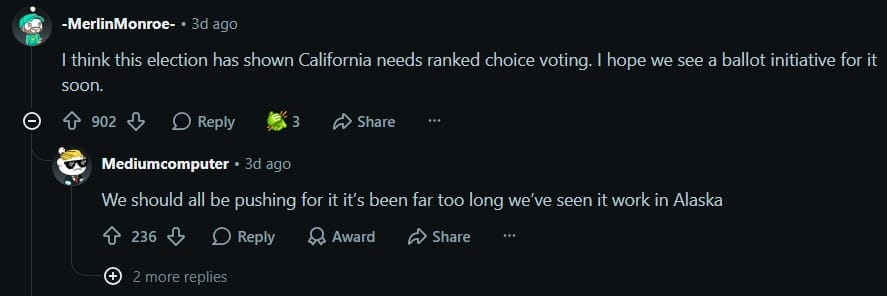
“I think this election has shown California needs ranked choice voting. I hope we see a ballot initiative for it soon,” wrote a user with the Reddit name MerlinMonroe. This comment has over 900 upvotes.
User MediumComputer replied, “We should all be pushing for it. It's been far too long. We’ve seen it work in Alaska.”
This conversation wasn’t prompted by the original post nor anything on IVN. It came up organically, showing how increasingly frustrated voters are with election systems that can result in vote-splitting and winners that don’t have majority support.
Reform is no longer a niche topic. People are looking into alternative ways to conduct elections and educating themselves on popular reforms like ranked choice voting (RCV) and nonpartisan open primaries.
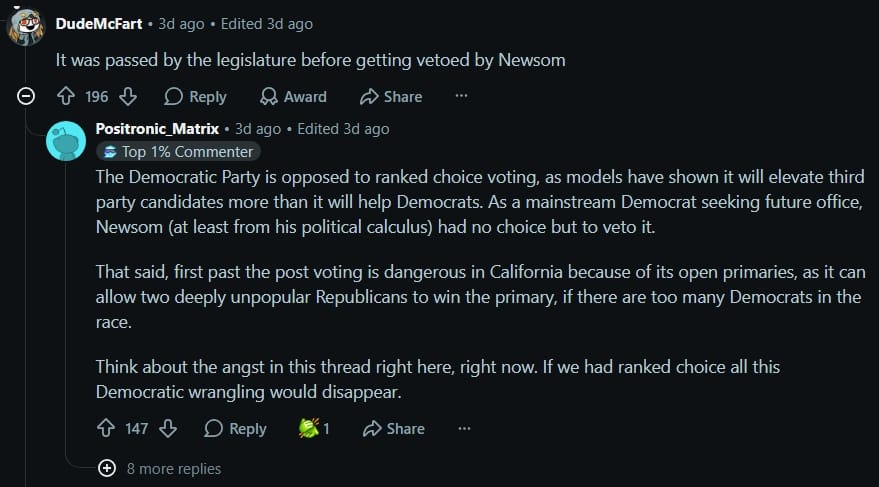
Another commenter even added, “[RCV] was passed by the legislature before getting vetoed by Newsom.” This references a 2019 bill, SB 212, which would have allowed general law cities, counties, and school districts to use ranked choice voting for local elections.
However, Gov. Gavin Newsom vetoed the bill.
Cities and counties in California cannot simply switch to ranked-choice elections. First, they have to be a charter city or charter county. Then, they need to amend their charter by getting approval from voters.
And then, they have to adopt new voting systems approved by the secretary of state.
This is one reason why Eureka recently announced that its voter-approved ranked-choice reform would be delayed. The city has yet to implement a new voting system capable of using RCV and still needs state certification.
There are different ways to conduct ranked-choice elections. The way Alaska does it, for example, is different from the way New York City does it, which is different from how Portland, Oregon, and Charlottesville, Virginia, use it.
Some versions use an instant runoff model that eliminates the last place candidate if no one has a majority of the vote and applies their voters’ next choices to the tabulation. Subsequent rounds of runoff are conducted like this until a single candidate has a majority of the vote.
There is a version of ranked choice voting called the condorcet method (also called the majority-rule method) that pits all candidates against each other in a head-to-head contest and determines which candidate defeats all other candidates.
Under both methods, voters use ballots that allow voters to rank the candidates.
Chad Peace
In Alaska, the state uses a nonpartisan Top Four system that advances four candidates to the general election instead of two. Then, ranked choice voting is used to determine a majority winner among the top vote-getters.
Research shows this election model has led to more cross-partisan coalitions and higher voter engagement from underrepresented communities that were locked out of the state’s closed primary elections prior to 2020.
In NYC, ranked choice voting is used only in closed partisan primaries that deny access to 1-in-5 voters because they're unaffiliated. Primary winners then go on to compete in choose-one general elections that don’t require a majority winner.
In most cases, the winner was already decided in the Democratic primary – an outcome that would occur if California moved back to a closed primary system like it continues to use in presidential preference elections.
There is a bill in the New York City Council that proposes eliminating primary elections and conducting one all-voter and all-candidate election that incorporates RCV. This would also be a different way to conduct ranked-choice elections.
A similar proposal is also being offered by Better Ballot Sacramento.
Where ranked choice voting is proposed, it tends to do well with voters. NYC voters approved the reform with more than 70% of the vote. The same can be said for Washington, DC, which approved RCV and open primaries in 2024.
This is because across the country, regardless of political preferences, voters want more choice in elections. They want election systems that incentivize candidates to appeal to a broader segment of the electorate and win by majority.
They also want voters to be treated equally at all stages of the elections process.
Reddit user Positronic_Matrix brought up a common narrative being pushed about the 2026 governor’s race: “First past the post voting is dangerous in California because of its open primaries, as it can allow two deeply unpopular Republicans to win the primary.”
First, while this is the most popular talking point that has spread nationwide about the election, it was not likely to happen even before Swalwell dropped out. Now, it is extremely unlikely since Swalwell was the highest polling Democrat.
There are still many voters who remain undecided and polling data suggests the two Republicans, Chad Bianco and Steve Hilton, have hit (or are very close to hitting) their support ceilings.
Second, though the outcome is possible, it isn’t the fault of nonpartisan primaries that open taxpayer-funded elections to all candidates and voters, and have been found to increase competition and engagement in elections.
The main point of contention is the number of candidates that advance from the primary and election models that can lead to a political minority deciding election outcomes.
The Independent Voter Project, which authored and sponsored the Top Two measure approved by voters in 2010, now advocates for a Top Four with RCV model similar to Alaska.
Steve Peace
The group has conducted polling in San Diego, Chula Vista, Los Angeles County, and statewide that shows a majority of respondents support adopting this type of system and want to keep elections that ensure equal voting rights for independent voters.