
 Chad Peace
President Trump called Alaska's ranked choice voting system "disastrous" and "very fraudulent" on Friday. He gave his "complete and total support" to the repeal effort heading to Alaska's 2026 ballot.
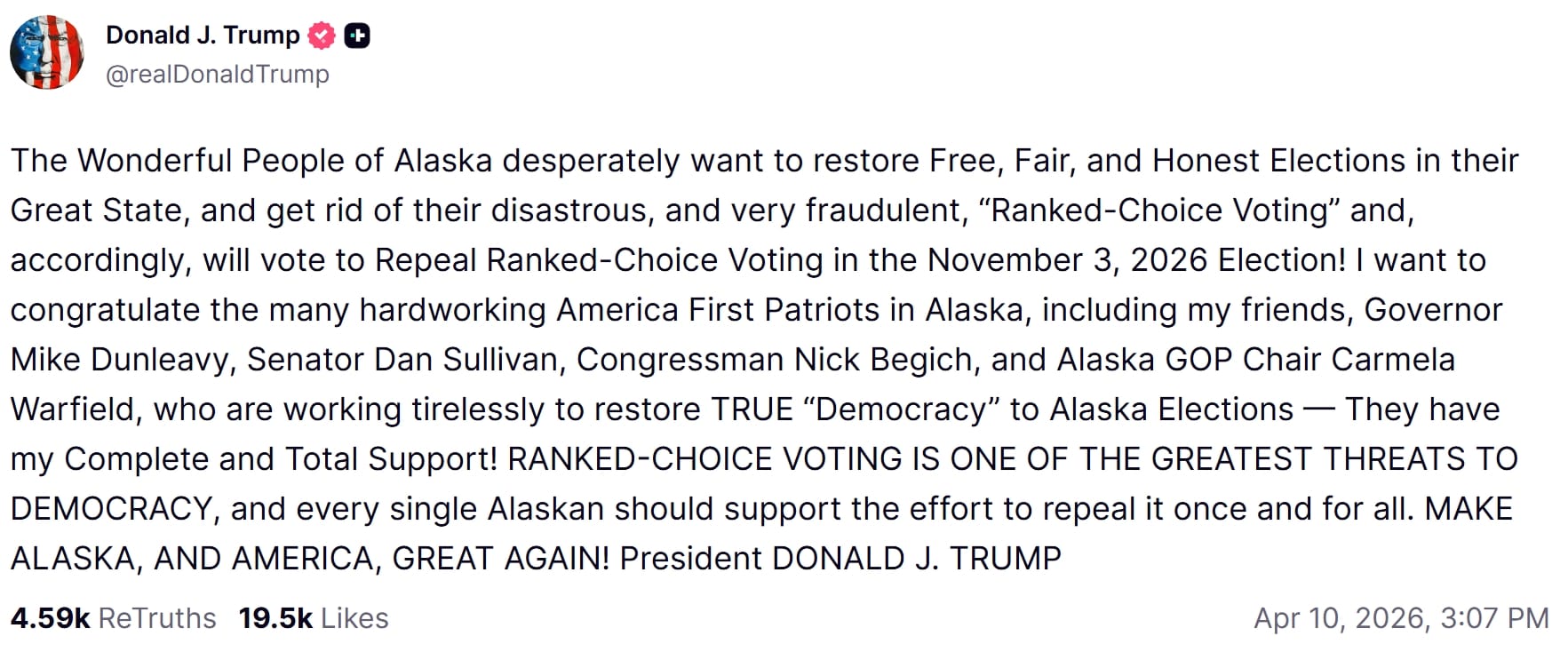
Strong words. No evidence.
There is nothing fraudulent about Alaska's election system. Voters approved it in 2020. It survived a repeal attempt in 2024 by fewer than 800 votes. Every result has been publicly verifiable. Every count has been transparent.
Calling an election system "fraudulent" because you don't like the outcomes is not a legal argument. It is a political one. And it tells you everything you need to know about what this is really about.
What Alaska's System Actually Does
Alaska's system combines an open primary, where all candidates appear on one ballot and all voters can participate, with a ranked choice general election. Voters rank candidates in order of preference.
If no one wins a majority of first-choice votes, the lowest-performing candidate is eliminated, and those votes are redistributed until someone crosses 50%.
The open primary replaced a system where political parties controlled who could vote in their primary and, by extension, who could compete in November. The ranked choice general replaced a system where a candidate could win with a plurality even if most voters preferred someone else.
Alaska gave voters more choices and more power.
That is what the president wants repealed.
 Shawn Griffiths
The Real Complaint Is Competition
Trump did not explain how the system is "fraudulent." He did not identify a single instance of fraud. He did not point to a legal deficiency, a procedural failure, or a miscount.
What he did was endorse the reelection campaigns of Senator Dan Sullivan and Congressman Nick Begich. Both would benefit from a return to the old system, where party-controlled primaries filter out competition before most voters ever see a ballot.
That is the quiet part. Alaska's system creates competition. It forces candidates to earn support from a broader electorate instead of performing for a narrow partisan base. For incumbents and party insiders, that is uncomfortable.
For voters, it is the whole point.
The Dark Money Irony
The 2026 repeal initiative does not just target ranked choice voting and the open primary. It also guts Alaska's campaign finance transparency rules.
Shawn Griffiths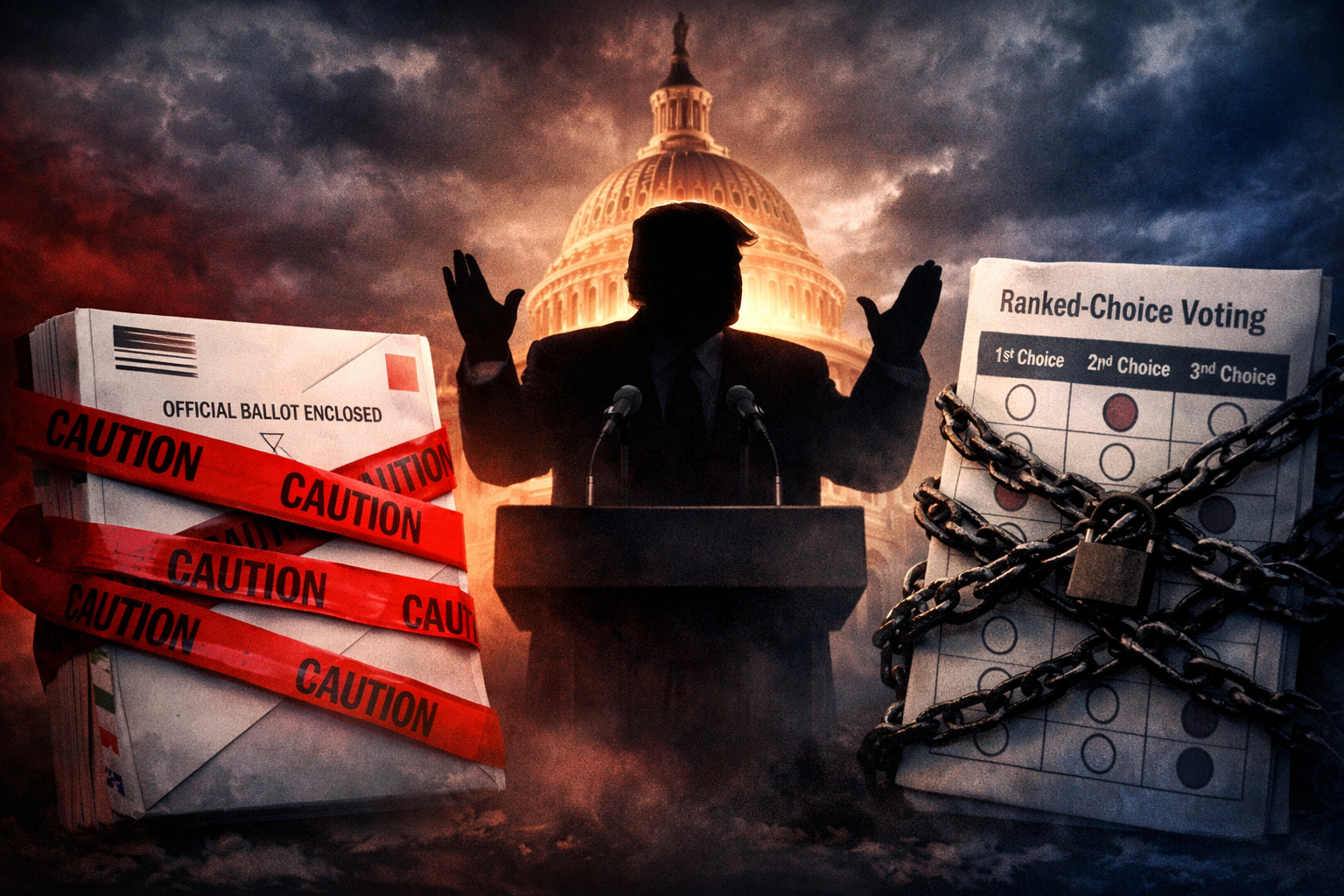
The original 2020 ballot measure included some of the strictest disclosure requirements in the country. Groups spending money to influence Alaska elections are required to disclose who is actually funding them.
The 2026 repeal would eliminate those rules entirely.
Read that again. The people calling for "free, fair, and honest" elections are simultaneously trying to eliminate the strongest disclosure requirements in the state. They want to repeal the rules that let voters see who is paying for the ads, the mailers, and the campaigns designed to influence their vote.
If you are worried about the integrity of elections, the answer is more transparency, not less.
The president did not mention that part.
This Is Not a Partisan Issue. It Is a Power Issue.
Here is the part that most coverage of this story misses.
The opposition to systems like Alaska's is not ideological. It is structural. Whoever holds power opposes competition from outside the party.
In Alaska, it is the Republican Party establishment leading the repeal effort, with the president now lending his voice.
In California, it is the Democratic Party that has historically played the same role.
When California voters passed Proposition 198 in 1996 to open up primaries, it was the California Democratic Party that led the legal challenge all the way to the US Supreme Court. The Republican Party joined as a co-plaintiff.
The blanket primary was struck down in California Democratic Party v. Jones (2000).
When IVP authored and helped pass the nonpartisan top-two primary (Proposition 14) in 2010, both major parties opposed it. So did every minor party.
And when IVP and more than 30 voter rights organizations backed legislation in 2019 to give California's millions of No Party Preference voters a fair ballot in the presidential primary, that legislation was derailed by pressure from the national Democratic Party, according to the bill's own author.
The pattern is consistent. When a party is in control, it fights any reform that opens the process to competition. When a party is out of power, it occasionally sees the value of a more open system. Then it takes power and fights the same reforms.
The principle never changes. The only thing that changes is which party is doing the blocking.
Let's Talk About "Fairness"
The president and his allies frame this as a question of "free, fair, and honest" elections.
Fine. Let's talk about fairness.
How is it fair that joining a political party gives a voter more rights than staying independent?
In most states, if you choose not to register with a party, you are locked out of the primary election entirely. You are a full citizen. A full taxpayer. And a partial voter.
How is it fair that two private organizations get to use publicly funded elections to filter out candidates before the rest of the electorate gets a say?
How is it fair that a system designed to protect incumbents and party insiders from competition is described as "free" and "honest," while a system that lets every voter participate equally is called "fraudulent"?
Alaska's system is not perfect. No election system is. But it was designed to do something simple: give every voter an equal voice regardless of party affiliation.
The fact that the most powerful person in the country wants to take that away should tell voters everything they need to know about whose interests are really at stake.
The Road Ahead
Alaska voters will decide the fate of their system in November. If the repeal measure passes, it eliminates the open primary, ranked choice voting, and the stricter campaign finance disclosure rules that came with it.
Voters in other states should pay attention... including California.
The lesson from Alaska is not about ranked choice voting specifically. It is about whether voters will continue to let political parties dictate the terms of participation, or whether they will insist on a system where every voter has equal access to every stage of the process.
The opposition will always come from whichever side holds power. That has been true in Alaska. It has been true in California. It will be true in every state where voters push for a system that puts competition ahead of party control.
When everyone in power agrees on something, it is usually not the voters who benefit.