 Shawn Griffiths
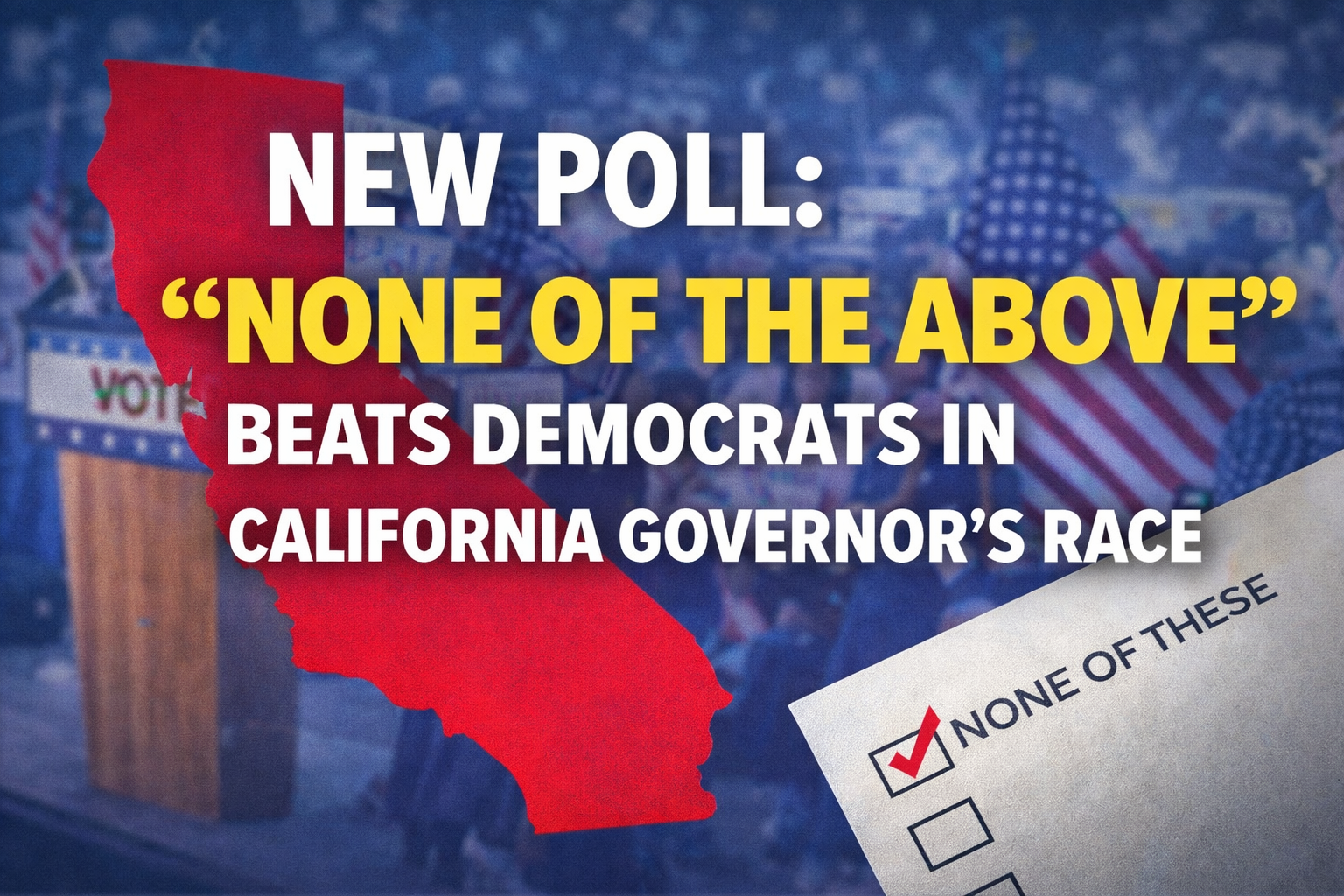
SAN DIEGO, Calif. - California independent voters are not a monolith. They exist across the political spectrum and hold diverse opinions on a variety of social and political issues. But one thing that unites them is a shared belief that California needs more choice elections.
Last week, the Independent Voter Project released the results of the largest poll to ever survey California independent voters, who are registered No Party Preference in the state. More than 1,700 independents participated.
The results show clear and overwhelming majorities support more choice in elections, want to keep a system that protects their right to an equal vote, and want limits on corporate and foreign spending in elections.
Support for these types of reforms could give California candidates the edge they need with independent voters to win the state's biggest and most competitive races, including the competitive 2026 gubernatorial Top Two primary election. Independent voters will decide the future of California's political landscape.
Here are 3 reforms, in particular, that were surveyed:
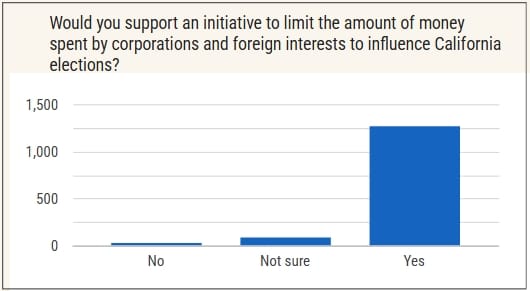
1. A campaign finance initiative that limits money spent by corporations and foreign interests to influence California elections. Nearly all respondents, 91%, said “Yes,” while only 2% said “No,” indicating a slam dunk reform for any campaign that wants to pursue it.
California already has limits on foreign spending in elections, but independent voters would also like to see more limits on corporate spending.
2. A nonpartisan Top Five (or Final Five) election system, which expands on the state’s Top Two System by advancing 5 candidates to the general election and uses ranked choice voting to determine a majority winner.
52.5% of statewide respondents said “Yes” to this reform, while roughly 21% said “No.” Notably, IVP has surveyed voters in San Diego and Chula Vista and found that two-thirds of voters in this region would support an initiative that adopts these reforms.
When IVP surveyed Los Angeles County independents, specifically, in the most recent poll, the number of independent voters who support more choice also exceeds 60%.
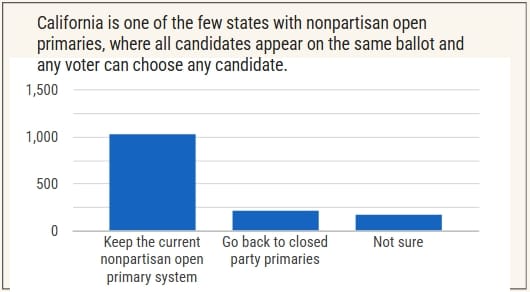
3. Keeping a primary system in which all voters and candidates participate on a single primary ballot, ensuring equal choice and inclusion for all eligible and registered Californians. This ensures equal voting rights for independent voters, who make up more than a quarter of the state's electorate.
74% of statewide independent respondents said, “Keep the current system.” Only 14% said California should return to a closed primary system.
Needless to say, any attempt by the Democratic and Republican Parties to return to the old closed partisan primary system that locks out independent voters -- which party insiders want to do -- or support for these efforts is guaranteed to alienate independent Californians to the determinant of a campaign.
U.S. Rep. Ralph Norman Supports Bigger Government Role in Suppressing Voter Choice
U.S. Rep. Ralph Norman, who is running for governor in South Carolina, supports his state moving to a closed primary system, relying on the familiar partisan argument that Democrats are infiltrating GOP primaries to weaken the party.
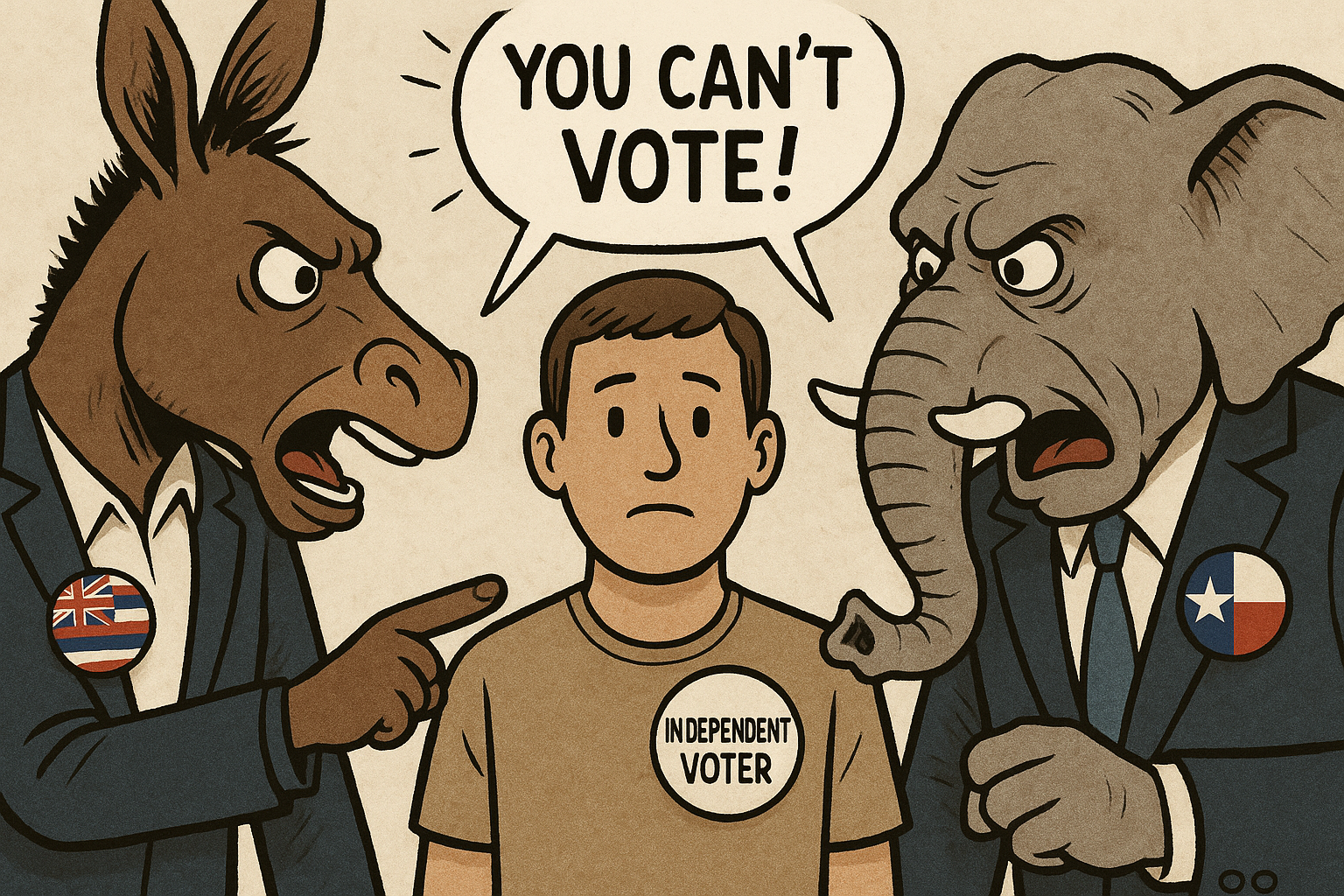
Yet, when parties have tried to make the case of "sabotage" from opposing party members, whether Democrats in Hawaii or Republicans in Texas, they have failed to provide sufficient evidence that this actually happens.
Norman encourages the Republican-controlled legislature to pass House Bill 3310, which not only restricts access to taxpayer-funded primary elections to party members, but expands the government's authority to register and track a person's political activity by forcing them to join a party.
It then will use this new registration model to suppress the voice of independent voters. A closed primary system would create two tiers of voters registered in South Carolina – those who can vote in primaries and those who can’t.
"We can't have those on the opposite party stopping people from being elected, and we've got to put a stop to that," Norman said.
“Putting a stop to it” suggests this happens in South Carolina, but current Republican Gov. Gov. Henry McMaster has previously opposed closing the state’s primaries because he says this alleged scheme, also called “party raiding.” is a myth.
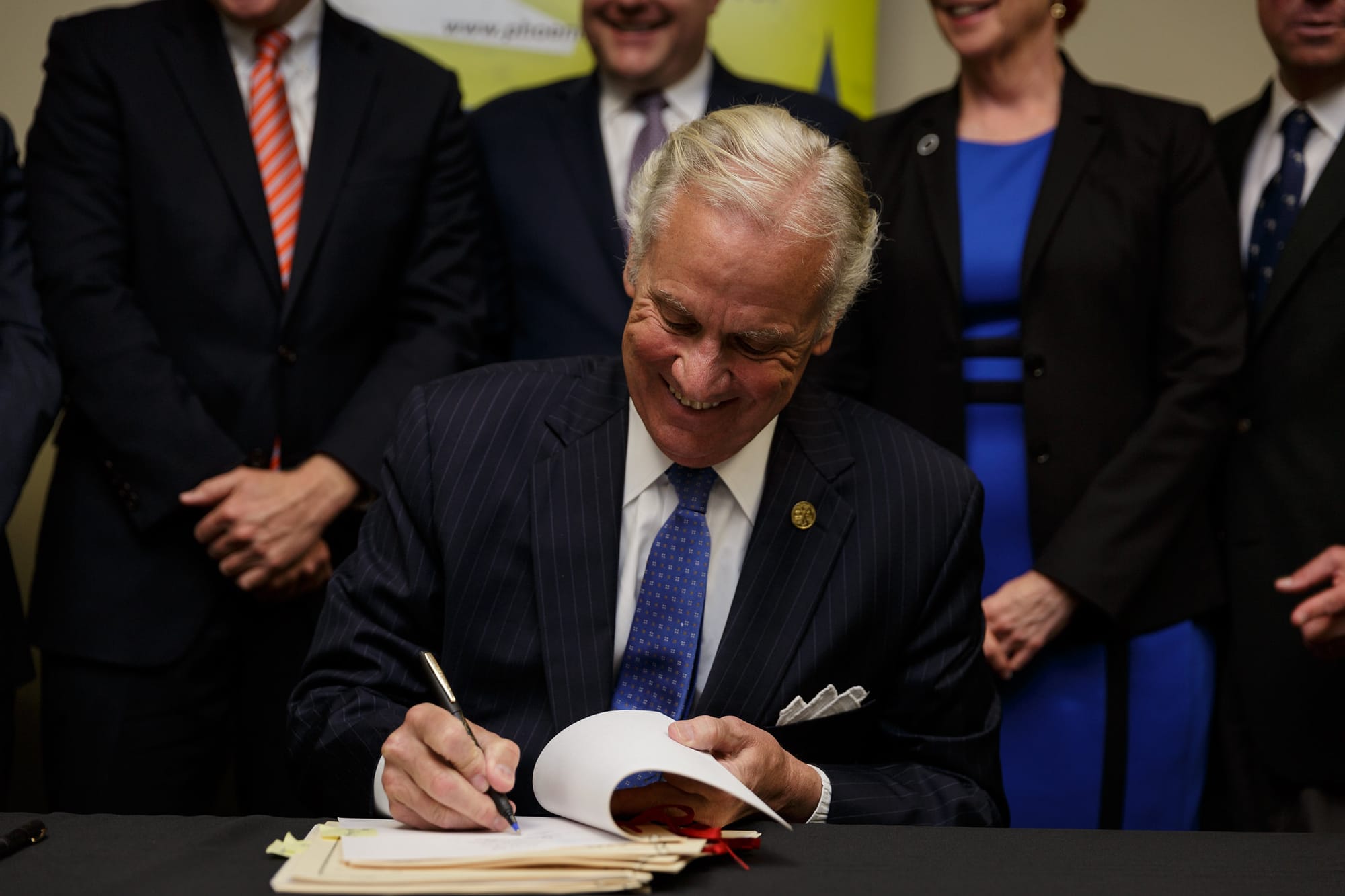
“If they want to vote in a primary it’s because they want to go in and vote for somebody,” McMaster said.
That has been a great strength of South Carolina. If you close those primaries, that’s just one more thing that everybody has to register for or maybe carry a card. We think an inviting party is better. Our history has proven that it has worked and that’s how we became the majority party.”
Research also supports McMaster on this issue.
John Johnson at the Marquette University Law School found in 2019 that in Wisconsin, which also conducts open partisan primaries, "there is no evidence that [party raiding] occurs at all," despite some officials in both parties encouraging it.
In fact, Johnson’s research found that in the extremely rare instances when a voter casts a ballot in a different party’s primary than the previous election, it is because they want to vote for a candidate – not sabotage or weaken a party.
Political scientists in California also came to the same conclusion, reporting that if "crossover" voting happens in primaries, it usually accounts for 1-2% of a state's electorate, and these voters are solely motivated by a desire to vote for a candidate.
Again, voters want choice. They do not think or scheme like partisans. They want candidates they can say they voted for rather than pick as the “lesser evil.”
Yet, both parties have used the “party raiding” argument as an excuse to give their leaders and aligned-special interest groups outsized influence over election outcomes, and not just primaries, but general elections that are effectively already decided before November.
The first committee hearing on the South Carolina closed primary bill and other related bills was held on Wednesday. It is reported that the state GOP is “at war” over the issue, with opponents not wanting to deny independent voters access to primary elections.
Some Tennessee Lawmakers Also Want to Force Party Affiliation on Voters
In Tennessee, House Bill 1159 in the state legislature is being considered, which requires voters to register with a political party in order to vote. State law already makes it a misdemeanor to vote in a party’s primary unless the voter is a “bona fide” party member.
Yet, the law does not clearly define what is required of a person to be a “bona fide” member of a party, leading to confusion at the polls when voters see signs threatening them with prosecution if the party does not like them voting in their primary.
Current Tennessee law doesn't make sense. It is technically an open primary state. Voters don’t have to register with a political party to vote in primary elections, but the 2023 law requiring voter allegiance has led to widespread instances of voter intimidation to keep them from voting.
In August 2024, a federal judge dismissed a lawsuit challenging the law.
"After being targeted for voting in a primary for someone I've known since childhood, I feel strongly that this law is simply meant to intimidate voters and suppress the vote in Tennessee," said plaintiff Gabe Hart.
I was told directly by my local D.A. that I should be concerned about being prosecuted; I was called a felon by a local elected official; and I was otherwise worried about both voting and speaking my mind because of this law."
Once again, it is a misdemeanor, not a felony. However, in states with partisan primary systems, independents often have difficulty voting in primaries or are treated like criminals – even in states where it is legal for them to vote in the primaries.
Other plaintiffs shared similar stories.
The judge in the case said these voters didn’t have standing to bring the lawsuit, and even if they did, state officials have "sovereign immunity,” which protects state officials from lawsuits that do not have their consent.
HB 1159 would officially make Tennessee a closed primary state. Shannon Rasmussen, a veteran and independent representing the better elections group Open Primaries, says it's the easy button for state lawmakers who have long tried to shut out independents.
“They have historically failed in the past (to pass closed primaries) and we will keep showing up for committees and testifying against them so that this one will do the same,” Rasmussen said.
Indiana Senate Advances RCV Ban that Decides for Voters What They Can and Cannot Understand
The Indiana Senate this week passed a ban on ranked choice voting, advancing the legislation to the state House. If signed into law, Indiana (RCV) would become the 18th state in the last few years to ban the voting reform.
And yet, no jurisdiction in Indiana has tried to use RCV.
The bill’s author, State Sen. Blake Doriot, cited the 2022 special election in Alaska to illustrate why RCV “is not clear, it’s confusing, and it needs to be banned.” He noted that despite the Republican starting out with more votes, he ended up losing.
The election he is referring to was a 3-way contest between current U.S. Rep Nick Begich, former Gov. Sarah Palin (two Republicans), and Democrat Amy Peltola. Peltola ended up winning because she got more second-choice support from Palin’s voters.
In Doriot’s mind, his fellow Republican should have won, so RCV is bad, and yet Begich won in the next election cycle under RCV in another competitive election.
RCV allows voters to rank candidates in order of preference (1st choice, 2nd choice, 3rd choice, etc.) If no candidate gets a majority of first-choice selections, then an instant runoff kicks in that eliminates the last place candidate and applies their voters’ next choice to the tabulation.
Subsequent runoff rounds are held, if needed, until a single candidate has a majority.
Doriot argues that people “should be able to understand how winners are chosen without needing a math lesson.” The only thing RCV requires of voters (and doesn’t even require it) is that they rank their options on the ballot like they would rank their favorite foods.
Exit polling in jurisdictions that use RCV consistently find that most voters don’t see the confusion, they don’t struggle with their ballots, and they want to keep using RCV – but Indiana may ban it before voters even get a chance to understand it.
RCV is not currently used anywhere in the state, so there is no reason for voters or public officials to give it much thought. Yet, Doriot and other RCV opponents are deciding for voters what they can and cannot comprehend.
“When the legislature decides something is difficult or ‘hard to learn,’ it is ‘disparaging the ability of Hoosiers to understand complex things,’ said Democratic State Sen. Andrea Hunley. “We learned how to play Euchre for goodness sake.”
It is an interesting example, but the rules of Euchre are far more complex than understanding RCV. Hunley said she is not necessarily an RCV supporter, but she tried to get an amendment to the bill passed that would form a committee to study the impact of the reform.
Quick Takeaways
- President Donald Trump is railing against “rigged elections" again, raising the topic of nationwide voter ID in response to Minnesota fraud investigations. While the fraud being investigated has nothing to do with elections, Minnesota is 1 of 13 states that does not require photo ID when voting. This also coincides with a California voter ID initiative, which looks likely to appear on the November ballot. The question is, will California Republicans lean on Trump to support the initiative?
- Speaking of the California voter ID initiative, Reform California announced this week that it will tie its proposed voter ID initiative with a grassroots effort to pick up 26 legislative seats for the Republican Party, a risky proposition as it connects an otherwise popular nonpartisan reform with partisan gain. “We’re done lighting money on fire with TV ads that voters ignore. If we want to win in California, we have to out-organize, out-work, and out-turnout the Left,” said Reform California chair and Assemblymember Carl DeMaio. DeMaio should announce in the next couple of weeks if the voter ID initiative has hit its final signature goal.
- The Maryland redistricting commission created by Gov. Wes Moore approved a new congressional map that strengthens the Democratic Party’s odds of picking up all 8 of the state’s districts (they currently hold 7 out of 8). Republicans make up nearly a quarter of the electorate, but this will also impact the 23% of the electorate registered as independents, since they are locked out of the primaries, which are the most critical elections under gerrymandered maps.