 Jeremy Gruber
Editor's Note: The following is an exclusive series on IVN from the better elections group Open Primaries. The content originated from the group's weekly newsletter, "Primary Buzz."
Texas may have just changed the trajectory of the national fight over closed primaries.
After years of failing to move legislation to close Texas Republican primaries, the party went to court instead. A federal judge has now put that effort on hold and pointed back to the Legislature. The message is hard to miss: courts may not be willing to let political parties accomplish through litigation what they have failed to accomplish democratically.
 Shawn Griffiths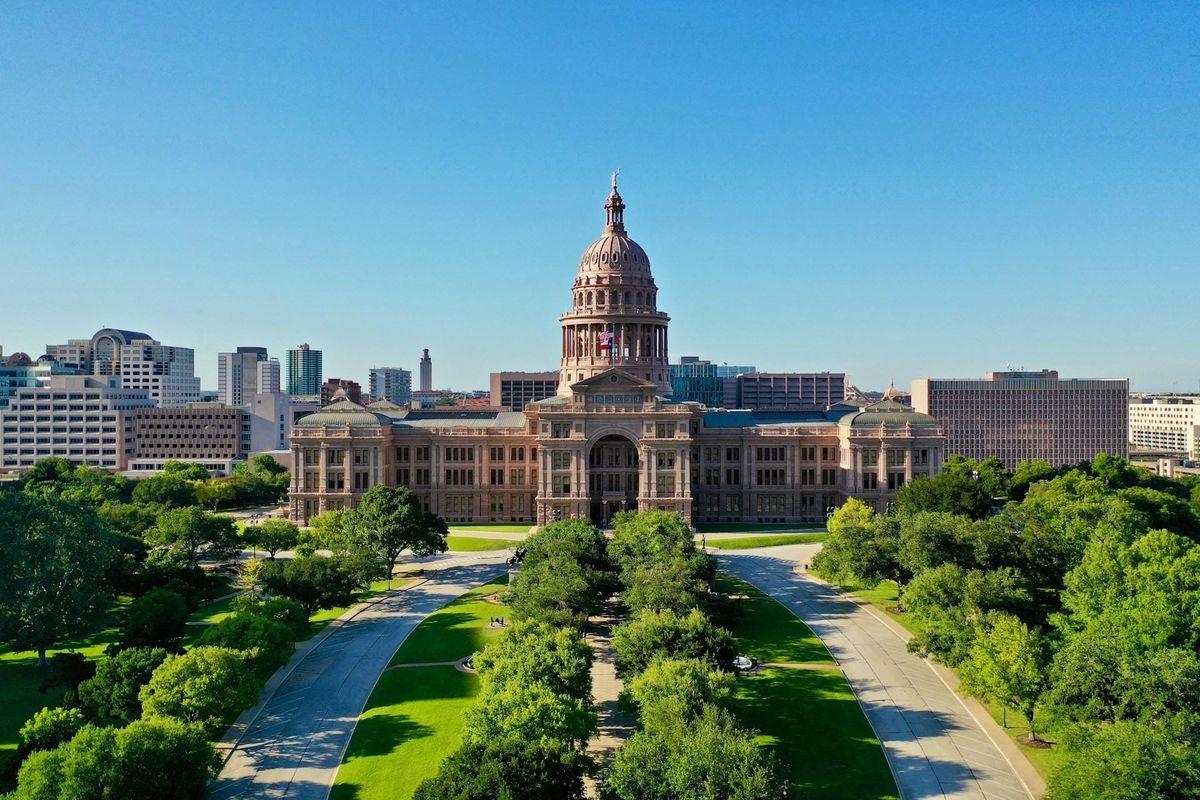
That echoes important decisions in Colorado, where courts have rejected challenges to the state’s system allowing unaffiliated voters to participate in party primaries.
And it could have immediate implications in South Carolina, where a similar Republican lawsuit is pending after efforts to close the state’s primaries through legislation stalled.
That would be a powerful reaffirmation that the voters—not political parties—belong at the center of our elections.
What We're Talking About
A POWERFUL DEFENSE OF CALIFORNIA’S TOP-TWO PRIMARY
This piece by Lenny Mendonca and Dan Schnur cuts straight through years of partisan attacks on California’s top-two primary. Partisans have been predicting its hypothetical failures since before Prop. 14 even passed — and this year, they went into overdrive.
 Lenny Mendonca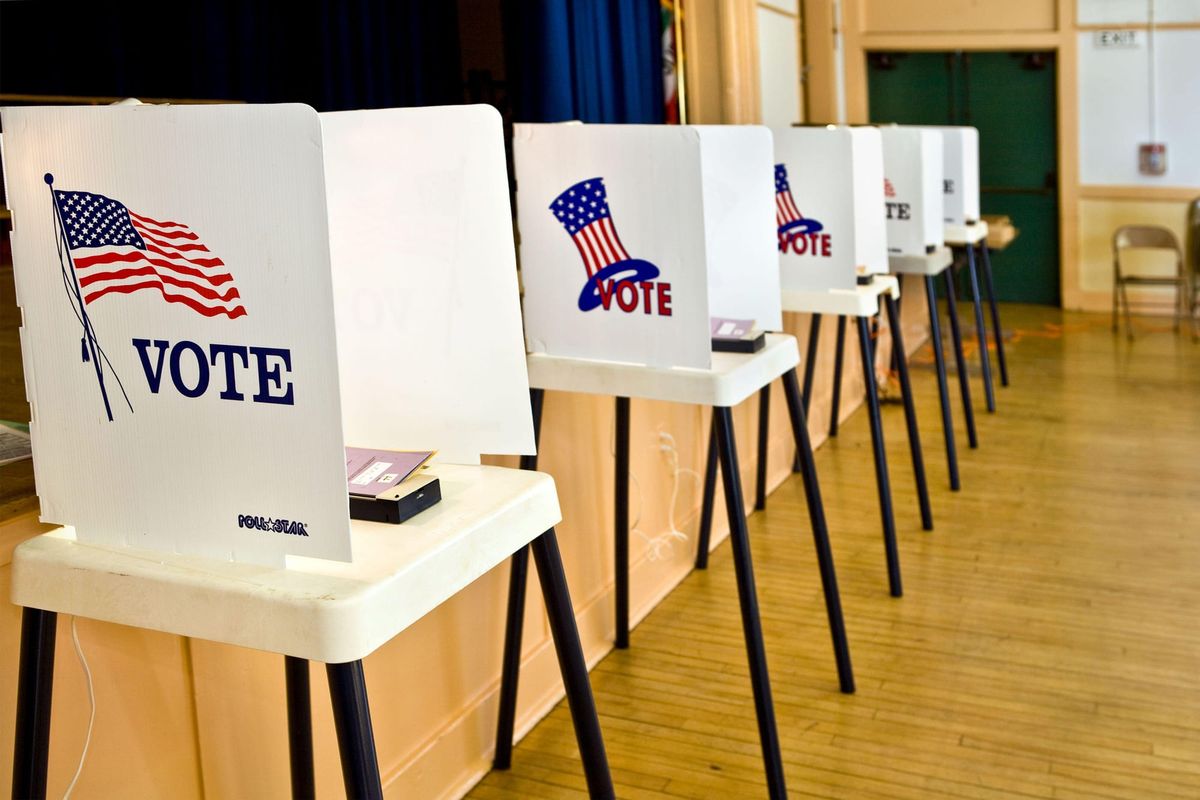
Now, some of the same Democratic insiders who opposed reform from the beginning are pushing to repeal it — a move that would shut roughly 5.3 million independent voters out of state primaries and return California to the closed system voters rejected.
Mendonca and Schnur make the essential point: this isn’t about which party wins. It’s about whether millions of Californians get to participate at all. That makes this a must-read — and an important defense of what California voters chose in 2010.
What We're Reading
FROMA HARROP: CLOSED PRIMARIES ARE A CURSE
Froma Harrop has a great way of cutting through the usual political excuses and laying out what is actually happening. In her latest editorial syndicated across the country, she puts closed primaries under the microscope—with Open Primaries SVP Jeremy Gruber right in the middle of the conversation.
She also exposes just how weak the usual arguments for keeping things this way are: 47% of American voters are unaffiliated, yet millions are shut out of the elections that often decide who wins. Her conclusion: “Closed primaries are a curse on our democracy.”
In Case You Missed It
Open Primaries President John Opdycke has a blunt message in The Fulcrum: Independents may decide elections, but too often they get nothing in return. They swing the outcome, the parties celebrate—and then independents are ignored.
Opdycke argues that it’s time to turn electoral power into political power: organize, apply pressure, open up the partisan systems that shut independents out, and demand a real seat at the table.
 John Opdycke
Activities / Events
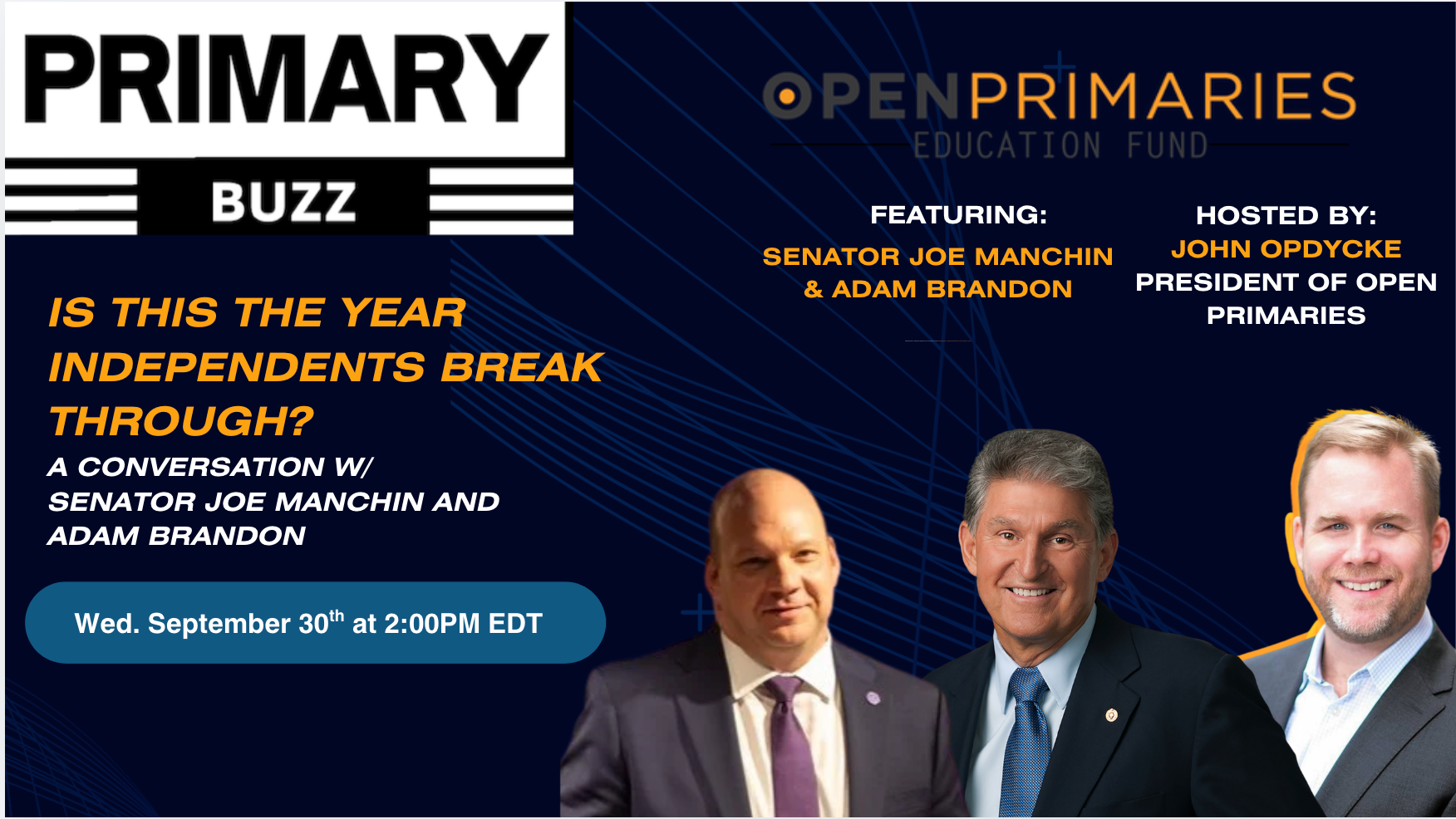
Is This The Year Independents Break Through? A Conversation with Joe Manchin and Adam Brandon
Hosted by Open Primaries President John OpdyckeWednesday, September 30 | 2:00 PM EDT | Virtual
Independent voters are the largest force in American politics. But when it comes to who holds power in Washington, Republicans and Democrats still have a near-total monopoly.
Could 2026 be the year that begins to change?
Join Open Primaries President John Opdycke for a timely conversation with former U.S. Senator Joe Manchin and Adam Brandon, senior adviser to the Independent Center and former president of FreedomWorks, about their ambitious new effort to elect independent candidates to Congress while challenging the two-party system from the outside.
Their goal is to build the infrastructure independent candidates have long lacked and prove that candidates can run and win without a D or R next to their name.
The stakes go beyond electing a handful of candidates. Their effort raises a much bigger question: Why should two private political parties have so much control over who gets elected, how Congress operates and whether independent voices have a seat at the table?
With closely divided chambers, growing dissatisfaction with the two-party system and millions of Americans identifying as independents, even a small number of truly independent members of Congress could have an outsized impact potentially influencing congressional leadership, committee rules and how Washington does business.
Can independents finally translate their numbers into political power? Can candidates compete without the machinery of the two major parties? And could 2026 be the beginning of a fundamentally different kind of Congress?
Campaign Updates
PENNSYLVANIA KEEPS MOVING
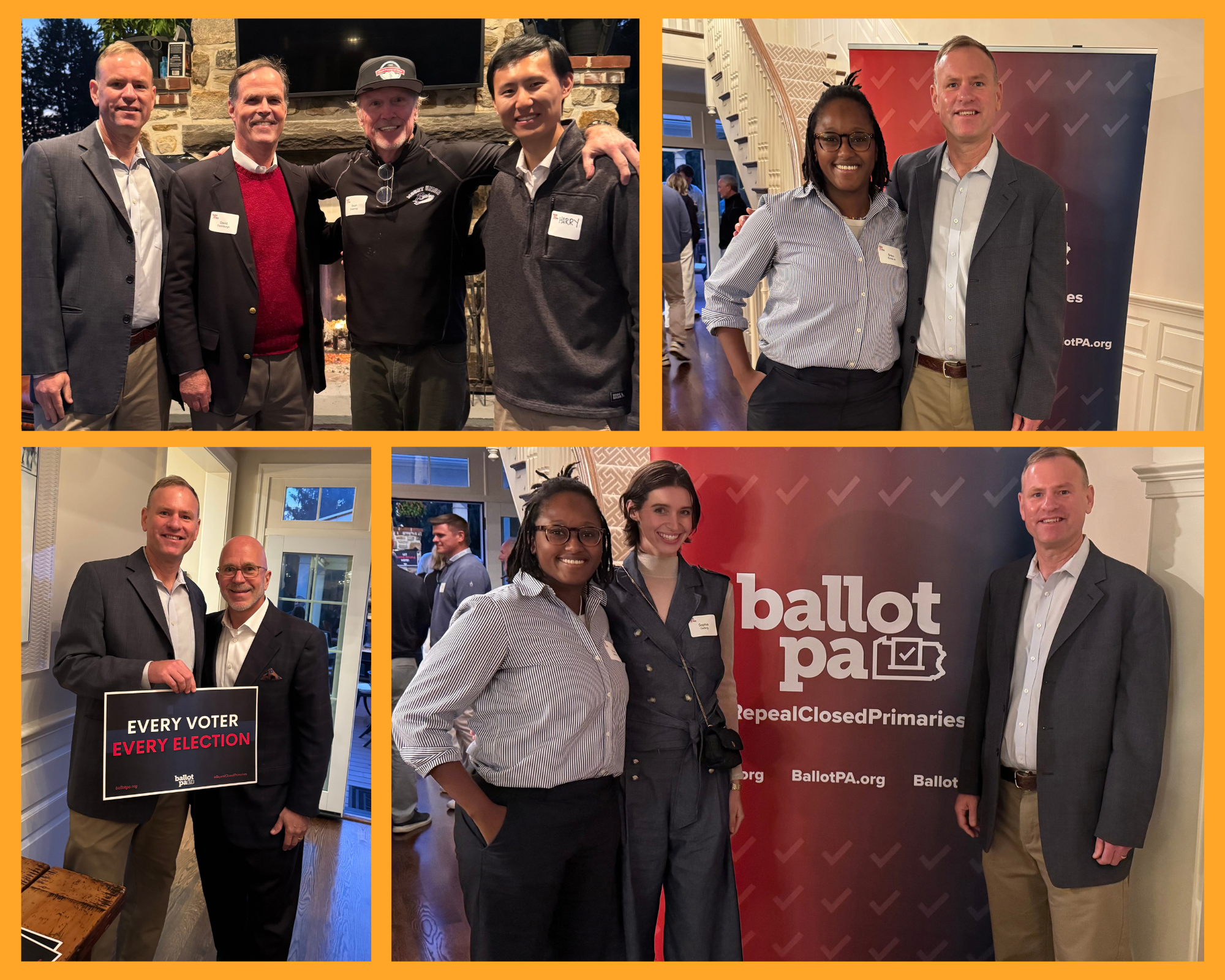
I joined CNN’s Michael Smerconish and Ballot PA Action’s David Thornburgh at a Philadelphia-area gathering of open primaries supporters last night. Kudos to Open Primaries National Organizer and Phily local Bree Doldron for her tireless work to organize the event. It comes at a pivotal moment: the state House is scheduled to vote next week on HB 280, legislation to open Pennsylvania’s primaries.
Open Primaries has spent 10 years building the case for open primaries in Pennsylvania, supporting both legislation and litigation to give every voter a voice. And with new legislative developments in the works, stay tuned—there’s a lot more to come.
NEWSFLASH: USA TODAY WANTS TO HEAR FROM INDEPENDENTS
Independent voters are the largest voting bloc in America. Now USA TODAY wants to hear directly from them.
National columnist Chris Brennan is asking independent voters to take a short, seven-question survey about why they’re independent, whether independents have enough political power, and what people get wrong about them.
As Brennan puts it: “Independent voters are a significant chunk of the electorate, and they don't get the attention they deserve.”
He’s right. So, let’s give independents a voice.
Take the USA TODAY survey and tell them what you think.
MASSACHUSETTS: LET ALL VOTERS VOTE
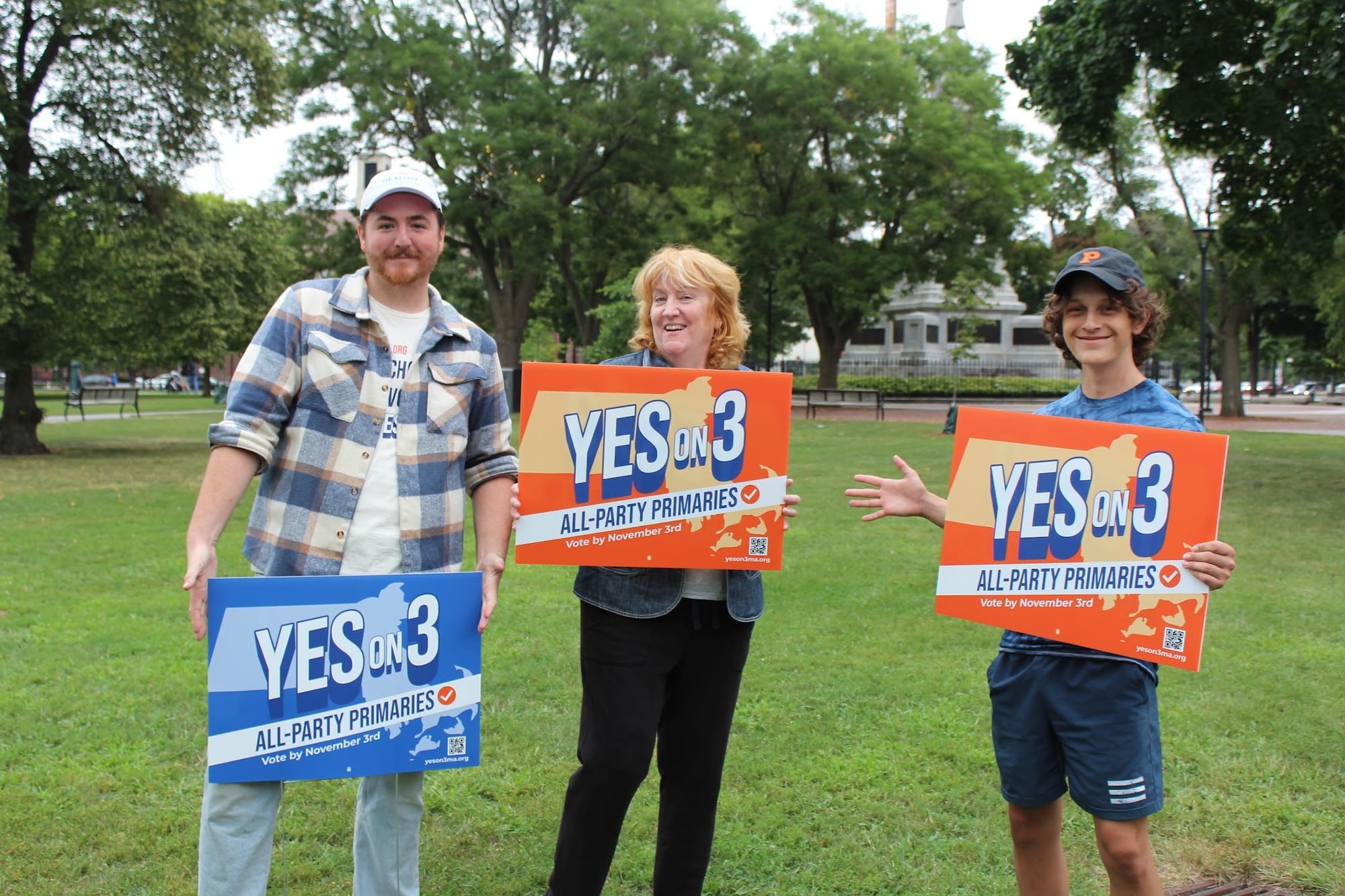
Massachusetts has the highest percentage of independent voters in the country. 67% of Mass voters are not affiliated with a political party.
Yet when primary elections arrive, those voters still have to choose a party ballot to participate. And in a state where three out of five legislative races this year have only one candidate on the ballot, that primary often is the election.
Question 3 would change that.
Qn #3 proposes an All-Party Primary. It would put every candidate on one primary ballot, let every voter choose among them, and send the top two finishers to November—regardless of party. Check out what WA State Rep. Parsley has to say about the value of a Top Two system.
Massachusetts may be the first state to make this move from a semi-open primary to an all-party system. The support for Qn #3 includes several Indivisible chapters, the Western MA Building Trades, the NAACP New England Area Conference, Veterans for All Voters, Open Primaries and the Forward Party, to name a few of the endorsing organizations.
It also includes at least 10 mayors who already use a similar system in their own cities.
Battle lines have been drawn. The campaign faces stiff opposition from both the Democratic and Republican parties, several elected officials, multiple unions (SEIU, UAW, AFL-CIO) and the Mass Alliance.
For the state's two-thirds of voters who aren't enrolled in a party, it's a simple proposition: no party membership should be required to have a voice.