 Shawn Griffiths

ANCHORAGE — It appears everyone is playing dirty in Alaska’s 2026 elections. Republicans are crying foul over two Dan Sullivans running for US Senate. However, independent congressional candidate Bill Hill now says Republicans are playing a similar game against him.
His campaign reported Thursday that Alaska voters have received multiple anonymous text messages encouraging them to support Democrat Eric Hafner, a candidate on the ballot serving a 20-year sentence in federal prison in New York who has never visited Alaska.
Campaign Manager Kevin Groh even provided a screenshot of the text message:
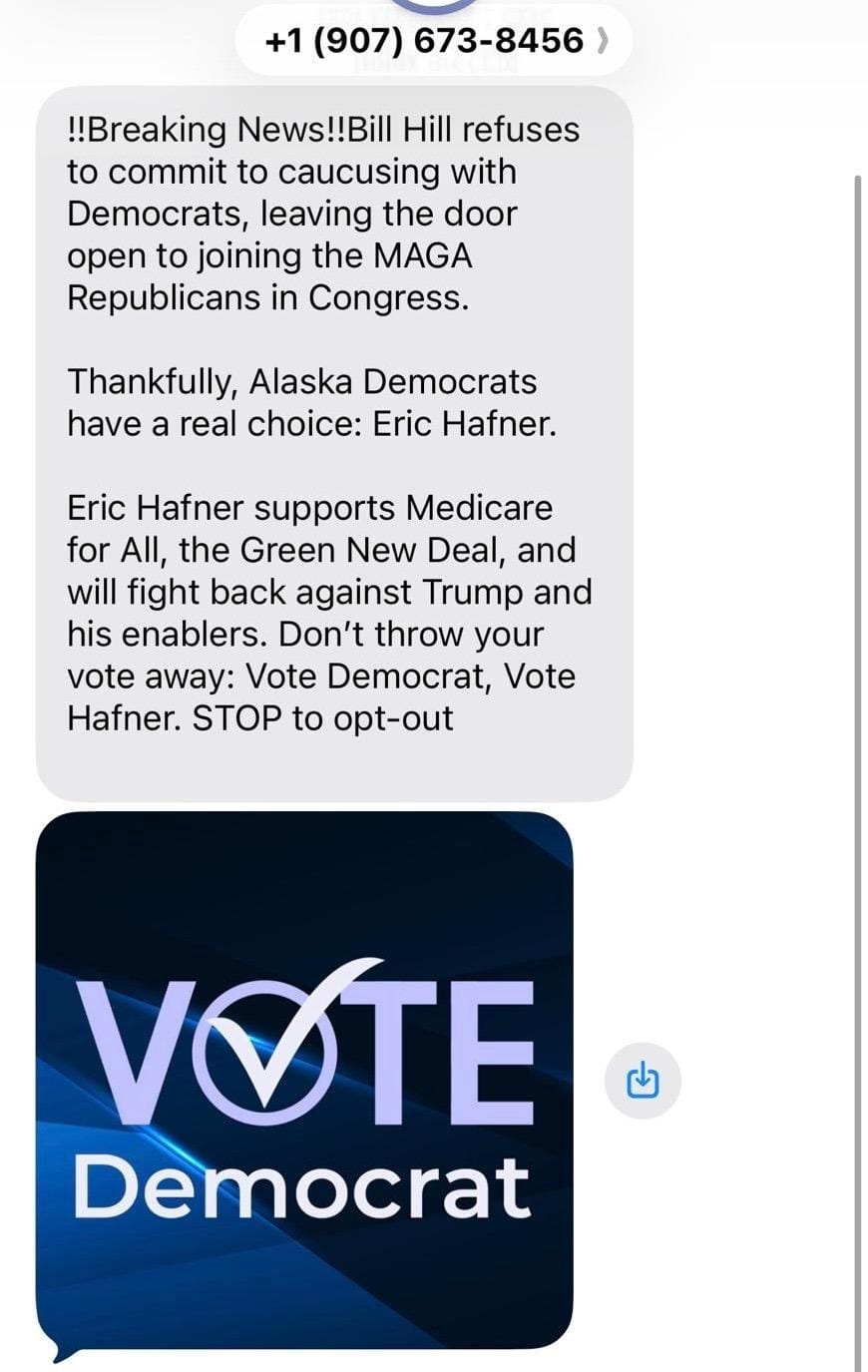
Groh alleges national Republican groups are behind the messages, hoping to siphon support from Hill and help Republican US Rep. Nick Begich win another term right as polls show Hill catching up to the incumbent.
An October Data for Progress poll showed Hill trailing Begich just 51% to 49% in a simulated final round of ranked choice voting.
“Groups are resorting to dirty tricks because they know this race is close, and they know Nick Begich’s record is a losing one,” Groh said.
“Alaskans are smart and can see the truth: Nick Begich is a Florida-raised elite who keeps voting to raise our costs, Eric Hafner is a federal inmate in New York, and Bill Hill is a lifelong Alaskan running to lower costs and take on the rampant corruption in DC.”
It is important to note that while there is a documented history of Republicans promoting Hafner in the past, the individuals or groups behind the latest texts have not been independently identified.
The text messages are not signed, nor is there any kind of disclaimer attached to them. This raises another question: Did someone break the law in this case? Groh says yes, but things may not be so straightforward.
Republicans Have Played This Game Before
This isn't the first time Hafner has received political assistance from the GOP and alleged affiliated groups.
In 2024, the Anchorage Daily News reported that the National Republican Congressional Committee promoted Hafner’s candidacy in Alaska’s US House election (in which current US Senate candidate Mary Peltola lost the seat to Begich).
This reporting was subsequently confirmed in Alaska Public Media's election coverage. The goal was to encourage voters who might otherwise support Peltola to back another candidate.
Hafner took 1% of voters’ first-choice selections, which didn’t quite cover the gap between Begich and Peltola. IVN author Matt Shinners reported that only 37% of Hafner’s voters went to Peltola in the second round of ranked-choice tabulation.
In the final round, Begich got the majority with 51.22%.
The tactic was used again in this year’s August primary. The Anchorage Daily News reported that an unidentified group sent messages promoting Hafner, who advanced once again to the general election under Alaska's Top Four primary.
To this day, it remains unclear who paid for those messages.
It is possible that in the final days of the election, Republicans are hoping that Hafner’s voters won’t rank a second-choice pick like many didn’t in 2024. The Hill campaign seems to think so.
Meanwhile, Republicans are demanding accountability over allegations that Democratic operatives helped recruit Daniel J. Sullivan Jr., a candidate who shares a first and last name with Republican incumbent Sen. Dan S. Sullivan.
President Donald Trump has demanded that Peltola be prosecuted after the New York Times reported that people connected with Peltola’s campaign were involved in the effort to recruit the candidate he calls “Decoy Dan.”
The US Department of Justice has issued subpoenas while Alaska Gov. Mike Dunleavy has launched his own investigation. Dunleavy has even suggested that the Senate race won’t be certified if Peltola wins.
Today’s New York Times reporting reveals disturbing new evidence of an organized effort to manipulate Alaska’s elections by recruiting candidates—including one with the same name as an incumbent U.S. Senator—to deliberately confuse voters and misdirect their votes. The Alaska…
— Governor Mike Dunleavy (@GovDunleavy) October 29, 2026
The governor wrote on X:
“Deliberately tricking voters into casting their ballots for someone else strikes at the integrity of our elections. Anyone or any organization found to have broken the law must be held accountable.”
Both parties have demonstrated a willingness to exploit same-name or lesser-known candidates to influence election outcomes. The party doing the complaining often depends on which side stands to benefit.
 Chad Peace
Did the Anonymous Texts Cross a Legal Line?
Now comes the question: Did the anonymous group that sent the text messages break the law? Well, it’s possible. But it depends on currently unknown information.
Federal campaign finance laws generally require political advertising to disclose who is behind it. However, Federal Election Commission has established exceptions for certain text messages, including short SMS communications.
For example, the agency permits political texts of 160 characters or fewer without disclaimers under its small-item exception. Also, it has determined that certain opt-in, short-code text messages do not qualify as public communications.
And, it expanded disclosure requirements for certain paid digital advertisements in rules that took effect in 2023.
In other words, determining whether these texts were illegal would require identifying the sender, who funded them, and examining how the messages were distributed. It is possible that this information will remain a mystery.
The FEC can’t launch any investigations because it lacks the quorum needed to authorize one.
For now, Alaska voters can only watch as candidates accuse opposing political operatives of manipulating voter choices through dirty tactics and vote based on the information they have.