 Steve Peace
Legendary political strategist Bill Cavala died in December 2009, six months before California voters approved Top Two and opened their primaries to every candidate and every voter regardless of party. He spent his entire career within the old closed primary system, and despite his rich partisan credentials, he became a major behind-the-scenes supporter of Proposition 14.
Cavala was a UC Berkeley political science professor who gave nearly four decades of his life to teaching and public service, as a trusted senior aide to Speaker Willie Brown and a key campaign strategist for every Speaker who followed Brown, including Cruz Bustamante, Antonio Villaraigosa, Bob Hertzberg, Herb Wesson, Fabian Nunez, and Karen Bass. He helped John Garamendi and Jackie Speier get elected to Congress. He pioneered the use of targeted direct mail in California.
“To say Bill was a campaign genius or had great political acumen was like saying Beethoven was a great musician or Hemingway had a way with words,” Bob Pence, an acolyte of Cavala told Paul Hefner at Capitol Weekly who wrote this moving tribute. “There is no shortage of us who passed Bill’s wisdom and advice off as our own thoughts.”
Yes, his office was a wreck of paper and cigarette smoke, and his door stayed open to whoever wandered through. Yes, champagne was his preferred tool of persuasion, both for talking candidates into running and, for talking them out of it.
Oakland Post publisher Paul Cobb remembered him in the Hefner tribute as having “the aura of the gambler who knew when to politically fold them."
Which is what comes to mind reading the news this week out of Sacramento, where a group of California's most prominent political consultants, from both parties, are still pushing a ballot initiative to repeal Top Two and return California to closed partisan primaries. They are calling it, with admirable bluntness, "Undo the Top-Two."
Cavala, one suspects, would have wanted to see the polling.
Because here is the math. California has 23 million registered voters. Nearly 6.9 million of them, registered as having no party preference or as members of a minor party, declined to join either major political party. That is 30 percent of the electorate, more than the entire Republican registration in the state.
Undoing Top Two means telling those voters they may no longer participate in primary elections unless they sign up with a club they have already decided not to join.
The case for repealing Proposition 14 was built this spring on the premise that two Republicans might finish in the top two in the June 2 governor's race, locking Democrats out of November.
The math behind the case for repeal was also suspect. California's registration is 45 percent Democratic and 25 percent Republican. A 25 percent undecided column in those polls was, by any reasonable reading, mostly Democratic. Nevertheless, the chair of the state Democratic Party publicly called on fellow Democrats to drop out a full three months before the election to prevent such an outcome.
What ended up happening is that a Democrat and a Republican advanced. So, the crisis, having done its work, took its leave. Unfortunately, the proposal to repeal Top Two did not.
Near the end of his career, Cavala wrote a paragraph explaining why, in one of his final races, he had sent likely voters just one piece of mail despite having nearly a million dollars to spend:
"Those of us who have been successful in this business know that while individual voters can be inattentive to the point of stupidity, electorates have a way of absorbing information and making wise collective decisions. Campaigns are an effort to affect this process by supplying prejudicial information. But when electorates come to a conclusion, they cease to be in the market for information. They tune out a campaign as ambient noise."
After the 2012 election cycle, 59 percent of likely California voters said Proposition 14 was mostly a good thing. By 2024, that number had risen to 68 percent, with majority support across political groups and along the ideological spectrum.
The market, as “the professor” might have said, is closed.
It is also worth noticing what 16 years of Top Two actually produced. In the 2009-10 session, the last elected entirely under the old closed primary system, the California Legislature was 73 percent male and 62 percent white in a state where people of color already constituted a majority.
Today, women hold 49 percent of all the seats. People of color hold 55 percent.
Latina women went from 8 to 25.
Under Top Two, the most diverse legislature in California history was elected by the broadest electorate in California history.
Make of that what you will.
Somewhere in Sacramento, one of the consultants behind Undo the Top-Two could eventually find himself sitting across from a client who took his advice. A former legislator who supported this insanity. A legislator who simply could not explain to 30 percent of her constituents why she voted to take away their right to vote.
The polling is clear. California NPPs who trust neither major party overwhelmingly want to keep the current nonpartisan open primary system (78 percent). But so do NPPs that favor Democrats by very wide margins (89 percent), and even NPPs that favor Republicans (54 percent), despite President Donald Trump’s firm opposition.
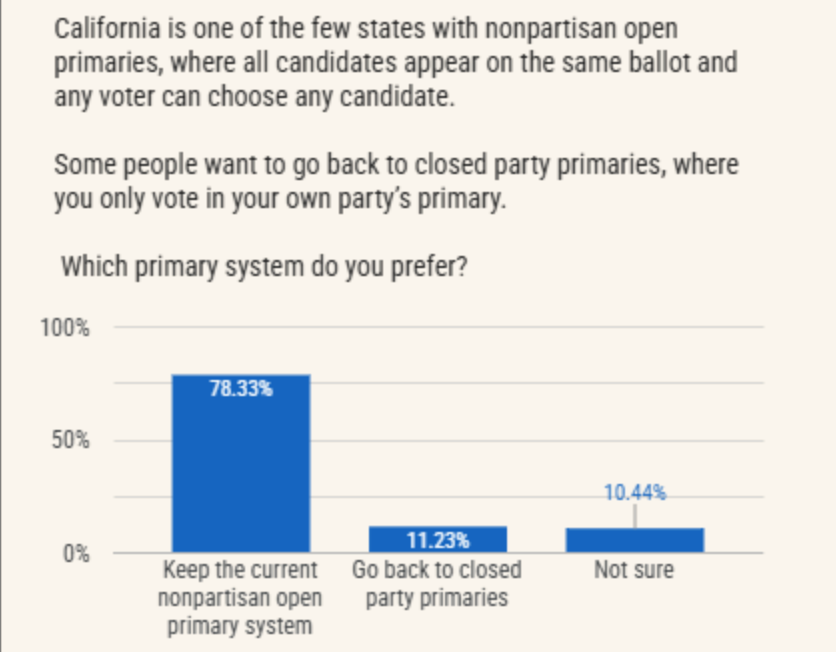
Unlike the political operatives, academics, data geeks, and political press who obsess over deciphering the “outcome” of giving every voter an equal voting right, voters simply see open nonpartisan primaries for what they are — a voting rights issue.
The outcomes? That’s entirely up to the voters. Not the political parties, not financial contributors, not political activists, left, right, or center.
One of the fading legacies of the Bill Cavala era is what State Capitol folks called “member protection.” There is little doubt that “the professor” would have chuckled through heavy drags on a cigarette as he quietly derailed any talk of nonpartisan primary repeal with one of his patented colloquialisms, “Wise politicians never lose track of the fact that, collectively, the voters are smarter than we are.”