San Diego State University officials and consultants laid out their $3 billion plan for expanding the university into Mission Valley.
At a news conference on campus, officials said the plan could take as little as 15 years for the complete buildout to occur, with the first phase being finished by 2022.
If passed by voters in November, the project would include 1.6 million square feet of classroom and research buildings, two hotels, one with 250 rooms the other 150, a river park and open space, 4,500 housing units, retail shops, a pair of hotels and a multi-use, a stadium that could be used for aztecs football and other sports, including the NFL should they choose to return.
SDSU President Sally Roush said, "Mission Valley offers a once in a lifetime opportunity to grow the higher education footprint for the region."
WHO WILL FINANCE THE PROJECT?
SDSU Interim President Sally Roush, JMI Realty CEO John Kratzer and Architect Gordon Carrier made the presentation on campus. They all noted the project would be mostly funded by public-private partnerships, and wouldn't rely on taxpayer financing. The main exception would be the stadium, which would be funded by bonds that are paid back by future revenues.
Sally Roush stated, "This project will have no reliance on taxpayer or university funds. Stadium will be funded by revenue bonds and covered by revenue generated from the stadium." She continued, "No tuition dollars and no student fees will be used in this development as part of the stadium financing."
The lack of taxpayer financing is a big piece in this, as officials with a competing proposal, Soccer City, along with City Councilman Scott Sherman have suggested the SDSU plan would include taxpayer dollars.
52% OF PROJECT WILL HAVE OPEN SPACE
Gordon Carrier, who is leading the architectural planning and design of the project, says 90 acres will be devoted to open space which translates to roughly 52% of the project. Carrier said, "Campuses are about the space between buildings, to facilitate student and faculty movement."
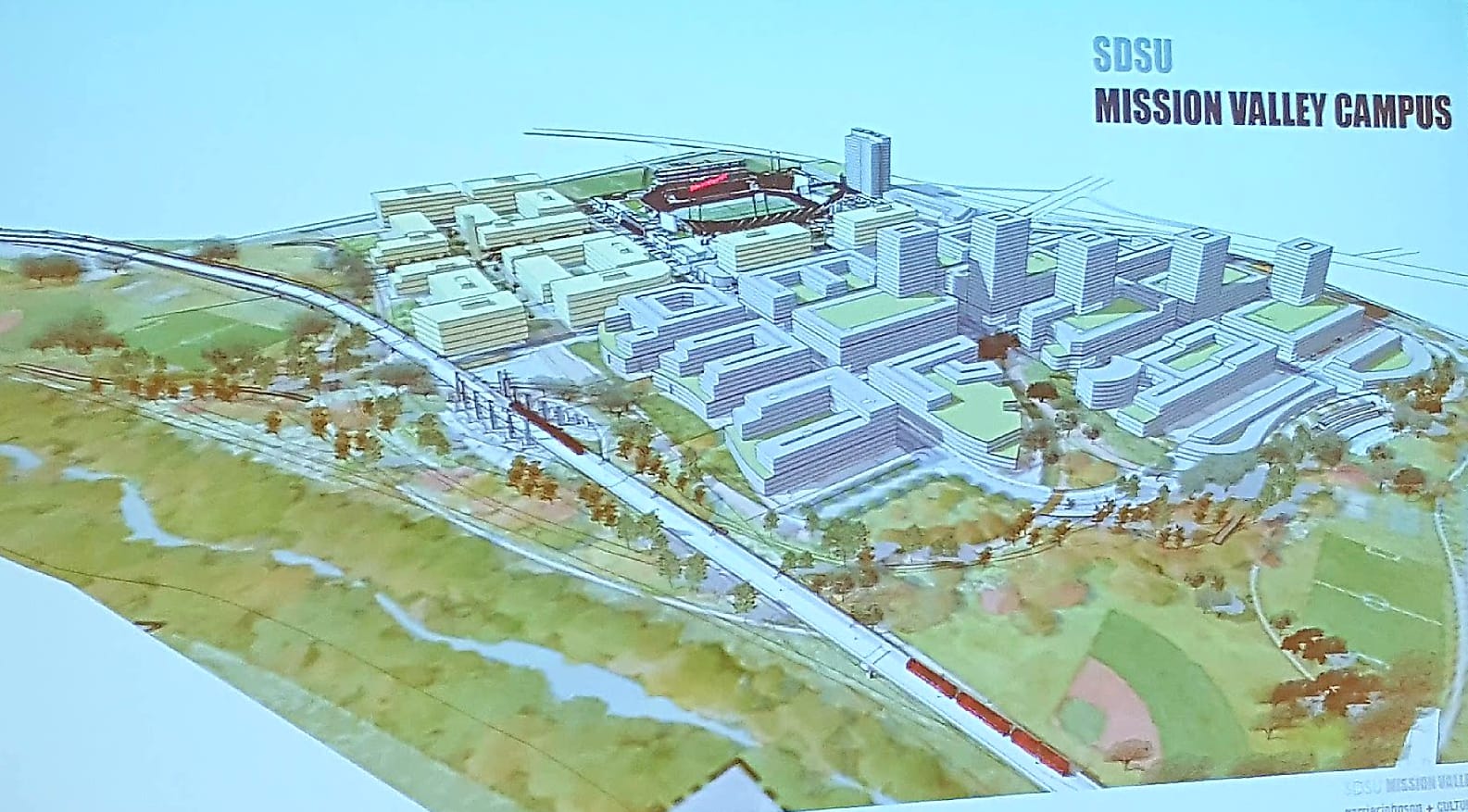
SDSU Mission Valley Campus
Carrier says addressing hydrology, engaging with the San Diego River and working with the Mission Valley Planning Group to create a fully integrated space has been the three point focus for his team.
Carrier noted that the first phase of the project would concentrate on the riverpark, stadium and some education and research facilities.
THE FIVE BUILDING PRINCIPLES
John Kratzer works for JMI Realty, and is a consultant to SDSU on this project. Kratzer has had significant input into developing the Ballpark Village section of downtown. Kratzer spoke at the news conference and highlighted the five principles the team used when considering developing the site.
- SDSU Expansion. Future growth for the university is vital to its success
- College Campus Environment. SDSU officials conveyed that the design and feel of the campus replicates a college "feel" and environment. The scale of buildings, open space, removing cars from the space must all be part of the effort.
- No Taxpayer Dollars. This project must not include any taxpayer dollars. Kratzer said it will be funded through public/private partnerships. SDSU wouldn't be the first university to engage in these funding mechanisms.
- Regional Asset for San Diego. This must be a regional attraction. That means emphasizing the river park and creating the higher education innovation hub that will attract businesses and resources from outside the area.
- Transparent Process. Has to be an open and transparent CEQA process. Kratzer noted that the CEQA process for the SDSU Mission Valley plan has already began.
San Diego State University officials will unveil specific plans regarding a new stadium for the Aztecs and if/when the NFL wants to return to San Diego on Thursday.