

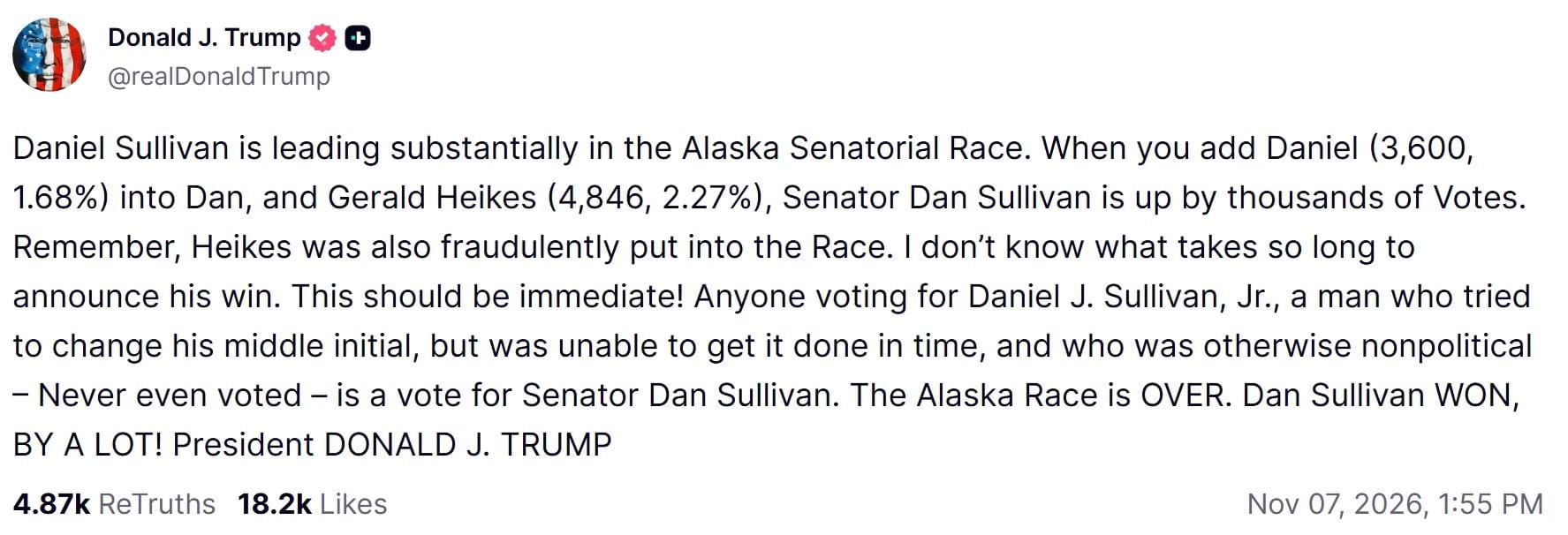
Among his Truth Social posts over the weekend, President Donald Trump declared that the Alaska Senate race was over and that incumbent US Sen.Dan Sullivan won “by a lot.” But as many know, neither claim is true.
It is possible that the incumbent could end up winning when all is said and done, but that won’t be known until more votes are counted. There is still 26% of the statewide vote that remains outstanding (which is 60-75,000 votes).
“Daniel Sullivan is leading substantially in the Alaska Senatorial Race. When you add Daniel (3,600, 1.68%) into Dan, and Gerald Heikes (4,846, 2.27%), Senator Dan Sullivan is up by thousands of Votes,” Trump wrote.
This is true. If every vote cast for Daniel J. Sullivan and Gerald Heikas was added to Sen. Sullivan’s vote count, he would have a majority. But that isn’t how this works. Democratic nominee Mary Peltola currently leads, 48.17% to Sullivan’s 47.88%.
It is also known at this point that not every person who voted for Heikes and “Decoy Dan” prefers the incumbent.
While Trump bashes ranked choice voting, the reform reveals how voters would have or might have voted if a candidate wasn’t in the race. For example, available ranked-choice data shows only 16% of Daniel J’s votes ranked the incumbent second.
The New York Times reports that if the second-choice votes from the ballots that have already been counted for Daniel J and Heikas were applied to the tabulation “Dan S. Sullivan would gain only four-tenths of a percentage point.”
Surprising set of second-choice votes in Alaska's Senate race, from ballots released so far, among those who voted for "Decoy Dan" as their first choice. Go figure. https://t.co/uKrQLwfEhl pic.twitter.com/sCP0RBiCOP
— Orin Kerr (@OrinKerr) November 6, 2026
And this does not include the outstanding votes, which could give the senator a boost, but they could also get Democrat Mary Peltola over a majority. The next major batch of ballots is expected on Monday or Tuesday, which will give us a better picture of where the race is headed.
Was Heikes a Fraudulent Candidate?
“Remember, Heikes was also fraudulently put into the Race,” Trump claimed, alluding to the accusation that Daniel J. Sullivan was also a fraudulent candidate.
Was Heikes being on the general ballot a calculated move by the Democrats? There is evidence to suggest yes. Is his placement fraudulent? Not unless it can be proven that his candidacy violated the law in some way.
There were plenty of partisan shenanigans that went on in this year’s Senate race. The New York Times reported on a Democrat-led operation to recruit a same-name Sullivan candidate and perhaps even Heikes.
Heikes denies that he was recruited by the same person tied to the Daniel J. Sullivan controversy, but said he was recruited.
He originally placed fifth in the primary behind Democrat David Leslie. Leslie then withdrew, which advanced Heikes. It is reported that a Democratic operative named Jerid Kurtz was involved in both candidate recruitment and encouraged Leslie to drop out.
The whole thing has turned into a mess. The FBI has issued subpoenas and Alaska Gov. Mike Dunleavy has launched his own investigation.
But as far as Heikes’ placement on the ballot, while it may have become part of the Democrats’ strategy, it is legitimate under the state’s Top Four primary rules until it is proven that his candidacy or funding violate some type of state law.
Still, his absence may not have helped the incumbent much. A second Democrat on the ballot may have given Sen. Sullivan an initial edge in first-choice selections, but there is no evidence that (a) all of Heikes’ voters would have turned out and (b) that they all would have voted for Sen. Sullivan.
In fact, ranked-choice data of votes already counted show 36% of Heikes votes chose the incumbent as their second choice. But 37% did not rank a second option, meaning these voters may not have participated had he not been on the ballot.
This is impossible to prove one way or the other.
This is why advocates of ranked choice voting continue to point out that the reform helps mitigate partisan gamesmanship. Republicans and Democrats in Alaska continue to try to leverage a “spoiler effect” that does not exist to the same extent it does in other places.
If voters can rank their preferences, attempting to “siphon” votes away from a candidate may not pay off in the long run because when the candidates who place lowest are eliminated, their voters still have an opportunity to declare their preference among the top contenders.
In this case, who they prefer between Sen. Sullivan and Peltola (if they have a preference). Some may choose to allow their ballots to become exhausted because they don’t want to choose between the final candidates.
Votes for Daniel J Sullivan Were Not Confused Votes
“Anyone voting for Daniel J. Sullivan, Jr., a man who tried to change his middle initial, but was unable to get it done in time, and who was otherwise nonpolitical – Never even voted – is a vote for Senator Dan Sullivan,” Trump wrote.
There is some truth to Trump’s claim about Daniel J. Sullivan. He put in a request to the Alaska Division of Election in early June that his name appear on the ballot with the incumbent’s middle initial, “S,” but retracted the request 8 hours later.
It had nothing to do with a deadline.
However, as mentioned above, simply declaring a vote for one candidate is a vote for someone else is a claim made in bad faith. Especially, when ranked choice voting reveals that Daniel J Sullivan wasn’t a spoiler for the incumbent.
Based on the available data, most of the votes for Daniel J were protest and “for the laughs” votes, considering Peltola has so far performed much better with these voters.
Don't be confused. The results of this election may not be known until next week. Trump can post on Truth Social and tell reporters it's over all he wants, but at the end of the day it will be voters who have the final say.