
 Jeremy Gruber
Editor's Note: The following is an exclusive series on IVN from the better elections group Open Primaries. The content originated from the group's weekly newsletter, "Primary Buzz."
New York City just missed another chance to give 1.2 million independent voters a voice in its primary elections. But the latest defeat may have revealed something more important than another political setback: the movement for open primaries is finally beginning to look like a movement.
In a new long-form piece, I argue that reformers have spent years searching for the perfect strategy, coalition or campaign. The missing ingredient may be something much more fundamental-organized civic power.
The recently concluded NYC Charter Revision Commission hearings offered a glimpse of what that could look like. Independent voters from across the city-teachers, immigrants, veterans, union members, students, retirees and lifelong New Yorkers-showed up and asked a fundamental question: Why are we excluded from elections we help pay for?
That question is becoming harder to ignore.
With the possibility of an open-primary question returning to the ballot, it might be tempting to just focus on that. But I argue that the next chapter of the fight in NYC cannot simply be another campaign. It has to be a movement built by the millions of New Yorkers who have been shut out of their own elections.
What We're Watching
MARYLAND LIEUTENANT GOVERNOR ON CLOSED PRIMARY LEGAL CHALLENGE
Maryland’s closed-primary system is facing a challenge in the courts-and the challenge is being led by someone who knows the political system from the inside.
Former Lt. Gov. Boyd Rutherford, chief counsel for Open Primaries Education Fund’s lawsuit, sat down with former state Sen. Bobby Zirkin for Across the Aisle to talk about political independence, election reform and why nearly one-quarter of Maryland voters are shut out of taxpayer-funded primaries.
Rutherford makes the case plainly: when a primary effectively decides who wins, excluding independent voters isn’t just a political inconvenience. It’s a democratic failure.
Watch this powerful conversation about breaking down partisan barriers, giving voters more choice and building an electoral system that rewards candidates for reaching beyond their party’s base.
Want to learn more about Open Primaries’ litigation program? Follow all the cases on our portal here.
'Yes on 3' for Nonpartisan Primaries in Massachusetts
This November Massachusetts voters have the opportunity to create a Top Two primary system for the state by voting Yes on Qn #3. If passed, the initiative would create a nonpartisan primary where all the candidates for an office are on one ballot and all voters receive the same ballot.
There is a myth about Massachusetts – that it is a “blue” state. Yet, 65% of voters in Massachusetts are independents – that is more than the members of the Democratic and Republican Party combined. When you look even more closely you discover that 75% of those independents are under 34. And 70% of people of color in Massachusetts are independents.
The current semi-open primary system allows independents to vote in the primaries by picking a party ballot. However, independent voters in MA turn out at very low rates, not wanting to be limited by one party ballot. Check out this video featuring Open Primaries activists Evelyn Dougherty from Boston and Doug Balder from Dartmouth talking about Qn 3.
Massachusetts has the least competitive state elections in all 50 states! This has been the case for a decade. This fall 60% of state legislative races will be unopposed. Qn 3 was spearheaded by the Coalition for a Healthy Democracy. Chair Danielle Allen believes that Qn 3 will “jumpstart competitiveness” because “...when politicians don’t have rivals, they don’t listen to voters.”
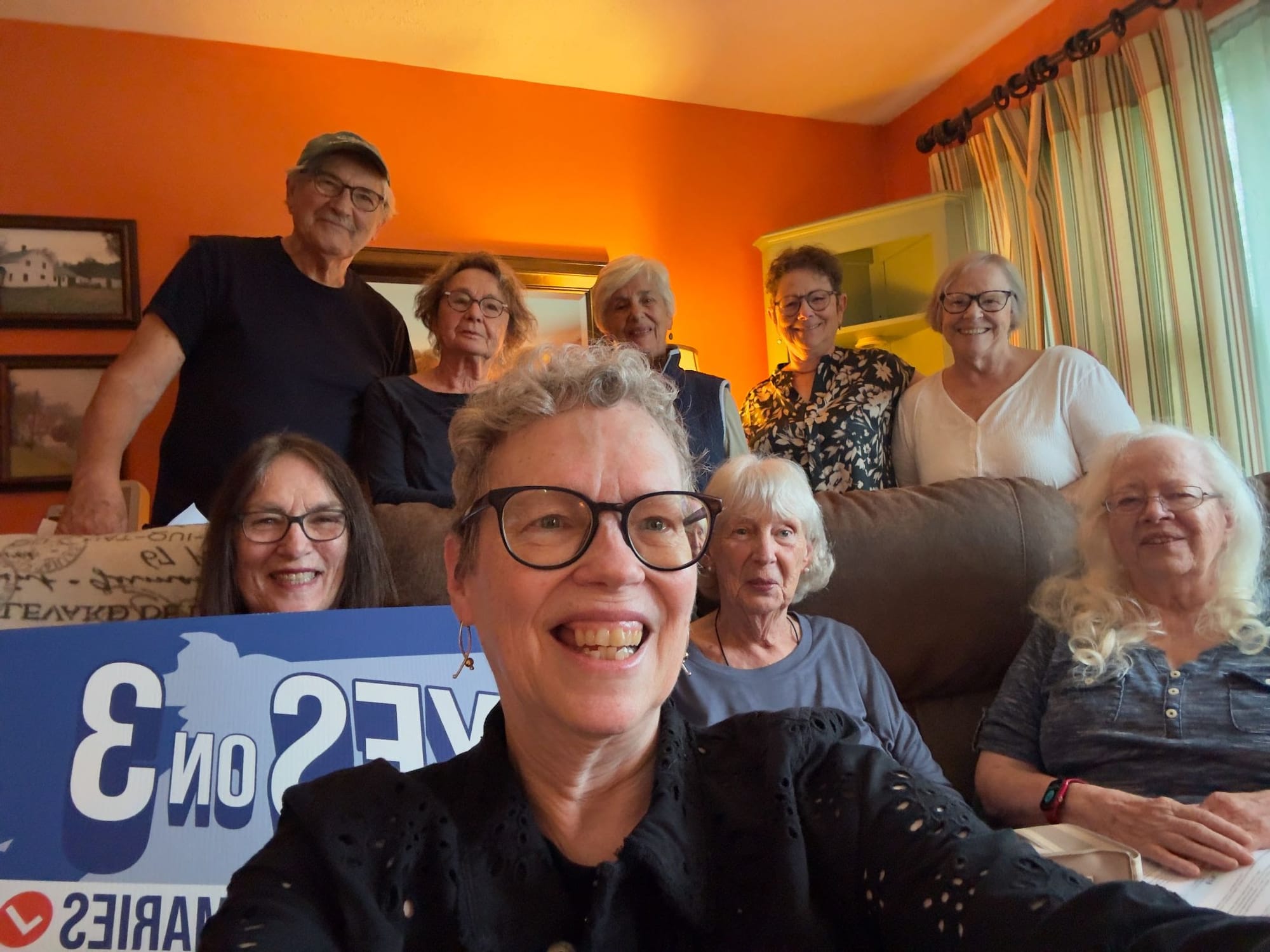
Last week, National Organizing Director Cathy Stewart spoke at a houseparty for Yes on 3 organized by Joyce Dattner and hosted by Mary Lou Burdick in Cheshire. There was a lively conversation about Qn 3, the growth of independent voters and the advantages of a nonpartisan primary.
Stay Tuned – the establishment forces in both parties are opposing the initiative and are likely to come out after Labor Day with some heavy-handed pushback.
What happens when you knock on an independent's door?
That is what Hadley Haas, a candidate for the PA State Representative found out when she knocked on Tom Graf’s door in PA. Tom asked Hadley if he could film her and asked her what her view of independents and opening the primaries was. Check out what happened.
Great work Tom!
All Votes Count Iowa Attends the Iowa State Association of Counties Convention
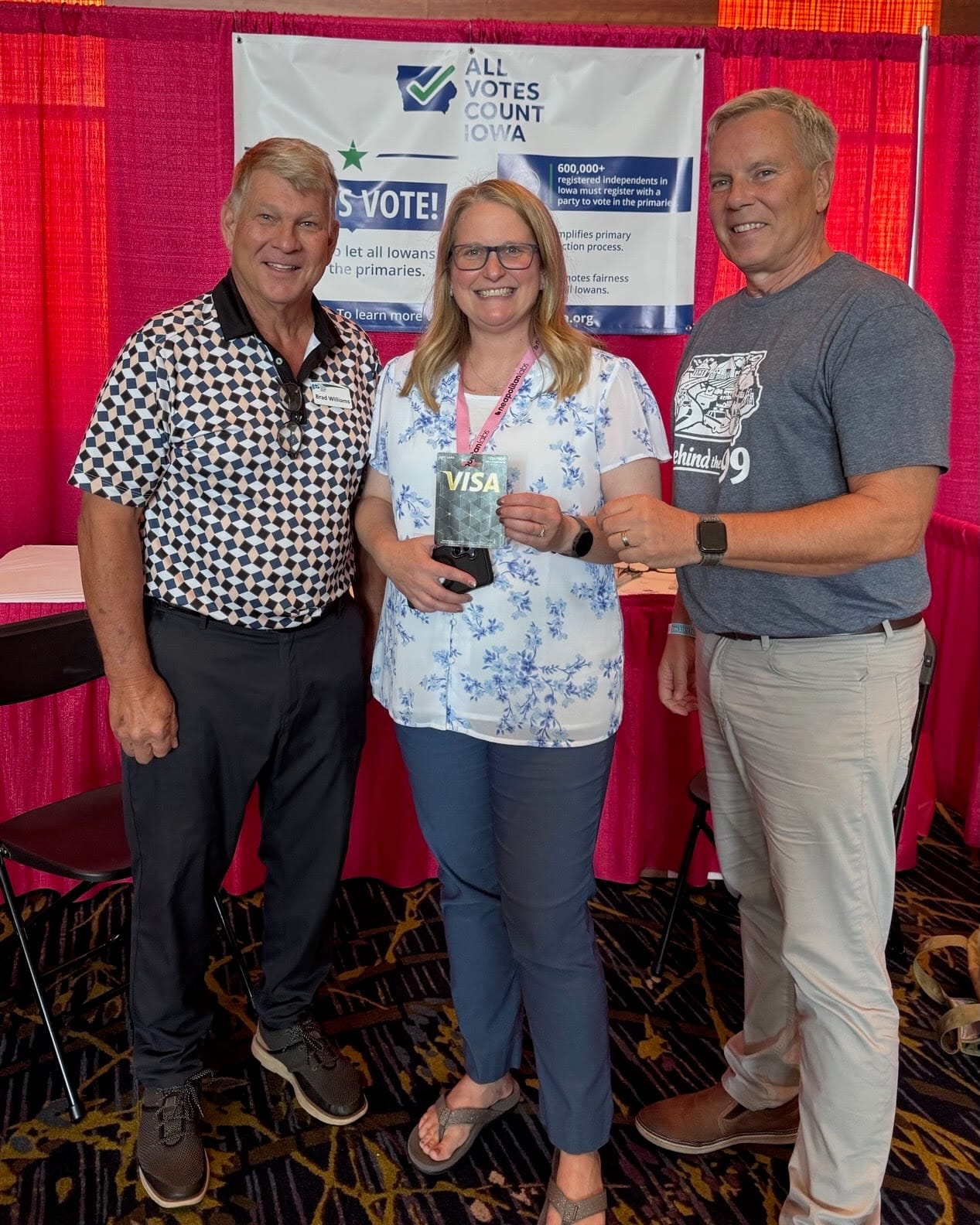
The All Votes Count Iowa team had a booth at the Iowa State Association of Counties annual convention where elected officials meet to promote cooperation and discuss cross county issues.
Tom Synhorst and Brad Williams, co-founders of All Votes Count Iowa, spoke with 125 County Auditors, Recorders, Treasurers, and Supervisors who stopped by the booth. They shared the effort to pass legislation that would give Independent voters full voting rights in Iowa primaries without being forced to join a political party.
The team found broad support from the officials they talked with. They also got important feedback on the cost and administrative challenges for County Auditors under the current, semi-closed primary system in Iowa.
Tom Synhorst noted, “Most of those that visited our booth agree that Iowa’s 600,000+ registered Independents should not face obstacles to voting in taxpayer-funded primaries.”
What We're Reading
Perot 2.0 Is Coming — Without Perot
In 1992, Ross Perot came out of nowhere, won 20 million votes, and terrified the two-party establishment. The parties spent the next three decades making sure it wouldn’t happen again.
They may have failed.
In a new piece, Open Primaries President John Opdycke argues that something much bigger than a single independent candidate is emerging in 2026: a Perot 2.0 movement without a Perot.
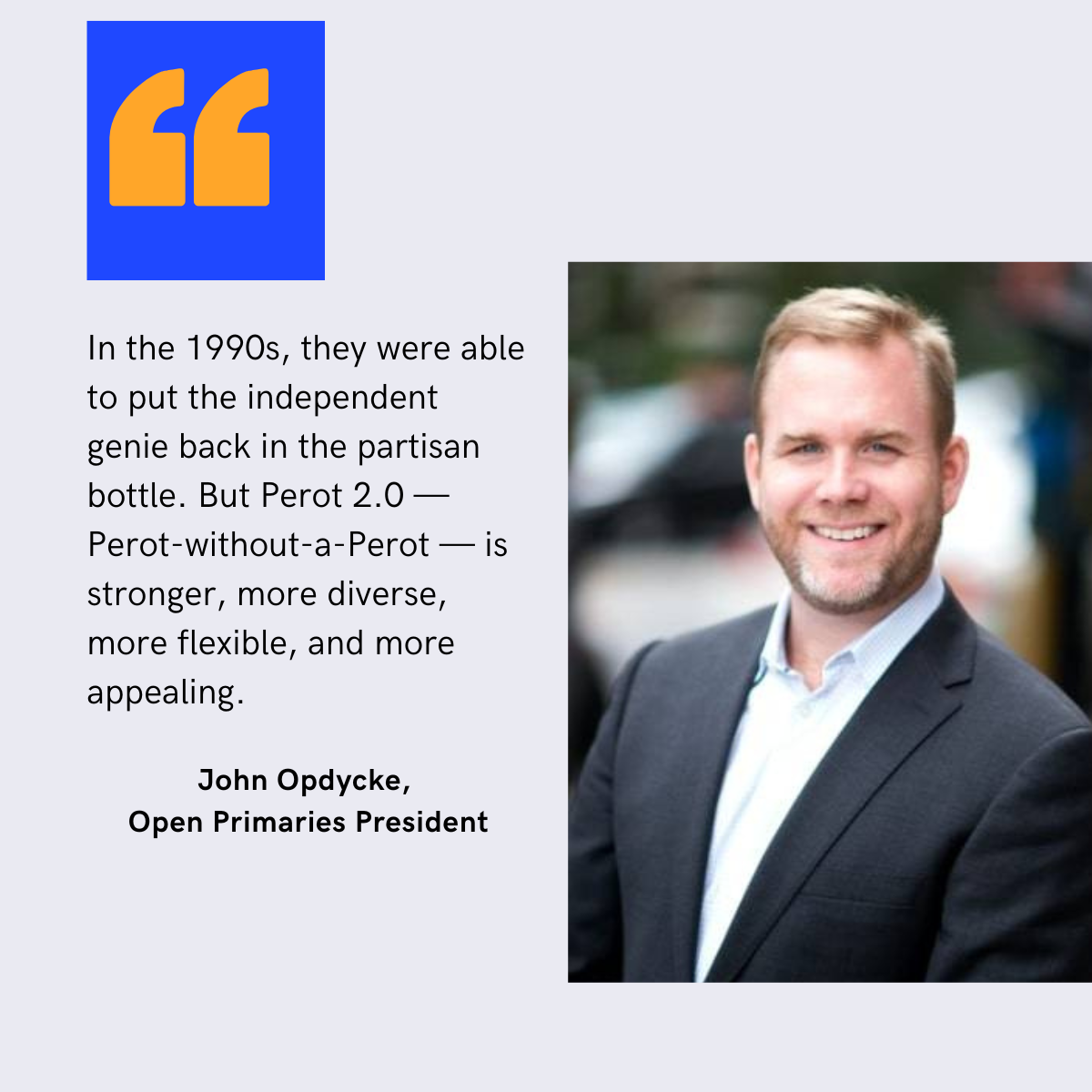
Independent candidates are surging. Independent voters are surging. And across the country, voters are fighting for open primaries, challenging closed-party systems in court, and demanding a political system where competition actually exists.
The genie is out of the bottle. And this time, there may be no putting it back.
Read John Opdycke’s full piece on how 2026 is shaping up to be the year of the independent surge.
Fast Takes
Alabama: Who should pay for a closed ALGOP primary?
Alaska: Alaska’s alternative to extremism.
California: Assembly Democrats Defend Independent Voters' Rights In Top Two Nonpartisan Primary
Florida: Florida’s ‘Phantom Candidates’ Are Back And They’re Still Locking Voters Out
Oklahoma: 500,000 Oklahoma Independents Can Vote on Voter ID Tuesday — But Not for Governor
Pennsylvania: Opening the primaries.
IN OKC AND BEYOND: MAYOR HOLT MAKES THE CASE FOR OPEN PRIMARIES
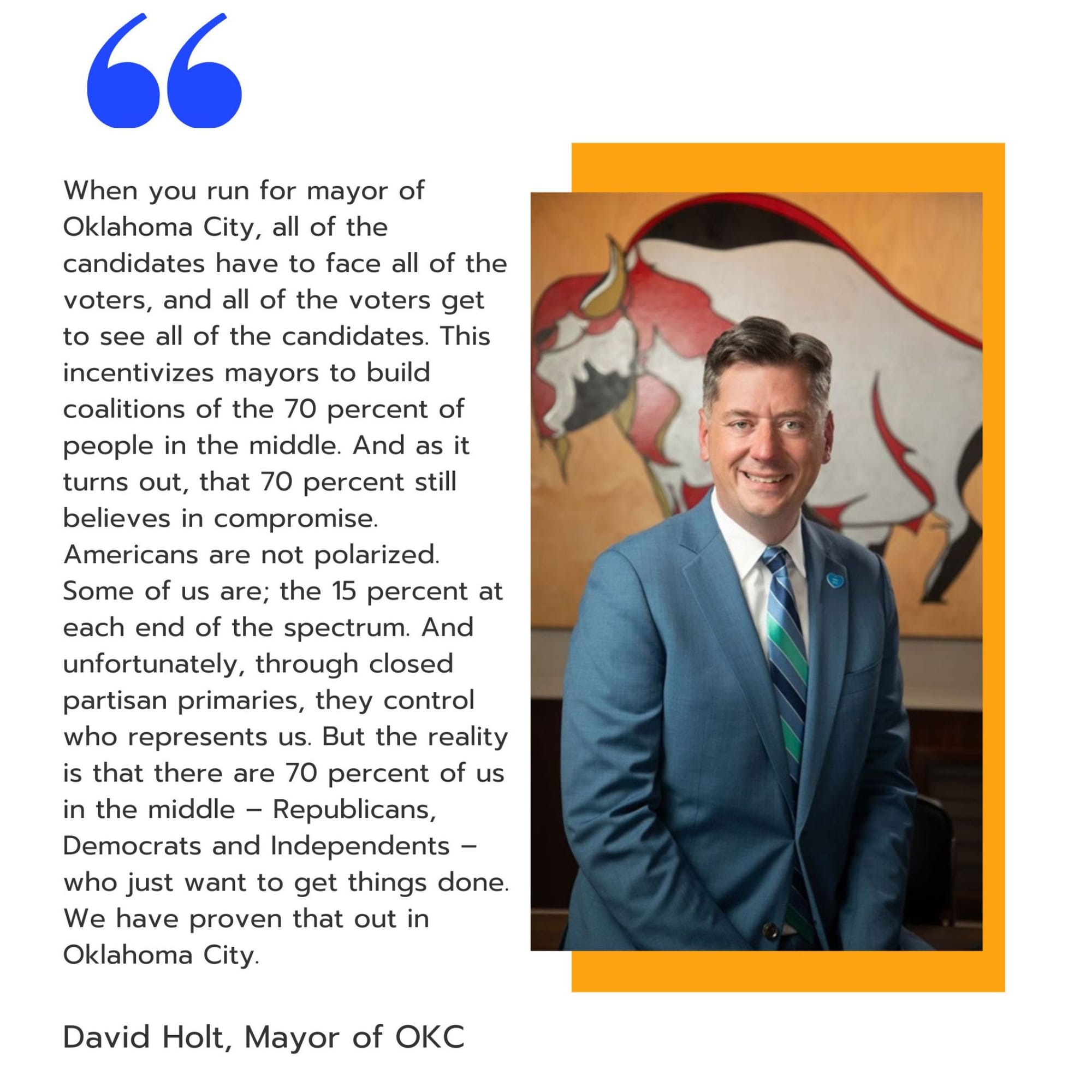
Mayor Holt has been on a tear across the TV talk shows all year, especially after he penned an essay in the NY Times last year crediting his city’s “red state diversity” to its top two primary elections. Watch his interview on CNN:
Then watch him discuss how open, nonpartisan primaries have changed Oklahoma City’s political culture:
And last year, Mayor Holt joined Tulsa Mayor GT Bynum, former Congressman Mickey Edwards, and Open Primaries President John Opdycke on stage to discuss the importance of letting All Voters Vote.
Activities/Events
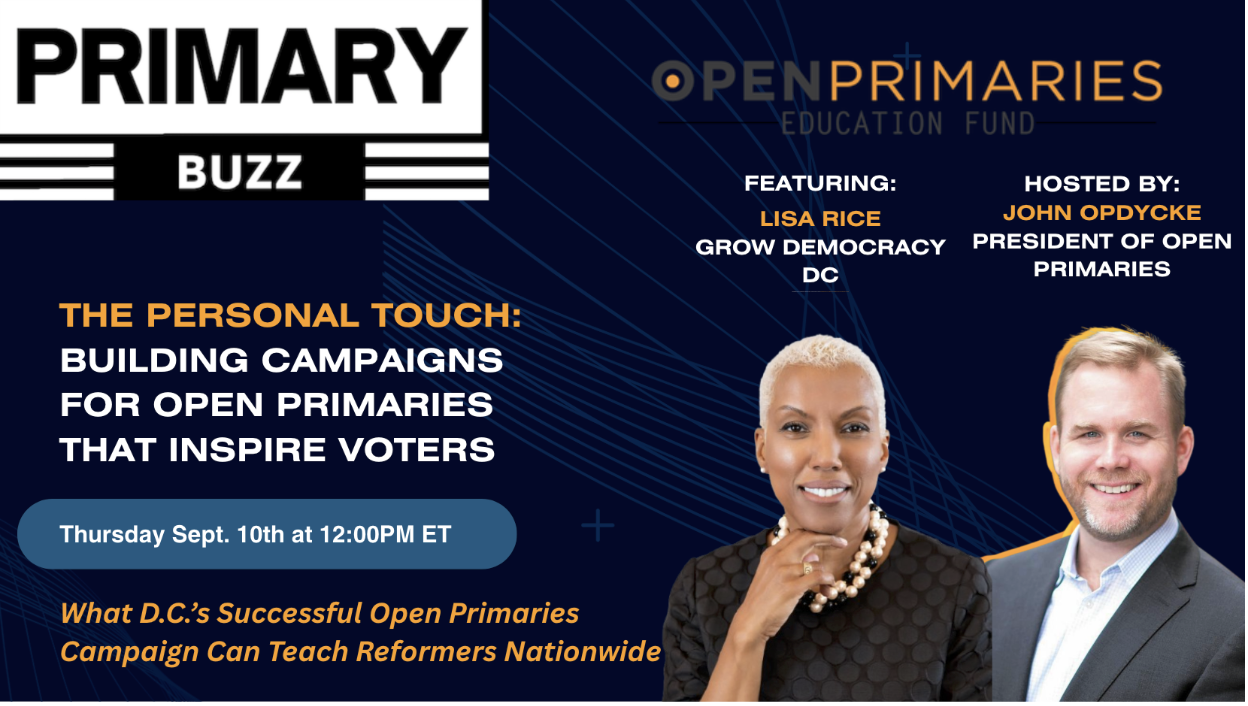
The Personal Touch: Building Campaigns for Open Primaries that Inspire Voters
What D.C.’s Successful Open Primaries Campaign Can Teach Reformers Nationwide
September 10 at 2:00 PM ET. Featuring Lisa Rice, Founder of Grow Democracy DC. Moderated by Open Primaries President John Opdycke
Winning open primaries isn’t about policy. It’s about enfranchising voters who are shut out and building trust that changing the rules creates positive possibility and opportunity. If voters are not inspired, don’t trust campaign leadership, and don’t see a relationship between open voting and improving their lives - who cares what the policy is.
In 2024, 73% of D.C. voters approved Initiative 83, voting to open the city’s taxpayer-funded primary elections and deploy ranked choice voting in the general election. But after the measure passed, ranked choice voting was implemented, and open primaries was shelved by the city council - leaving nearly 100,000 independent voters shut out.
For nearly two years, the will of the voters was blocked. But Lisa Rice, founder of Grow Democracy DC, and her team don’t know how to take no for an answer - thank god!
Please join us for a discussion about how the DC team went to the mattresses and forced the city council to implement open primaries in the nation’s capitol.
Open Primaries President John Opdycke will sit down with Lisa to explore what the D.C. campaign can teach reformers across the country: How do you make structural reform personal? How do you build a coalition that lasts beyond Election Day? And how can campaigns connect with and inspire voters in ways that move political leaders to act?
Join us on September 10 at 2:00 PM ET for a behind-the-scenes conversation about what it takes to turn voter support into lasting political change.