

Ahead of the 2026 midterms, North Carolina Republicans redrew the state's congressional map in hopes of picking up another House seat. With every precinct reporting, the plan appears to have backfired.
By IVN's estimates, had Republicans kept the old map, they likely would have won one more seat than they did.
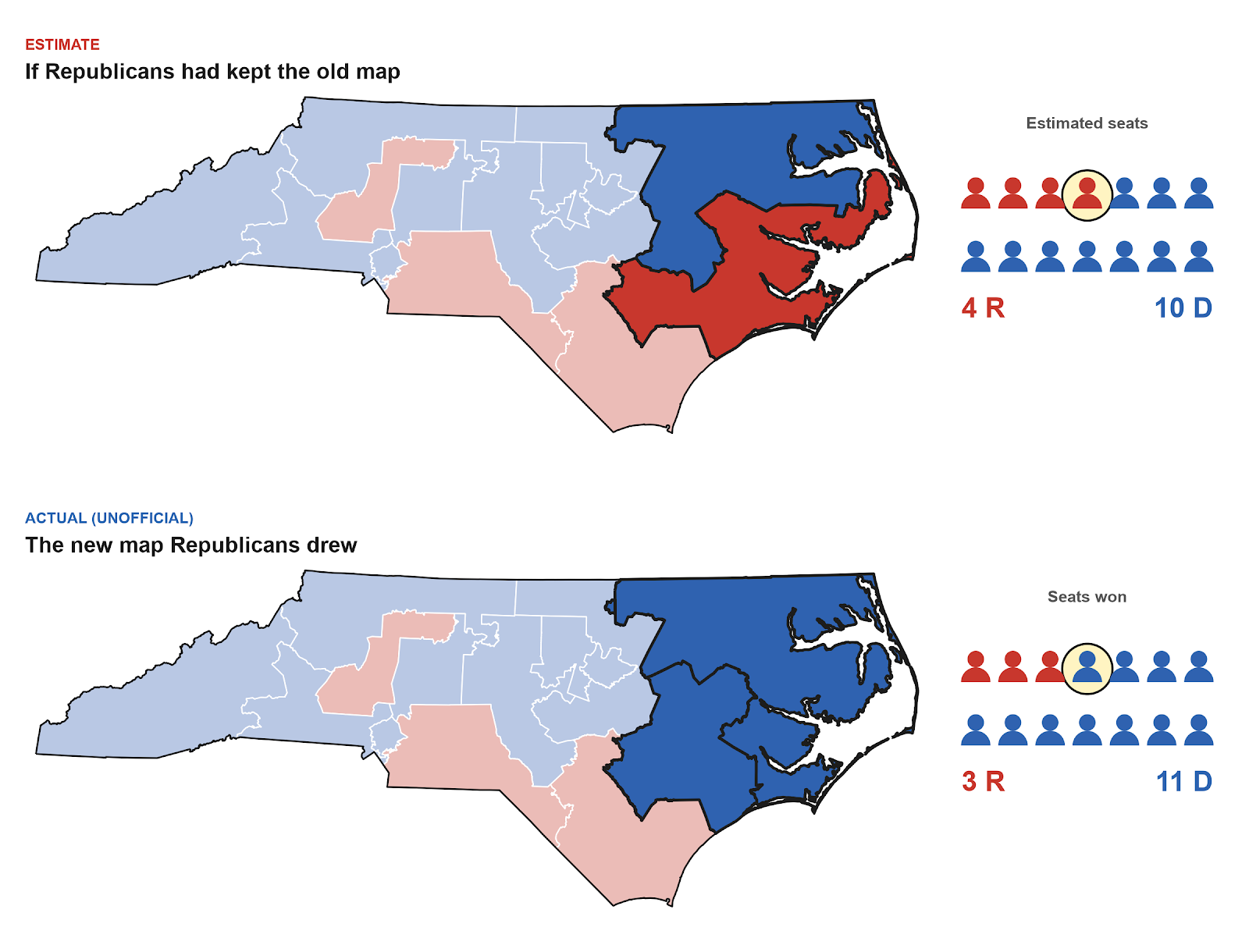
North Carolina’s latest round of redistricting was part of President Donald Trump's nationwide push to shore up the GOP's narrow majority in the US House. It was the thinnest majority either party held in modern history.
It is worth noting that Republicans had already redrawn the state’s congressional map in 2023, transforming an evenly split delegation into a 10-4 Republican majority after the 2024 elections.
However, Republican leaders saw an opportunity to pick up an 11th seat by targeting Democratic US Rep. Don Davis in the state’s 1st Congressional District.
In October 2025, North Carolina became the fourth state that year to move forward with a congressional redraw, joining Texas, California, and Missouri. The goal wasn't hidden from voters. It was a political calculation to protect the party.
"The motivation behind this redraw is simple and singular," state Sen. Ralph Hise said: "draw a new map that will bring an additional Republican seat to the North Carolina congressional delegation."
That is, by definition, a gerrymander.
Gerrymanders work by moving voters around so the other party's supporters are either packed together or spread too thin to win. In this case, six Republican-leaning coastal counties were moved from the 3rd District into the 1st.
They also shifted four inland counties the other way.
In a normal year, that trade might have worked. But 2026 is not a normal year. Democrats won about 58% of the two-party vote in North Carolina's House races, according to unofficial results.
In the targeted 1st District, Democratic Rep. Don Davis held on by 10,794 votes.
Meanwhile, the 3rd District (weakened by giving up those coastal counties) flipped: Democrat Raymond Smith Jr. leads Republican Rep. Greg Murphy by 258 votes.
Under the old lines, IVN estimates shows Murphy would likely have won by about 8 percentage points, or roughly 21,000 votes.
That 258-vote margin is about 0.1% of the votes cast, close enough that North Carolina law lets the trailing candidate request a recount. But a recount is unlikely to change the outcome.
 Shawn Griffiths
A FairVote study of statewide recounts from 2000 to 2023 found they shifted margins by about 0.03% on average, and the few that reversed a result began with margins of 0.06% or less. The results are not final until the state certifies them.
The redraw may still pay off for Republicans in a more ordinary year. By our estimate, it moved the 1st District about 8 points toward Republicans and the 3rd about 8 points toward Democrats, trading one safe Republican seat and one Democratic seat for two competitive ones.
That was a bet that Republicans would have a decent year. In 2026, they lost that bet.
Methods
We used unofficial county-level US House results from the North Carolina State Board of Elections as of Nov. 16, 2026. Using voter-file data from VoterCount.ai, we matched every registered voter to their district on both the old and new maps.
Within each part of a county, we spread the official vote totals across that area's voters, weighting by early voting, past turnout and party registration so that each area matches its official result exactly. We then added those votes back up under the old map to see who would have won.
The 2025 redraw changed only the 1st and 3rd Districts, so the other 12 districts have the same results under both maps. Because the redraw moved whole counties, about 95% of the old-map estimate for the 1st and 3rd is a direct sum of official county totals; the rest is modeled.
The estimate assumes people would have voted the same way under the old lines. It cannot account for how candidates, campaigns or turnout might have differed.