 Shawn Griffiths
SACRAMENTO, Calif.—Republican Assemblymembers Josh Hoover and Natasha Johnson led a press conference Thursday to announce two proposed amendments that get partisan politicians out of the most powerful election roles.
The first amendment was their jointly filed ACA 23 to make the secretary of state a nonpartisan office. The second was SCA 3, which was re-introduced this week by Sen. Roger Niello of Fair Oaks.
SCA 3, which Niello says he has been working on since 2006, would strip the attorney general of the authority to write ballot measure titles and summaries and give it to the nonpartisan Legislative Analyst’s Office.
 Shawn Griffiths
Like the secretary of state, the attorney general is a partisan office. Candidates run partisan campaigns, try to get party endorsements, and always face pressure from party leaders to act in a partisan manner.
Both proposals have the same goal: Take party politics out of the administration of elections. “Combined we believe these reforms will help restore trust in our elections,” Hoover remarked.
“Elections only work if people who vote in them can trust the process, and right now that trust is at an all-time low,” said Johnson. “One thing is very clear: Allowing partisan offices to oversee our elections is a recipe for disaster.”
Her remarks are backed by polling data.
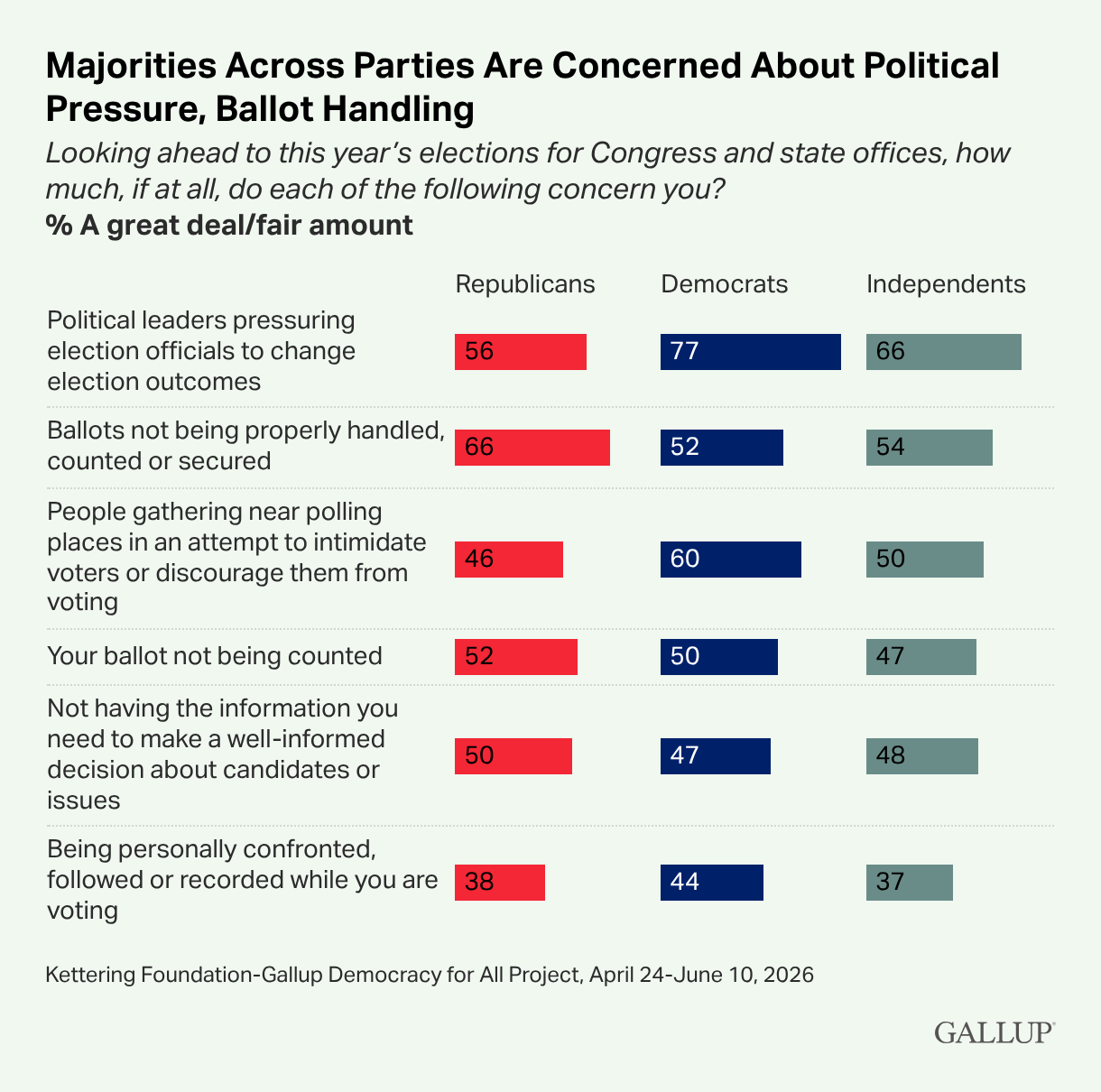
Gallup released new survey numbers in July that found that 67% of US voters were concerned “a great deal” or “a fair amount” that political leaders will try to pressure election administrators to manipulate election outcomes this year.
This includes 66% of independent voters.
As already reported on IVN, ACA 23 would amend the state constitution to add “secretary of state” to the list of elected positions required to be nonpartisan along with judicial, school, county, and city offices.
This means when candidates run for the office, a party designation will not appear next to their name on the ballot, and they cannot be nominated by a party or a party’s central committee.
Adopting ACA 23 would move California in a direction recommended by bipartisan bodies like the Carter-Baker Commission, which noted that the US is one of the only democracies in the world that lets party members run elections.
“The secretary of state oversees our elections, certifies the results, and shapes how ballots get to voters,” Johnson said.
“And yet, that person runs for office with a party label next to their name, nominated by a party, and ultimately—whether they will admit it or not—they answer to that party
SCA 3 would transfer authority to write ballot measure titles and summaries from a partisan executive office to a nonpartisan legislative body. This information is what voters see in state-issued information guides and on the ballot.
How the language of a measure is written can sway a voter and it is not uncommon for voters, campaigns, and stakeholders to accuse the attorney general of trying to influence the outcome of an election with the words they choose.
Just this year, advocates of a statewide voter ID initiative—led by Assemblymember Carl DeMaio of San Diego—sued the attorney general’s office over the title of their initiative, "Prohibits Citizens From Voting Unless They Present Government-Issued Identification."
Niello pointed out that the initial title before DeMaio’s group, Reform California, turned in enough signatures to qualify the proposal for the ballot was, "Establishes Additional Voter Identification and Citizenship Verification Requirements."
The plaintiffs argued that the change was not “impartial” as required by law.
However, Judge Jennifer Rockwell in Sacramento denied their petition, ruling the AG’s materials were accurate and fell within the "considerable latitude" the office gets under state election law.
“This has been a continual abuse of the attorney general putting his or her thumb on voters’ opinions with regard to a biased title and summary statement,” Niello said.
Niello argued that voters need greater trust that the information they are getting is free of party influence.
The press event also included other Republican officials and candidates, like Don Wagner, who will face incumbent Secretary of State Shirley Weber in November and Assemblymember DeMaio.
Both ACA 23 and SCA 3 are state constitutional amendments, which means they need two-thirds of the Assembly and the Senate to clear the legislature. Then, the proposals must be approved by a majority of California voters.