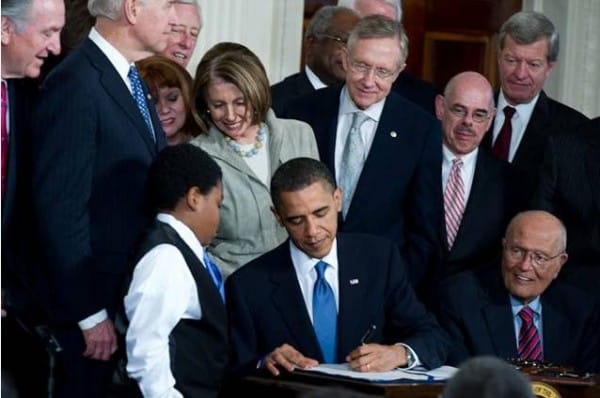
President Obama signs the Affordable Care Act in 2009. Credit: reid.senate.gov
The Affordable Care Act, as upheld by a June Supreme Court decision, will cost $84 billion less than expected due to Medicaid opt-outs, according to the Congressional Budget Office. A recent analysis by the non-partisan CBO found the health care reform law will reduce the national deficit in light of decreased costs.
On the same hand, 3 million fewer people will gain coverage under the Medicaid expansion due to various states opting out of the program.
"For the average person who does not enroll in Medicaid as a result of the Court’s decision and becomes uninsured, federal spending will decline by roughly an estimated $6,000 in 2022," says the CBO report.
This analysis is in review of previous CBO estimates made earlier this year. The reduction in costs totals $84 billion over an 11-year period from 2012 to 2022.
"That reduction occurs mostly because federal spending during that period for Medicaid and CHIP is now projected to be $289 billion less than previously expected, whereas the estimated costs of tax credits and other subsidies for the purchase of health insurance through the exchanges (and related spending) have risen by $210 billion."
Given the revised calculations, the CBO maintains the Affordable Care Act would "on net, reduce deficits." The office found no revision of this estimate necessary following the Supreme Court decision, even with Medicaid opt-outs. CBO analysis has always estimated the health care law would reduce federal deficits.
A repeal of the health care law, on the other hand, was found to increase federal budget deficits by $109 billion from 2013 to 2022.
This finding is undoubtedly a blow to Republican arguments for repealing the Affordable Care Act on the ground that it will negatively effect what is viewed as out-of-control federal deficit spending.
Despite an increase in savings and a positive effect on the national deficit, states forgoing Medicaid expansion will miss out on cutting down mortality levels of low-income Americans.
The New England Journal of Medicine published a study yesterday linking Medicaid expansion to significantly fewer deaths.
"State Medicaid expansions to cover low-income adults were significantly associated with reduced mortality as well as improved coverage, access to care, and self-reported health," says the report.
Medicaid expansion estimates put deaths on a decline by 6.1%, according to the researchers.
These benefits would be lost in states who choose to decline health care reform's Medicaid expansion provisions.