Skip to content
Subscribe

Why the War on Cannabis Refuses to Die: How Boomers and the Yippies Made Weed Political

For much of the eighteenth and nineteenth centuries, American physicians freely prescribed cannabis to treat a wide range of ailments. But by the mid-twentieth century, federal officials were laying the groundwork for a sweeping criminal crackdown. Cannabis would ultimately be classified as a Schedu

Why the War on Cannabis Refuses to Die: How Boomers and the Yippies Made Weed Political
Photo by Rick Proctor on Unsplash
Published:

For much of the eighteenth and nineteenth centuries, American physicians freely prescribed cannabis to treat a wide range of ailments. But by the mid-twentieth century, federal officials were laying the groundwork for a sweeping criminal crackdown. Cannabis would ultimately be classified as a Schedule I substance, placed alongside heroin and LSD, and transformed into a political weapon that shaped American policy for the next six decades.

This seven-part series chronicles the milestones, backlash, and unintended consequences that have shaped the war on cannabis from the 1960s to the present day.
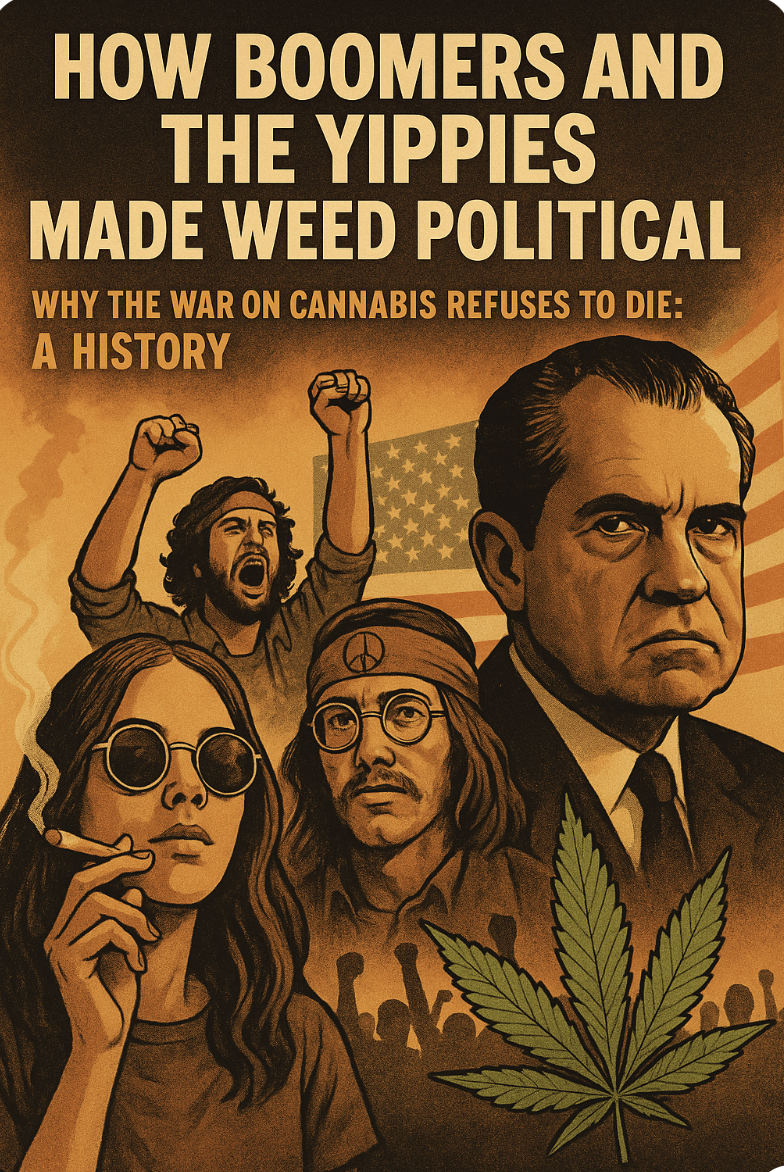
How Boomers and the Yippies Made Weed Political

Part One: How Boomers and the Yippies Made Weed Political

By the late 1960s, cannabis use in the United States was exploding—both in scale and across social boundaries.

Baby boomers, coming of age during a time of war and cultural upheaval, embraced cannabis as a symbol of rebellion and freedom. Sociologists described this generation as the “growing edge” of American life: confident, affluent, and unafraid to challenge the postwar norms of authority, conformity, and restraint.

“Probably the most affluent, confident, indulged crop in human history,” said psychologist and counterculture icon Timothy Leary.

[This] generation of young Americans threw caution to the winds and recklessly rejected the fear-imposed systems that have kept human society surviving—the work ethic, male domination, lifestyle conformity, inhibition of sensuality and self-indulgence, reliance on authority.”

Cannabis arrests surged alongside the cultural shift. In California, possession arrests jumped from 7,560 in 1964 to over 50,000 by 1968. Nationally, federal cannabis seizures increased more than tenfold between 1969 and 1973; hashish seizures rose more than twentyfold.

As the decade wore on, cannabis became increasingly entangled with the politics of protest. Following the assassinations of Rev. Martin Luther King Jr. and Robert F. Kennedy, protests erupted at the 1968 Democratic National Convention in Chicago, bringing cannabis, civil disobedience, and youth resistance together in the national spotlight.

Enter the Yippies.

A self-styled band of anarchists, artists, and dropouts, the Youth International Party was led by Abbie Hoffman and Jerry Rubin, both veterans of the anti-war movement.

Hoffman and Rubin had come to believe that American politics and culture had devolved into a state of abject absurdity…The War in Vietnam was absurd. Consumerism and greed were absurd. The political rhetoric coming from both parties was absurd. And the only way to fight serious absurdity, Hoffman and Rubin decided, was with absurdity itself.”

In 1970, the Yippies organized the country’s first major “smoke-in” in Washington, D.C., drawing a crowd of 25,000.

Their street theater and radical tactics enraged President Richard Nixon, who was actively searching for a wedge issue to galvanize conservative voters and secure reelection.

On June 17, 1971, Nixon delivered a televised address declaring drug abuse “public enemy number one.” It was the beginning of the modern War on Drugs—and the moment cannabis became a national political target.


A Fire Still Burning

The crackdown Nixon launched still burns on, decades after a generation of rebels, protesters, and psychedelic thinkers struck the match.

Read Part Two: Nixon Admitted Weed Wasn’t Dangerous, But Killed It to Crush Political Dissent

Adhere to the IVN etiquette

By posting a comment, you agree to adhere to our etiquette rules: No partisan attacks, no personal attacks, substantiate your sources, no self-promotion.

Contact IVN

Questions about this article or our coverage? Send us a message. A free IVN member account is required.

Message sent

Thanks, we’ll review it and get back to you if needed.

Message not sent

Sorry, something went wrong. Please try again.

Sign in to send a message

Messages are tied to your IVN member account. Signing in is free and takes a few seconds.

Republish this article

Republishing guidelines

Republish IVN articles for free. Independent Voter News articles may be republished online or in print under a Creative Commons BY-NC-ND 4.0 license, on these terms:

  1. Credit the author and IVN. Keep the byline ("By Author Name, Independent Voter News") and the attribution note at the end, which links to the original.
  2. Keep the meaning. You may update time and place references and apply your house style. You may trim for length, as long as the cuts don't change the meaning or misrepresent the author. Keep the headline. Mark any additions as your own (for example "Additional reporting by ...").
  3. Translations are welcome. Translate faithfully, add "Translated from English by [your outlet]", and tell us at editor@ivn.us.
  4. Keep the links, including the link to the original article.
  5. Keep the tracking image. The HTML includes a 1-pixel image that counts readers on your page. It collects no personal information.
  6. Photos and illustrations. Images credited to IVN may be used with this article only. Images credited to others (AP, Getty, Unsplash, Wikimedia and so on) stay under their owners' terms. Secure the rights or switch "Include images" off.
  7. Don't sell it. You can't sell our articles or sell ads specifically against them. Your normal site advertising is fine.
  8. No implied endorsement. Don't suggest that IVN or the author endorses you, your candidates or your causes, or that donations to you support IVN.
  9. Keep labels. Opinion or analysis pieces keep that label.
  10. Point search engines to the original. Where your CMS allows, set the canonical URL to the original IVN article.
  11. No bulk or automated republishing, and don't submit our articles to aggregators (Apple News, Google News, MSN) as your own.
  12. Corrections and removals. Update your copy when we correct it, and remove it promptly if we ask. We'll contact you at the email you give us.
  13. Questions or print republication: editor@ivn.us.

IVN staff: fill in who you're inviting above, then create the invite.

Preparing the article

Why the War on Cannabis Refuses to Die: How Boomers and the Yippies Made Weed Political

Choose a format
  • HTML
  • Email HTML
  • Markdown
  • Formatted (.docx)
  • Plain text
  • WordPress blocks
  • PDF
Choose a platform

Photos credited to others need their owners' permission.

To for

Republishing somewhere else? Questions? editor@ivn.us