Skip to content
Subscribe

Who is Responsible for the National Debt?

Published:

credit: Center for American Progress
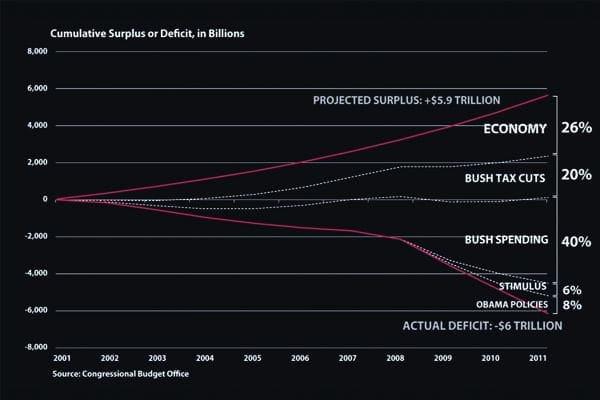
On January 31, 2001 the Congressional Budget Office released an economic outlook report projecting a surplus of $5.9 trillion into 2011.

“In the absence of significant legislative changes and assuming that the economy follows the path described in the report, CBO projects that the total surplus will reach $281 billion in 2001. Such surpluses are projected to rise in the future, approaching $889 billion in 2011 and accumulating to $5.6 trillion over the 2002-2011 period.”

The report went on to conclude that despite indicators that the economy was slowing down, economic shrinkage was destined to be short lived. The CBO projected, given that economic policy remain largely unchanged, GDP would begin to rise at 3 percent per year beginning in 2002. "Assuming that current tax and spending policies are maintained, CBO projects that mounting federal revenues will continue to produce growing budget surpluses for the next 10 years."

A month later, the Bush administration released ‘A Blueprint For New Beginnings.’ The 200-page document outlined the President’s vision for significant reductions in government spending coupled with what would become known as the Bush-era tax cuts. The report criticized the growth in government spending that would be aided by budget surpluses, and expressed a philosophy whereby tax cuts would encourage economic growth.

“[The Bush] tax relief program acts as a near-term insurance policy against an unwanted deepening of the current slowdown and should help growth return more quickly to a robust pace. Tax relief will also help to boost the economy’s underlying rate of long-term growth”

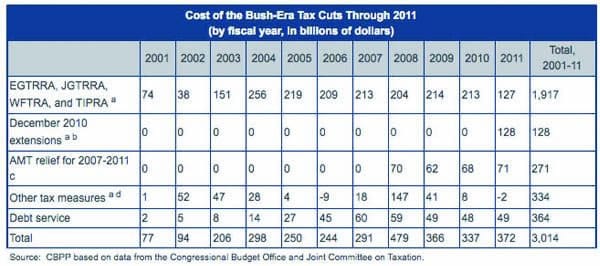
The Center on Budget and Policy Priorities, a research and policy think-tank focused on middle and low income issues, estimates that these tax cuts reduced revenues by almost $2 trillion from 2001-2008. This loss in revenue constitutes about 20% of the United States’ budgetary shortfalls when compared to the original CBO projection from 2001.
The Center for American Progress, a progressive think-tank, has outlined further contributors to this disparity citing data from the Congressional Budget Office. Their report shows that under-performance of the economy from 2001 to 2011 carved out almost 26 percent of projected surpluses. Additionally, the wars in Iraq and Afghanistan and increased spending under Bush comprise about 40 percent of the discrepancy between original projections and present conditions. President Obama’s policies including extending the Bush tax cuts and stimulus spending have contributed 14 percent overall.

In raw terms, since Obama took office, the debt has increased by $5 trillion. A variety of factors have contributed to this, including his extension of the Bush tax cuts in 2010 and continued military involvement overseas.

Slower than anticipated economic growth, coupled with government spending from 2001 onwards, are the primary contributors to today's mounting federal debt. It is possible however, that the Congressional Budget Office was simply wrong in their original assessment, overestimating the impact that policies at the time would have had going into 2011. These figures highlight the extent to which decisions made in the past can dramatically impact future fiscal realities.

Adhere to the IVN etiquette

By posting a comment, you agree to adhere to our etiquette rules: No partisan attacks, no personal attacks, substantiate your sources, no self-promotion.

Contact IVN

Questions about this article or our coverage? Send us a message. A free IVN member account is required.

Message sent

Thanks, we’ll review it and get back to you if needed.

Message not sent

Sorry, something went wrong. Please try again.

Sign in to send a message

Messages are tied to your IVN member account. Signing in is free and takes a few seconds.

Republish this article

Republishing guidelines

Republish IVN articles for free. Independent Voter News articles may be republished online or in print under a Creative Commons BY-NC-ND 4.0 license, on these terms:

  1. Credit the author and IVN. Keep the byline ("By Author Name, Independent Voter News") and the attribution note at the end, which links to the original.
  2. Keep the meaning. You may update time and place references and apply your house style. You may trim for length, as long as the cuts don't change the meaning or misrepresent the author. Keep the headline. Mark any additions as your own (for example "Additional reporting by ...").
  3. Translations are welcome. Translate faithfully, add "Translated from English by [your outlet]", and tell us at editor@ivn.us.
  4. Keep the links, including the link to the original article.
  5. Keep the tracking image. The HTML includes a 1-pixel image that counts readers on your page. It collects no personal information.
  6. Photos and illustrations. Images credited to IVN may be used with this article only. Images credited to others (AP, Getty, Unsplash, Wikimedia and so on) stay under their owners' terms. Secure the rights or switch "Include images" off.
  7. Don't sell it. You can't sell our articles or sell ads specifically against them. Your normal site advertising is fine.
  8. No implied endorsement. Don't suggest that IVN or the author endorses you, your candidates or your causes, or that donations to you support IVN.
  9. Keep labels. Opinion or analysis pieces keep that label.
  10. Point search engines to the original. Where your CMS allows, set the canonical URL to the original IVN article.
  11. No bulk or automated republishing, and don't submit our articles to aggregators (Apple News, Google News, MSN) as your own.
  12. Corrections and removals. Update your copy when we correct it, and remove it promptly if we ask. We'll contact you at the email you give us.
  13. Questions or print republication: editor@ivn.us.

IVN staff: fill in who you're inviting above, then create the invite.

Preparing the article

Who is Responsible for the National Debt?

Choose a format
  • HTML
  • Email HTML
  • Markdown
  • Formatted (.docx)
  • Plain text
  • WordPress blocks
  • PDF
Choose a platform

Photos credited to others need their owners' permission.

To for

Republishing somewhere else? Questions? editor@ivn.us