Skip to content
Subscribe

What Would Get You to Vote?: Incentives for Voting

Published:

Credit: U.S. Coast Guard
The June 5th primary election in California saw a near-record low turnout of voters across the state. Only 31.1% of eligible Californians voted in the election. The dismal numbers are likely to be a preview of what is to come in November.

Why vote anyway? Besides gaining some vague sense of having done your civic duty, is it worth the time and effort? The probability that your vote would determine the outcome of an important election is beyond improbable. So your vote doesn’t really matter, or does it?

Those who religiously turn up to vote in any given election are likely to be on the furthest sides of the political spectrum. Just as the very liberal are bound to be ardent supporters of President Obama at voting stations this November, strict conservatives will file out in droves to make sure he loses. At the same time, those with more moderate views, who make up the majority of the American population, are most likely to skip a trip to the polls.

The problem with leaving voting to the political extremists is that they will vote for politicians who most share their views, thus electing candidates who fail to represent what most Americans deem important.

Many complain that work schedules prevent them from making it to a polling station on election day and changes should be made to make the voting process as easy as possible. Polling places could be open later than 8 p.m., and there could be modernization of the voter registration system so that a person might vote in various locations, but these changes are not predicted to be enough to drastically increase participation.

A recent article by The Atlantic explored ways in which to incentivize the voting process. Norman Ornstein, the article’s author, noted his favorite: to have each voting receipt also be a lottery ticket. With such incentives, there would undoubtedly be a greater turnout come election season.

Ornstein writes how mandated voting laws, like what can be found in Australia today, would never work in the United States due to the aversion Americans have toward being "forced" to doing something.

In Australia, if a citizen fails to turn up at a polling place on election day without a legitimate and written excuse, they are penalized with a $15 fine. Such disincentive would incur outrage in this country. Implementing a creative incentive however, would create buzz around the voting process and get people excited to participate.

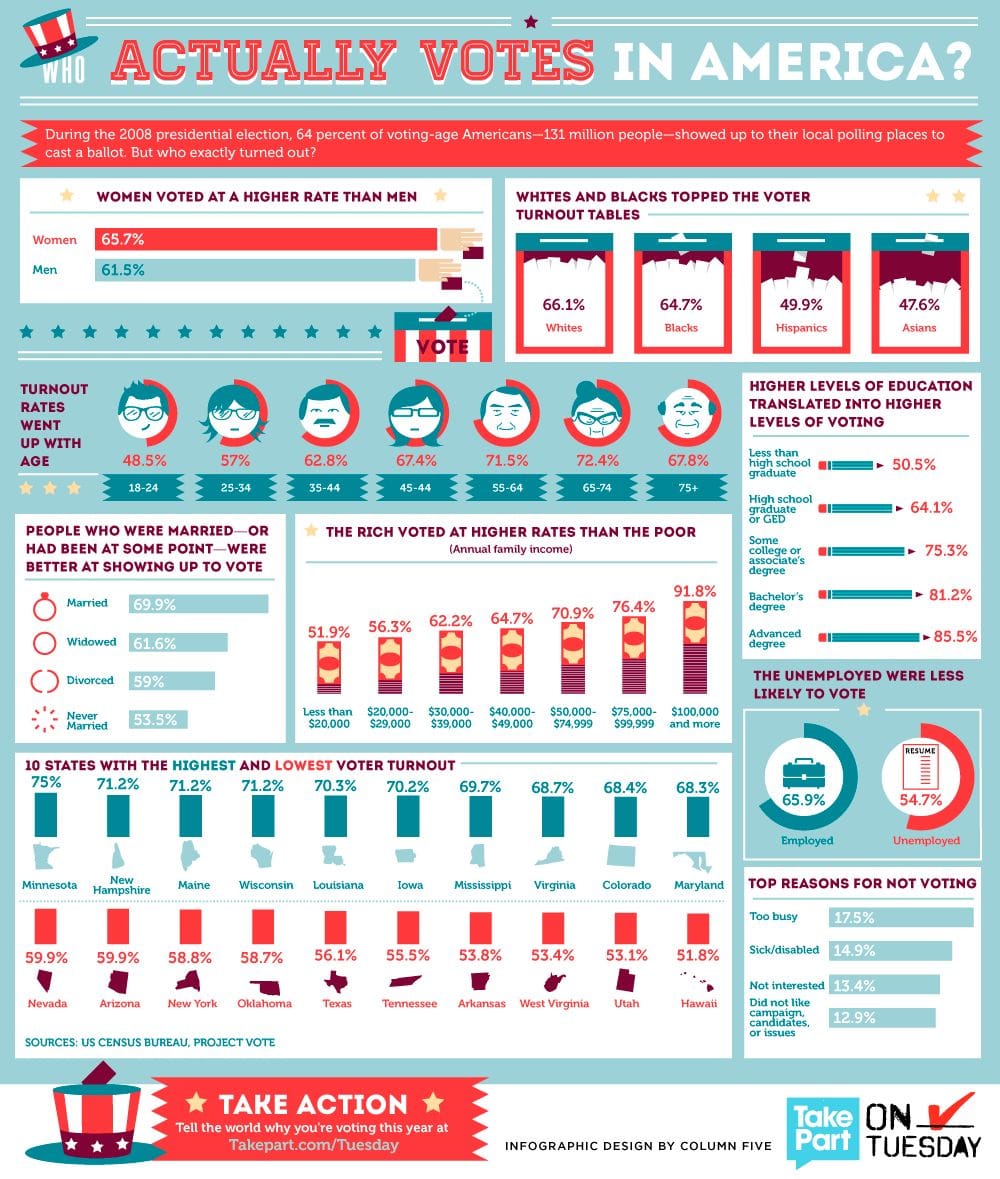
Share your ideas: what do you think would be a good incentive for voting? Credit: whytuesday.tumblr.com
Adhere to the IVN etiquette

By posting a comment, you agree to adhere to our etiquette rules: No partisan attacks, no personal attacks, substantiate your sources, no self-promotion.

Contact IVN

Questions about this article or our coverage? Send us a message. A free IVN member account is required.

Message sent

Thanks, we’ll review it and get back to you if needed.

Message not sent

Sorry, something went wrong. Please try again.

Sign in to send a message

Messages are tied to your IVN member account. Signing in is free and takes a few seconds.

Republish this article

Republishing guidelines

Republish IVN articles for free. Independent Voter News articles may be republished online or in print under a Creative Commons BY-NC-ND 4.0 license, on these terms:

  1. Credit the author and IVN. Keep the byline ("By Author Name, Independent Voter News") and the attribution note at the end, which links to the original.
  2. Keep the meaning. You may update time and place references and apply your house style. You may trim for length, as long as the cuts don't change the meaning or misrepresent the author. Keep the headline. Mark any additions as your own (for example "Additional reporting by ...").
  3. Translations are welcome. Translate faithfully, add "Translated from English by [your outlet]", and tell us at editor@ivn.us.
  4. Keep the links, including the link to the original article.
  5. Keep the tracking image. The HTML includes a 1-pixel image that counts readers on your page. It collects no personal information.
  6. Photos and illustrations. Images credited to IVN may be used with this article only. Images credited to others (AP, Getty, Unsplash, Wikimedia and so on) stay under their owners' terms. Secure the rights or switch "Include images" off.
  7. Don't sell it. You can't sell our articles or sell ads specifically against them. Your normal site advertising is fine.
  8. No implied endorsement. Don't suggest that IVN or the author endorses you, your candidates or your causes, or that donations to you support IVN.
  9. Keep labels. Opinion or analysis pieces keep that label.
  10. Point search engines to the original. Where your CMS allows, set the canonical URL to the original IVN article.
  11. No bulk or automated republishing, and don't submit our articles to aggregators (Apple News, Google News, MSN) as your own.
  12. Corrections and removals. Update your copy when we correct it, and remove it promptly if we ask. We'll contact you at the email you give us.
  13. Questions or print republication: editor@ivn.us.

IVN staff: fill in who you're inviting above, then create the invite.

Preparing the article

What Would Get You to Vote?: Incentives for Voting

Choose a format
  • HTML
  • Email HTML
  • Markdown
  • Formatted (.docx)
  • Plain text
  • WordPress blocks
  • PDF
Choose a platform

Photos credited to others need their owners' permission.

To for

Republishing somewhere else? Questions? editor@ivn.us