 Shawn Griffiths

The head offices of the US Agency for International Development (USAID) were closed Monday after staffers were told by email not to come to work. It is the latest move in the Trump administration's plan to shut down the agency.
USAID's website has also been removed.
Elon Musk, who is the head of President Donald Trump's Department of Government Efficiency (DOGE), announced that he and Trump agreed to shut down USAID after referring to it as a "criminal organization."
Musk has referenced a number of examples of waste and fund mismanagement. He said it was "beyond repair" and it was "time for it to die." The agency's closure would follow Trump's announced freeze on foreign assistance.
Democrats on Capitol Hill have objected to these actions. Sen. Chris Van Hollen of Maryland, for example, called the unilateral move to close USAID and Musk's involvement in it an "abuse of power."
They assert that USAID cannot be abolished without an act of Congress.
It is difficult for voters to escape the political noise and partisan narratives in favor or opposed to the administration's actions. So, what is USAID? And is there evidence of fraud and/or mismanagement within the agency?
What Is USAID?
The United States Agency for International Development (commonly referred to as USAID) is a federal agency responsible for administering humanitarian and other civilian foreign aid and development assistance around the world.
The agency was established in 1961 by President John F. Kennedy. However, there is a bit more to its creation. Kennedy created it by executive order, but under the authority of congressional legislation.
USAID is the result of the Foreign Assistance Act of 1961, which re-organized the government's foreign aid programs and set the foundation for USAID, which Kenney officially created on November 3, 1961, under Executive Order 10973.
The agency's stated mission is to promote global development, humanitarian assistance, and economic growth in countries around the world. Its programs include:
1. Providing aid during natural disasters, conflicts, and health emergencies;
2. Supporting health initiatives for maternal health, infectious diseases, HIV/AIDS, and COVID-19;
3. Strengthening democratic institutions, human rights, and the rule of law;
4. Promoting economic growth initiatives such as job creation, entrepreneurship, and trade partnerships;
5. Improving access to education, particularly for underserved communities; and
6. Addressing climate change and promoting environmental initiatives for conservation and sustainable development.
Prior to Trump's second term, USAID operated in more than 100 countries with a workforce of over 10,000 people. How much total humanitarian aid it provided varied from year-to-year as annual budgets changed.
However, the United States had provided over 40% of total worldwide humanitarian aid.
How Much Money Does the US Spend on USAID?
In Fiscal Year 2023, USAID managed over $40 billion in combined appropriations. This represents more than one-third of the funds provided for the Department of State, Foreign Operations, and Related Programs (SFOPS).
In January, Trump ordered a near-total freeze on all foreign aid -- which now includes the potential shutdown of USAID that was announced by Elon Musk on February 3. The USAID's headquarters are now closed, and its global programs have been halted.
Is There Evidence of Financial Mismanagement or Abuse in USAID?
Elon Musk has been critical of USAID. He accused the agency of mismanagement and funding controversial projects, including alleged gain-of-function research on coronaviruses linked to EcoHealth Alliance.
He has also pointed to agency contracts including a $1.2 million payment to Deloitte for HR services, $600,000 for an International Center for Language Studies, and over $100,000 for “miscellaneous foreign awardees.”
All of this Musk considers wasteful and mismanaged spending.
There have been other instances in which USAID has faced allegations of fund mismanagement. The agency's Office of Inspector General (OIG) previously identified various challenges and vulnerabilities to its operations.
For example, a health project managed by USAID, valued at $10 billion, encountered numerous issues, including inefficiencies and fraud allegations. These problems compromised the delivery of essential medical supplies.
The OIG also highlighted concerns regarding the conversion of program funds from U.S. dollars into other currencies, which posed risks of financial mismanagement.
Further, the OIG identified instances where fraudsters exploited compromised email accounts to deceive USAID employees and partners, resulting in the misdirection of funds intended for aid recipients.
It is worth noting that these vulnerabilities and challenges are not uncommon for large organizations, especially for an agency like USAID, which manages several programs around the world.
However, this also means it is always a legitimate concern. The USAID has responded to these challenges by implementing measures such as suspension and debarment actions to address misconduct.
Is It True That Only 10% of USAID's Funding Goes to People in Need?
Musk has raised several objections to the way USAID spends its funds. He has even suggested that less than 10% of the agency's budget is actually used to help people in need, but there is no hard evidence to support this claim.
Any sources and reports provided by USAID are not easily accessed online as the agency's website has been taken down. However, the Congressional Research Service broke down the agency's obligations in FY2023.
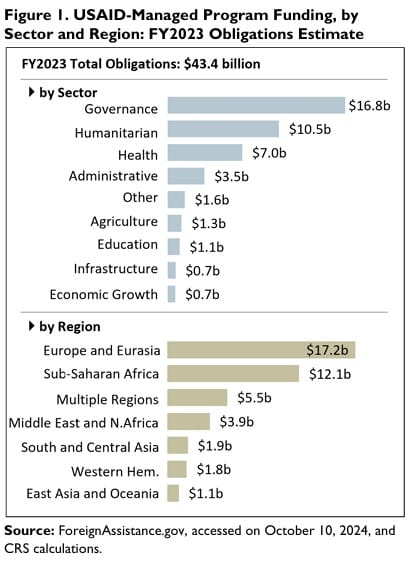
The $10.5 billion in humanitarian assistance includes over $6 billion managed by USAID to respond to crises in places like Sudan, Afghanistan, Haiti, and the Middle East.
While not addressed by Musk, there is a 10% figure associated with USAID's spending. This is the amount the agency has spent on local organizations, but the agency set a goal to increase this percentage to 25% by 2025.
Can The President Legally Dissolve USAID?
USAID was created by executive order, but its creation was due in part to authority granted by Congress. This raises the question over whether or not Trump and DOGE have the authority to completely shut down the agency.
The Foreign Assistance Act of 1961 laid the foundation for USAID. However, Congress later passed the Foreign Affairs Reform and Restructuring Act of 1998, which among other things, designated USAID as its own agency within the Executive Branch.
As it was established by Congress as its own entity, it cannot legally be dissolved, restructured, or abolished without an act of Congress.
There is also the issue of funding that has already been allocated to the agency, an authority that belongs solely to Congress under the US Constitution as the House of Representatives holds the Power of the Purse.
Therefore, reallocation of funding would also require an act of Congress.
The president's authority through executive actions is to recommend changes to the agency or seek, through congressional action, agency restructure or change to funding. Congress may also approve a president's request to abolish an agency like USAID.
Any authority the president doesn't have also includes committees he created, like the Department of Government Efficiency.