 Shawn Griffiths
In a political system that incentivizes division and hyper-partisanship, there isn't much coming out of Washington that can unite voters. But there is one issue that is bringing nearly everyone together:
They think government corruption is everywhere.
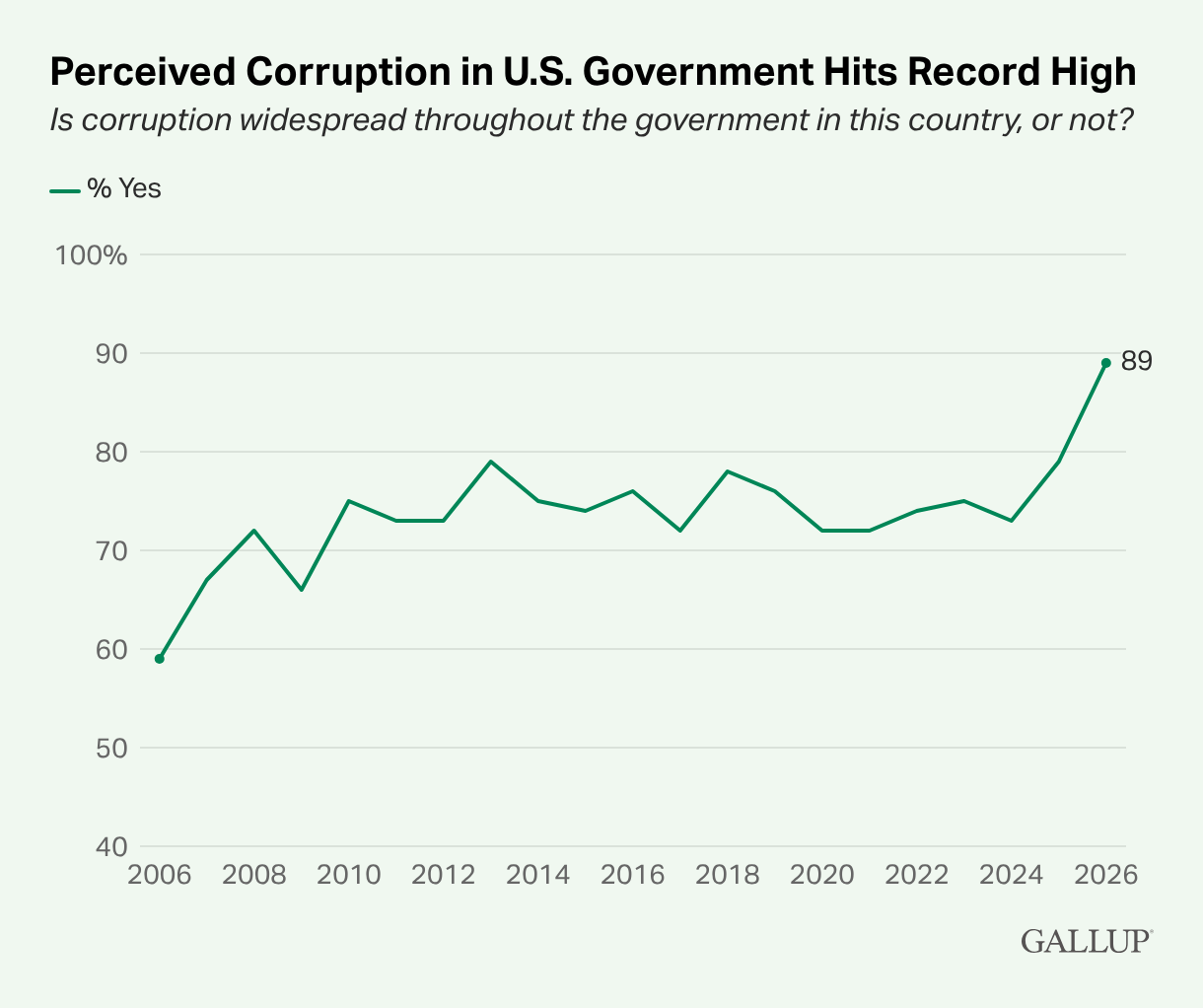
A record-high 89% of Americans believe corruption is widespread throughout the US government, according to Gallup. This is a 10-point jump from just one year ago—the largest single-year increase since 2006-2007.
And independent voters are even more pessimistic.
Gallup found 90% of independents believe corruption is present in every corner of government, up 12 points from 2024. That puts independents roughly in line with Democrats, at 91%, while 83% of Republicans say the same.
Think about that for a second.
It is getting harder and harder to identify 80-20 issues, much less 90-10, but clearly US voters look at what is happening at the federal level and nearly everyone agrees: something stinks.
Notably, Gallup is not making any determination of how much illegal or illicit conduct exists in government. It only records perception. However, perception matters when it comes to democratic legitimacy.
A political system cannot simply assume public confidence when overwhelming numbers of its citizens, both party members and independents, believe the system itself is compromised.
Especially, when the system does not incentivize those in power to change this perception. The number of Americans who believe corruption is widespread in government hasn't dipped below 70% at any point in modern history.
And yet, those in power have done nothing to clean up Washington. In the minds of voters, it is only getting dirtier.
Independent Voters Aren't Just Following the Partisan Tide
Independent voters are an important bloc to examine here because their perception is not influenced by who is in the White House or who has the majority in Congress.
Democratic attitudes toward corruption shifted dramatically after control of the White House changed. Just 57% of Democrats said government corruption was widespread during President Biden's final year in office.
That jumped to 76% during President Trump's first year back in office and now stands at 91%.
Republicans have been more consistent. About 8 in 10 currently see widespread corruption, even with Republicans controlling the White House and Congress.
But the skepticism among independents has persisted, regardless of which party is in power.
Their confidence in the legislative and executive branches, along with the government's ability to handle major problems, has fallen more than 20 points since the 1970s.
That type of decline matters when examining the growth of independent voters.
Gallup reported in January that a record 45% of US adults identified politically as independent in 2025, compared with just 27% each identifying as Republicans or Democrats.
In some states, registered independent voters make up the majority (look at Alaska, Colorado, and Massachusetts.)
Gallup polling alone may not prove that perceived corruption and institutional distrust are two factors in the rise of independents. But the trends are difficult to ignore side by side:
Voters are refusing to join a party at the same time confidence in those parties and institutions controlled by them remains extraordinarily low.
This Isn't Just One Poll
Gallup's corruption numbers fit a much larger pattern. Pew Research Center reported in December that just 17% of Americans trusted the federal government to do what is right always or most of the time.
At the same time, an AP-NORC poll found only 11% of Americans were extremely or very confident that the federal government could make progress on the nation's biggest problems.
Among independents, that number was just 5%.
And Gallup reported in July that average confidence across 14 major American institutions stood at only 27%, a figure that has remained below 30% for five consecutive years.
Twelve of the 14 institutions tracked were at or near their historic lows.
There is a bigger issue here than whether voters approve of Donald Trump, congressional Republicans, Democrats, or any individual politician.
Presidents change. Congressional majorities change. The party voters blame changes.
The distrust doesn't.
When 90% of independent voters believe corruption is widespread, the question for America's political establishment isn't simply how to win their votes in November.
It's why they should trust the system asking for their votes in the first place.