Credit: Mike Foster
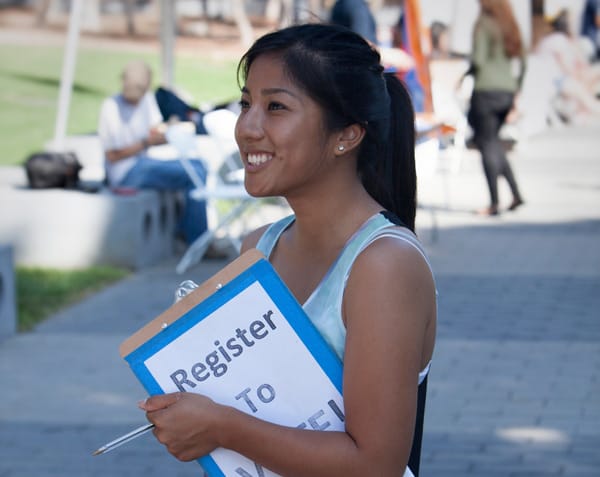
With the 2012 electoral deadlines rapidly approaching, all parties involved are making the final push to register first-time voters. A vast majority of of these voters are entering their freshman semester at respective colleges around the country, and are relatively in the dark regarding the voter registration process. So how does a college freshman, or any first-time voter for that matter, register to take part in the most elementary facet of democracy?
A University of California, San Diego (UCSD) student organization, the Student Organized Voter Action Committee (SOVAC), has heeded that call, and is registering students across their campus before the October 22 deadline.
SOVAC is a non-partisan student organization that is well-known on campus for their voter registration efforts. The UCSD group is a branch of a California-wide organization on all University of California campuses.
To register the incoming students, SOVAC negotiated with five of the six colleges at the University of California at San Diego to become a part of the move-in process. Now, Students registering for housing on campus are directed to register to vote with SOVAC before they even open the door to their new home.
During UCSD's move-in weekend this year, SOVAC registered over 1,500 students. The move-in day effort is a part of a larger project encompassing multiple organizations including: CALPIRG, CA New Americans, and the University of California Student Association. Collectively the organizations expect to register 5,000 new voters on the UCSD campus alone.
According to a Los Angeles Times article by Ethan Rarick, Where did Obama's 'Surge Voters' Go?, two researchers at the University of San Francisco, Corey Cook and David Latterman, looked at voting behavior of first-time voters in California. Cook and Latterman found that 2.1 million Californians voted for the first time in the 2008 election, whom they refer to as "surge voters." The research team further came to the conclusion that the majority of these voters were most likely to function as "decline to state" voters, or associate with Democrats. This was primarily on account of the state's voting record, as well as issues on the ballot - but also due partly to the voters' age group.
This age group may have never voted before, but its varying political convictions could prove decisive in this electoral season. Those running for public office should be aware of this shift, and focus on college-age voters as a key demographic in this election. Although the 1998 Higher Education Act requires universities to make voter registration forms available to students through on-site or online registration, groups like SOVAC are proving to be much more effective.
At Emory University in Atlanta, Georgia, a group called Emory Votes has registered an average of fifteen to twenty students daily since September 17. Also, non-student groups like Rock the Vote and HeadCount, which focuses on younger voters, hold massive celebrity-studded concerts and events where they can register. These events act as a catalyst to galvanize young voters, getting them out en masse, registered and empowered by the opportunity to take part in the process.
Although a July Gallup Poll found that fewer voters ages eighteen to twenty-nine plan to "definitely vote" in 2012 than in 2008, there is still sufficient time to get out on campus, online, or by mail to register to vote. The voter registration groups mentioned prior in this article are a simply a few of many, and they are working to facilitate this crucial aspect of any democratic society. Whether regarding the state of California, or the nation at large, this new crop of voters is increasing exponentially by the day.
With issues on the ballot such as health care/student loan reform, it should be interesting how this demographic of first-time voters turn out in November. Since most of them have never voted along party lines before, the floor is wide open.