Skip to content
Subscribe

Voter ID Laws Weakened in Arizona, Opens Door for More Legal Challenges

Published:

www.ncsl.org

www.ncsl.org

The need for voter ID laws is a contentious and politically driven argument that tends to crop up around election years following the passage of the first voter ID law in Indiana in 2006. Prior to 2006, not a single state had enacted a law that would require a citizen to bring a government-issued photo ID with them in order to vote. The law was upheld by the Supreme Court two years after its passing.

Many states had laws that required voters to provide some form of identification, but narrowing the requirement to a government-issued photo ID made this case different.

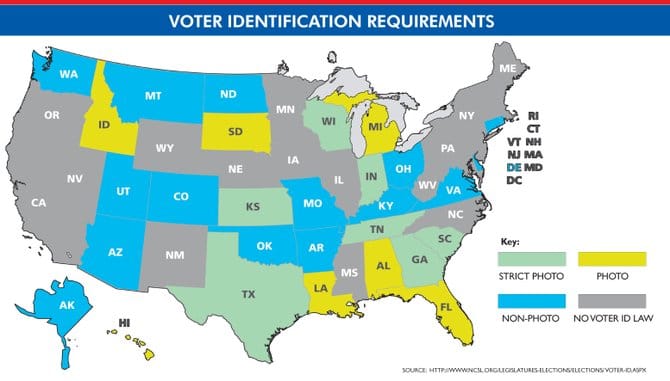
Since its passing, 31 states now have voter ID laws of varying strictness, but many people maintain that these laws restrict the rights of those who would wish to vote and violate the Voting Rights Act of 1965. The Voting Rights Act stands as a check against states seeking to enact restrictive voting laws. Section 5 of the VRA requires states with a history of discrimination to file an appeal with the Department of Justice before the state's legislature can amend its voting laws.

However, despite this check, some would argue that voter ID laws still disenfranchise potential voters.

Voter ID laws impact certain groups more than others. The elderly, youth, and minority groups are all much less likely to have a government-issued photo ID available and therefore are less likely to vote.

This is a problem for two reasons: It means a less diverse voting population during election years and an increased financial burden which some would view as a poll tax. The idea of these laws creating a poll tax is not a new one and has been used many times over the last ten years in the effort to fight voter ID laws.

Last week, the Supreme Court ruled against a voter ID law in Arizona requiring voters to provide proof of citizenship on top of their standard voter ID. As brought forward by the majority statement, the law placed a more arduous restriction on the right to vote instead of allowing Arizona citizens to simply use the federal form that provided proof of citizenship. The ruling effectively gives voters in Arizona two means of registering to vote: the state system with its many requirements and the less strenuous federal system.

What this ruling means for voter ID laws as a whole still remains to be seen. The context of these laws is important when considering future litigation against them.

While the ruling means voters in Arizona will have an easier time registering to vote, it does not make a greater statement about the condition of the 30 other states which still have similar laws. The legal precedent set by this case is states cannot produce laws that place undue restrictions on voter registration beyond what is expected of voters through the federal process.

This can leave the door open for similar appeals against strict voter ID laws in other states, but the process will be slow.

Adhere to the IVN etiquette

By posting a comment, you agree to adhere to our etiquette rules: No partisan attacks, no personal attacks, substantiate your sources, no self-promotion.

Contact IVN

Questions about this article or our coverage? Send us a message. A free IVN member account is required.

Message sent

Thanks, we’ll review it and get back to you if needed.

Message not sent

Sorry, something went wrong. Please try again.

Sign in to send a message

Messages are tied to your IVN member account. Signing in is free and takes a few seconds.

Republish this article

Republishing guidelines

Republish IVN articles for free. Independent Voter News articles may be republished online or in print under a Creative Commons BY-NC-ND 4.0 license, on these terms:

  1. Credit the author and IVN. Keep the byline ("By Author Name, Independent Voter News") and the attribution note at the end, which links to the original.
  2. Keep the meaning. You may update time and place references and apply your house style. You may trim for length, as long as the cuts don't change the meaning or misrepresent the author. Keep the headline. Mark any additions as your own (for example "Additional reporting by ...").
  3. Translations are welcome. Translate faithfully, add "Translated from English by [your outlet]", and tell us at editor@ivn.us.
  4. Keep the links, including the link to the original article.
  5. Keep the tracking image. The HTML includes a 1-pixel image that counts readers on your page. It collects no personal information.
  6. Photos and illustrations. Images credited to IVN may be used with this article only. Images credited to others (AP, Getty, Unsplash, Wikimedia and so on) stay under their owners' terms. Secure the rights or switch "Include images" off.
  7. Don't sell it. You can't sell our articles or sell ads specifically against them. Your normal site advertising is fine.
  8. No implied endorsement. Don't suggest that IVN or the author endorses you, your candidates or your causes, or that donations to you support IVN.
  9. Keep labels. Opinion or analysis pieces keep that label.
  10. Point search engines to the original. Where your CMS allows, set the canonical URL to the original IVN article.
  11. No bulk or automated republishing, and don't submit our articles to aggregators (Apple News, Google News, MSN) as your own.
  12. Corrections and removals. Update your copy when we correct it, and remove it promptly if we ask. We'll contact you at the email you give us.
  13. Questions or print republication: editor@ivn.us.

IVN staff: fill in who you're inviting above, then create the invite.

Preparing the article

Voter ID Laws Weakened in Arizona, Opens Door for More Legal Challenges

Choose a format
  • HTML
  • Email HTML
  • Markdown
  • Formatted (.docx)
  • Plain text
  • WordPress blocks
  • PDF
Choose a platform

Photos credited to others need their owners' permission.

To for

Republishing somewhere else? Questions? editor@ivn.us