

Photo Credit: Brent Moore / Flickr
Tennessee technically has open primaries in which party registration is not required to participate. However, it would be hard to tell under current state law.
In 2023, state lawmakers passed a law that made it a criminal offense to vote in a party's primary if a voter is not a ""bona fide" member of that party.
The thing is, there is no clear legal definition to what "bona fide" means or who exactly determines it or under what circumstances is challenging a vote appropriate.
Instead, when Tennessee voters went to the polls on primary election day this year, they saw this:
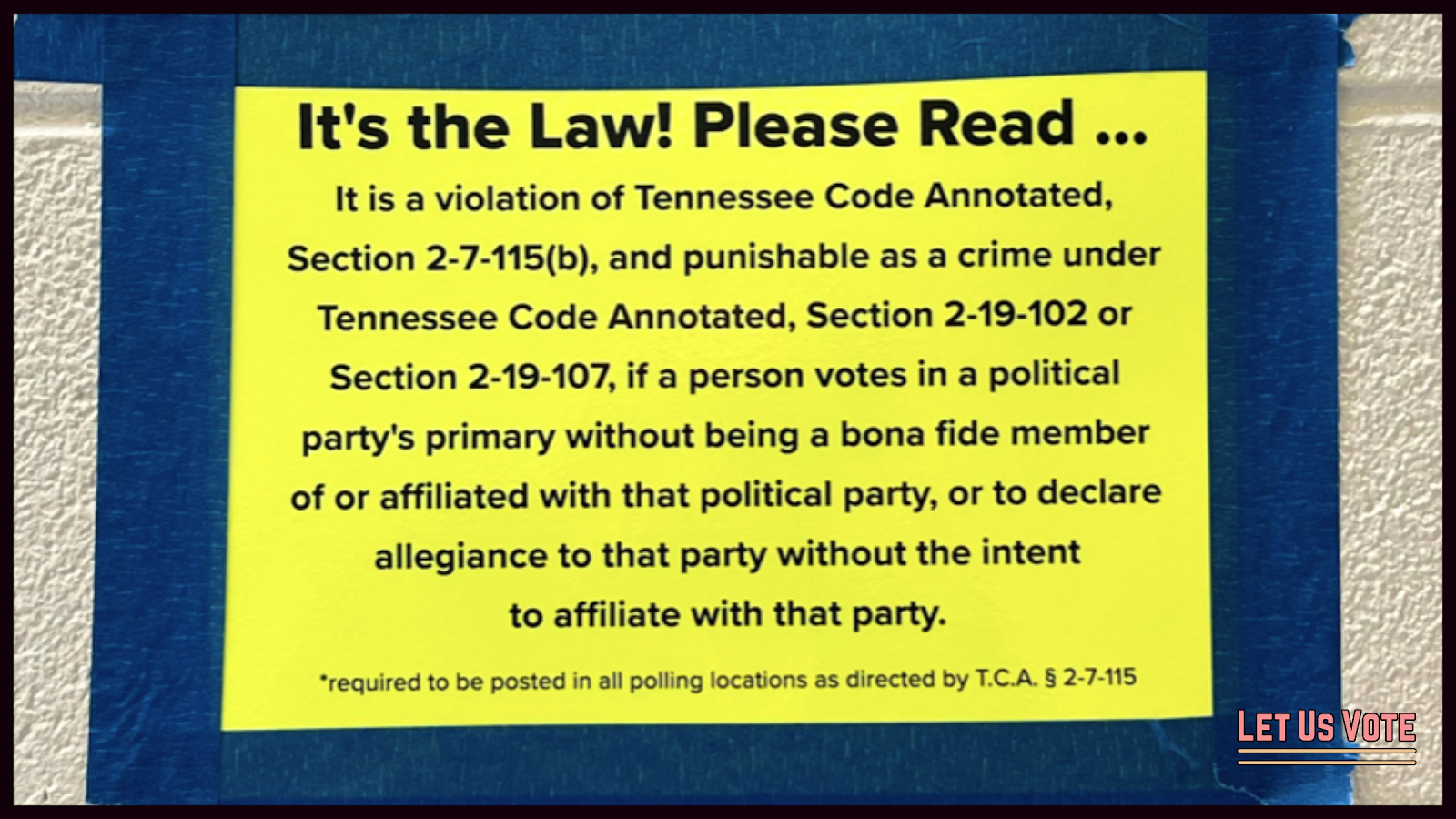
It is a form of voter intimidation tacked onto a system that already leaves many independent voters feeling voiceless and powerless.
Chloe Akers, Founder and CEO of The Best Tennessee, joined Open Primaries President John Opdycke in a recent virtual discussion to talk about the challenges independent voters face in Tennessee.
The conversation was a part of Open Primaries' ongoing series, The Primary Buzz.
"We don't have an amplification problem [in Tennessee]. We have an accountability problem," Akers said. "How can the middle majority of Tennesseans hold lawmakers accountable?"
She added that this was ultimately what led to the creation of The Best Tennessee, mobilizes independent voters and educates them on the importance of voting in primary elections.
Especially since primary elections are the most consequential elections in Tennessee.
"The general elections in Tennessee are largely uncompetitive," Akers said. "This is not a feeling. This is not a sentiment. This is data driven."
She explained that over the last decade the composition of the state House has changed by two seats. In that same time, the state Senate has only changed by one seat.
The elections that have the most impact on holding lawmakers accountable are the primaries, which is the case in every state in the US.
However, Akers said that on average less than 22% of voters participate in primary elections -- meaning even less of the eligible electorate decide the outcome.
"What we have in this state is a super minority electing a super majority of our representatives," she said.
And when a super minority elects most public officials, the incentive is to appeal and govern for the minority, not the electorate at-large.
During the virtual conversation, Akers discussed her group's comprehensive approach to shifting the incentives by turning out independent voters in the primaries.
Not all the data points are available from the August 1 primaries. However, Akers said her group can point to success stories after one primary cycle.
Even as they have to contend with partisan laws to suppress the independent vote.
"One of the challenging elements in Tennessee is we are technically an open primary -- but not entirely," she explained.
"Technically what our laws say is not that you can vote in the primary for any party you feel like in any given time," she added.
"What the law says is you are allowed to vote in the primary for the party that you are either a 'bona fide' member of or affiliated with at the time you go to vote."
The law does not define what "bona fide" means, thus when people see signs that say they could be charged with a crime for voting, it is confusing and intimidating.
Akers said:
"One of the things we are attempting to do that is very hard is explain that to the extent that it has acted as a barrier" to "getting people involved in the primary."
She added that her organization is helping people overcome the confusion and navigate the system but will also watch the legislature for efforts to outright close the primaries.
Check out the full conversation above.