Photo credit: Jeff Haynes
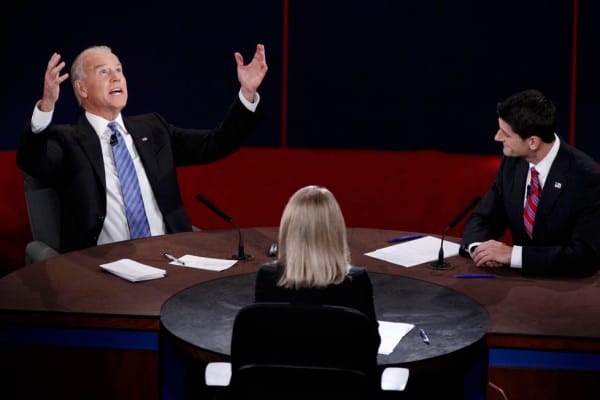
The vice presidential debate was regarded as being better on facts and more substantive than the first presidential debate, but followed much of the same narrative that President Obama and challenger Mitt Romney discussed the week previous. It was also akin to the presidential debate in the sense that facts remain obscured under an avalanche of partisan rhetoric and misleading figures. Last week's vice presidential debate fact check holds few surprises and it seems we can expect much of the same rhetoric in this week's presidential debate.
As was central to the presidential debate, the economy, healthcare, taxes, and the auto industry played central roles in the dialogue between Vice President Biden and his challenger Congressman Ryan. The Vice President appeared eager, perhaps too much so, to make up for the poorly received debate performance of his running mate in the previous week, while Paul Ryan kept up the steady assault on the policies of the Obama administration. Both participants were guilty of inaccuracies during the debate, and were happy to point out when their opponent was guilty of this.
On the topic of the Affordable Care Act (Obamacare) Paul Ryan can be quoted as saying, "Look at all the string of broken promises. If you like your health-care plan, you can keep it. Try telling that to the 20 million people who are projected to lose their health insurance if Obamacare goes through." Paul Ryan's number is accurate but is ultimately misleading. He is referring to a study done by the Congressional Budget Office in regards to the effects of the bill going into motion at the start of next year. While the 20 million number was taken from the study, it is also the worst possible case. When the CBO delivers reports, they often provide several different predictions, a baseline or the most likely outcome, a worst case, and sometimes a best case. The baseline estimate in the report says that 3 million Americans will not be able to keep the insurance that they want because a provision in the Affordable Care Act. While this is still not a small number, it is also a far cry from the 20 million number that Paul Ryan is using. The quote is ultimately misleading.
While still on the topic of the Affordable Care Act, Ryan said, "They got caught with this hands in the cookie jar, turning Medicare into a piggybank for Obamacare." This statement is in reference to the reduction in Medicare spending to the tune of $716 billion that will take place over a ten year period in an effort to help fund the act itself. His running mate Mitt Romney has also repeatedly made this claim, implying that the reduction in spending will be made directly to the budget of the program and in payouts to current beneficiaries. Politifact has previously rated this claim as only half true. While it is true that there has been a $716 billion cut to the Medicare program as a result of Obamacare, the idea that this will impact benificiaries directly is false. The cuts are aimed at reducing wasteful spending in hospitals and insurance companies by scaling back payments. In the sense that Paul Ryan is referring to budget cuts, his claim is false.
On the topic of the auto industry and in reference to the fact that the bailout of it was successful, the Vice President said, "Romney said, 'No, let Detroit go bankrupt.'" This quote has been used for the duration of the campaign by both the President and the Vice President in an attempt to attack Mitt Romney's judgement on the issue. As is often the case, the full story is much more complex than the short quote. What Biden is referring to is an Op-ed that Mitt Romney wrote for the New York Times in 2008 titled "Let Detroit Go Bankrupt". While that might sound damning, it comes with the caveat that he did not choose the title for the article, and further that what he called for was not a simple bankruptcy. What Mitt Romney was advocating for was a managed bankruptcy in which companies are able to relieve themselves from their debts, scale down production but ultimately emerge a much leaner but still functioning company. Biden is also exaggerating the role of the Obama administration in rescuing the auto industry- it was President Bush who was responsible for the first auto industry bailout.
When comparing the Obama tax plan to the proposals put forward by Mitt Romney and Paul Ryan, Biden said, "The middle class will pay less, and people making a million dollars or more will begin to contribute slightly more." This statement is only part true. The Obama tax plan has long since included a provision that he wished to permanently end the Bush era tax cuts. If these cuts were to expire, couples making more than $250,000 per year, and individuals who took in more than $200,000 per year would see their federal tax rate increase back to previous levels.
Mitt Romney and Paul Ryan have both very openly opposed the stimulus that the Obama administration approved at the start of the presidency, and had this to say in respect to it during the debate: "Was it a good idea to spend taxpayer dollars on electric cars in Finland or on windmills in China?" Ryan said this in response to Biden's claim that not only was the stimulus a good idea, but was exactly what the economy needed in order to stop from "going off the cliff". The claim that stimulus money went to outside sources that conferred no benefit on American industry is grossly oversimplified and mostly false as rated by Politifact.
The idea that stimulus money was used to build electric cars in Finland is in reference to $528 million in loan guarantees made by the U.S. Energy Administration. The point of contention here is that the money given to the company was first of all, not stimulus money, and second of all, meant to be paid back. That aside, the engineering work for the design of the electric cars to be produced was done in the United States. The money trail for the claim that stimulus money was sent to companies in China to produce windmills is much less clear. Money was confirmed to be used for windmills that were produced in China, but none of the wind farms that were funded by the stimulus use windmills that were entirely produced in China, and it is also clear that the amount of money given to American industry and workers vastly outstrips that spent abroad.
In regards to accuracy, it would appear that the vice presidential debate was no better than the previous week's presidential debate, and until our political debates evolve in such a way that moderators and fact checkers can hold candidates accountable in real time, it is likely that this week viewers can expect much of the same.