Photo: eutimes.net
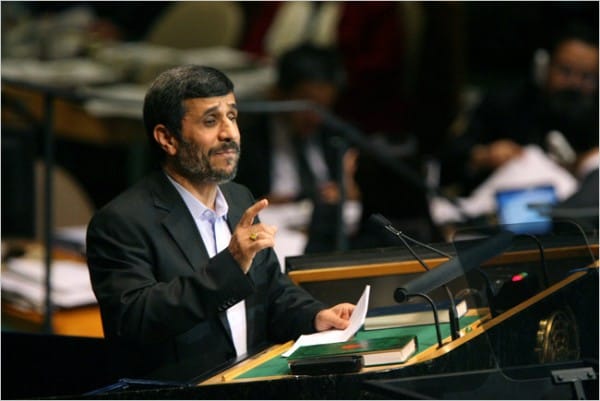
As Iran hosts the Nonaligned Movement Conference this week, the Middle Eastern country has shown the international community that it will not bow easily to antagonistic pressure as it gathers countries from all over the world to its capital.
With such an unstable, vocal, and armed government, US policy on Iran often falls into the foreign policy dialogue of both President Obama and presidential hopeful Mitt Romney on the campaign trail.
Presently, US policy on Iran walks a careful line between deterring nuclear breakout capability while not turning the new bubble of free-thinking youth in the Islamic Republic further against the West. This is not easy, as the leadership of Iran has continually pushed on through sanctions, IAEA inspections, and international condemnation.
While both candidates are hesitant to make any commitment to a violent halting of Iranian nuclear capabilities, it is clear that an armed conflict is a viable option alongside tougher sanctions.
It is easy to believe that an actual military strike would be the strongest option to deter Iran, however, an attack will further isolate an already solitary country, and push the younger population behind hard line principles.
In the current regime of Iran, the Supreme Leader has ultimate power over policy. However, to control the actions of all factions and power centers requires a large amount of power and credibility that Iran's government does not possess. Its economy is in shambles and its conventional military is asymmetrical.
The Revolutionary Guards are the main force for keeping order and power in the hands of the Supreme Leader. They are effective at keeping the Ayatollah in power, but this does not help stop public support for other dissenting factions that are more moderate and US friendly. A direct attack on Iran would surely change all of this. The Western boogeyman that so many hardliners point to would become manifest to the Iranian population.
Iran's reasons for wanting nuclear breakout capacity are the same on both popular and leadership levels, namely to be protected in a volatile and isolating region. The difference is that at the popular level, which is filled with a generation that does not remember the Iran-Iraq war, younger Iranians do not feel the imminence of an attack on their soil. A US attack would quickly and irreversibly alter this dynamic, and give the younger generation a tangible enemy to fear and remember, not just a rhetorical talking point.
With this unification of popular opinion, hardliners, and the Ayatollah, policy could change much faster and more dramatically without alienating various disparate factions that were formerly not marching in lockstep with Iran's central government. This would mean an Iran more willing to act outside its borders and pursue a foreign policy of conflict and aggression.