Skip to content
Subscribe

US Military Intervening in Guatemala Drug War

Published:

Guatemala - Mexico border. Credit: Google Maps
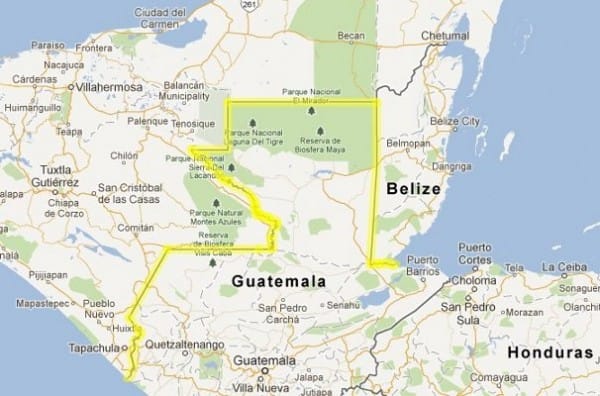
In a major escalation of the war against drug cartels, US Marines are now involved in the Guatemala drug war, aiming to stop drug shipments by airplane and boat. About 200 Marines are there with the express permission of the Guatemala government. However, some question whether our Constitution permits such an agreement.

In mid-July, the Guatemalan government signed what news reports and officials described as a “treaty” with the Obama administration — the U.S. Senate, however, never ratified any such agreement as required under the Constitution. Within a month of the controversial deal, U.S. Marines, equipment, and military helicopters began arriving in Guatemala.

The Marines cannot use weapons except in self-defense in the Guatemala drug war. Instead, they patrol primarily in helicopters, looking for potential drug smuggling, and then notify Guatemala military or law enforcement of anything suspicious. Nevertheless, war is murky, mission creep is always possible, and this is a new type of war. The US is attempting to defeat powerful transnational drug cartels and their allies. The enemy here is not a rebel force that wears uniforms nor are they located in just one country.

The US is targeting the Los Zetas drug cartel in Guatemala. The Zetas are based in Mexico where they are currently fighting the Sinaloa Cartel for dominance. The US government says the Zetas are the "most technologically advanced, sophisticated, and dangerous cartel operating in Mexico." Los Zetas began when several elite members of the Mexican military, some of whom received Special Forces training in the US, went rogue and became enforcers for the Gulf Cartel. They later split with the Gulf Cartel and formed Los Zetas.

The Zetas have a well-deserved reputation for extreme violence, which includes beheadings, torture, and mass slaughter. The Sinaloa Cartel, some say, prefers to corrupt with an implied threat ("our silver or our lead") while Los Zetas simply terrorize. The Zetas have camps where they train new recruits and possess powerful weapons, including anti-tank weapons, grenade launchers, and large machine guns. They have fought battles that lasted hours against law enforcement in Mexico. Given their huge profits from drug trafficking, human smuggling, and kidnapping, they can afford expensive weapons.

All of this suggests that US plans to eliminate Los Zetas drug smuggling in Guatemala will not be easy nor simple - and perhaps not even bloodless. Sophisticated transnational criminal cartels possessing seemingly unlimited amounts of money are a new phenomenon, especially since they also have characteristics of being insurgencies.

Adhere to the IVN etiquette

By posting a comment, you agree to adhere to our etiquette rules: No partisan attacks, no personal attacks, substantiate your sources, no self-promotion.

Contact IVN

Questions about this article or our coverage? Send us a message. A free IVN member account is required.

Message sent

Thanks, we’ll review it and get back to you if needed.

Message not sent

Sorry, something went wrong. Please try again.

Sign in to send a message

Messages are tied to your IVN member account. Signing in is free and takes a few seconds.

Republish this article

Republishing guidelines

Republish IVN articles for free. Independent Voter News articles may be republished online or in print under a Creative Commons BY-NC-ND 4.0 license, on these terms:

  1. Credit the author and IVN. Keep the byline ("By Author Name, Independent Voter News") and the attribution note at the end, which links to the original.
  2. Keep the meaning. You may update time and place references and apply your house style. You may trim for length, as long as the cuts don't change the meaning or misrepresent the author. Keep the headline. Mark any additions as your own (for example "Additional reporting by ...").
  3. Translations are welcome. Translate faithfully, add "Translated from English by [your outlet]", and tell us at editor@ivn.us.
  4. Keep the links, including the link to the original article.
  5. Keep the tracking image. The HTML includes a 1-pixel image that counts readers on your page. It collects no personal information.
  6. Photos and illustrations. Images credited to IVN may be used with this article only. Images credited to others (AP, Getty, Unsplash, Wikimedia and so on) stay under their owners' terms. Secure the rights or switch "Include images" off.
  7. Don't sell it. You can't sell our articles or sell ads specifically against them. Your normal site advertising is fine.
  8. No implied endorsement. Don't suggest that IVN or the author endorses you, your candidates or your causes, or that donations to you support IVN.
  9. Keep labels. Opinion or analysis pieces keep that label.
  10. Point search engines to the original. Where your CMS allows, set the canonical URL to the original IVN article.
  11. No bulk or automated republishing, and don't submit our articles to aggregators (Apple News, Google News, MSN) as your own.
  12. Corrections and removals. Update your copy when we correct it, and remove it promptly if we ask. We'll contact you at the email you give us.
  13. Questions or print republication: editor@ivn.us.

IVN staff: fill in who you're inviting above, then create the invite.

Preparing the article

US Military Intervening in Guatemala Drug War

Choose a format
  • HTML
  • Email HTML
  • Markdown
  • Formatted (.docx)
  • Plain text
  • WordPress blocks
  • PDF
Choose a platform

Photos credited to others need their owners' permission.

To for

Republishing somewhere else? Questions? editor@ivn.us