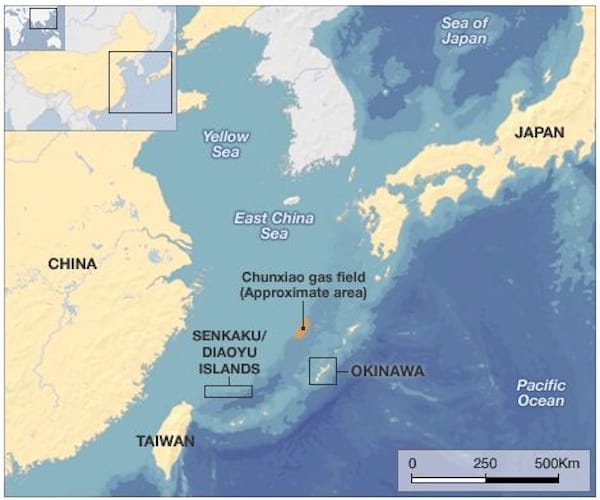
While the contention pertaining to the death of U.S. Ambassador Chris Stevens in Libya occupies the front pages, another overseas front, President Barack Obama's so-called Asian Pivot, may be entering a major stage as a potential diplomatic rift surfaces in the south Pacific.
In the South China Sea, just off the coast of China, lies a series of small, uninhabited islands whose ownership is contested by China and Japan.
The islands, known as Diaoyu in Chinese and Senkaku in Japanese, are located in a region, in which the surrounding waters are believed to contain untapped reservoirs of oil and natural gas. With the development of "drilling rigs capable of operating into a mile of water of more," the possession of these islands has become enticing.
The tension may have been lifted a week ago when the Japanese government reached an agreement to formally purchase the islands for 2.05 billion yen, or approximately $26 million. On Friday, Chinese surveillance ships were seen in waters near the islands, but after protests from the Japanese coast guard, the ships departed.
The significance of the island dispute for the United States is that it places Washington front and center in a diplomatic conflict in China's back yard. The U.S. has little direct interest in the ownership of these islands and the State Department has formally taken no position on the matter. Secretary of State Hillary Clinton's only remarks on the subject were to say that "the United States stands ready to support that process in any way that would be helpful to the parties."
However, as Foreign Policy's Joshua Keating explains, a series of twentieth century treaties negotiated by the United States has helped create confusion about ownership of the islands:
"In 1971, the U.S. and Japan signed a treaty reverting Okinawa and the surrounding islands back to Japanese control, which stated 'the United States of America relinquishes in favour of Japan all rights and interests under Article III of the Treaty of Peace with Japan signed at the City of San Francisco.'"China points to its own agreement with the United States, the 1943 Cairo statement issued by Winston Churchill, Franklin Roosevelt and Chiang Kai-shek. The three leaders agreed that following the war, 'Japan shall be stripped of all the islands in the Pacific which she has seized or occupied since the beginning of the first World War in 1914, and that all the territories Japan has stolen from the Chinese, such as Manchuria, Formosa, [Taiwan] and The Pescadores, shall be restored to the Republic of China.' If you accept, as Beijing does, that Diaoyu was part of Chinese-ruled Taiwan prior to 1895, then that would indicate that it would be returned to China along with the other seized islands."
The ownership matter is ambiguous, but Washington has apparently decided, to the consternation of Tokyo, that this island dispute is not a vital American national interest. However, this incident brings to light a variable that will likely dominate American international diplomacy in the twenty-first century: its relations with an economically expanding and more assertive China.
In a featured article in the September/October 2012 issue of Foreign Affairs, Columbia University professor Andrew J. Nathan and RAND Corporation political scientist Andrew Scobell, discuss how China sees the U.S.:
"In each of China's four security rings, the United States is omnipresent. It is the most intrusive outside actor in China's internal affairs, the guarantor of the status quo in Taiwan, the largest naval presence in the East China and South China seas, the formal or informal military ally of many of China's neighbors, and the primary framer and defender of existing internal legal regimes. This omnipresence means that China's understanding of American motives determines how the Chinese deal with most of their security issues."
China already sees the US as attempting to thwart its rise. This island dispute in the South China Sea may be resolved without any further tension or escalation. However, by positioning itself as a potential power broker in East Asian politics, the US is involving itself in China's business.
In this particular island dispute, the US is deferring to Japan perhaps hoping to give China a reason to believe America is an honest partner. Yet, with many of these sovereignty disputes in the making and its renewed presence in the region, the U.S. has assured that it will be involved in Chinese matters for years to come.