Skip to content
Subscribe

UC Berkeley Researchers Mapping Proposition 30 Social Media

Published:

Sample image demonstrates how social media spreads. Credit: opinion.berkeley.edu
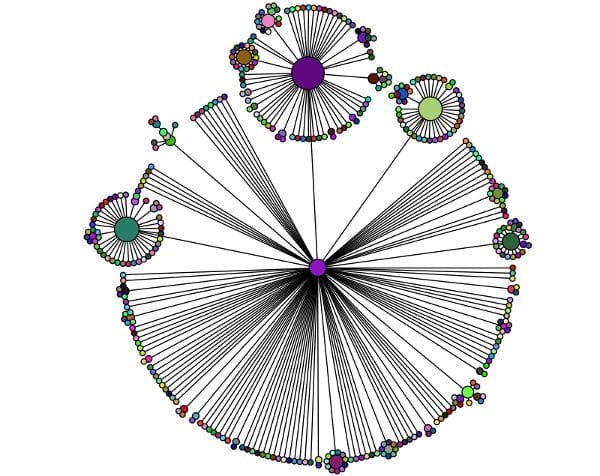
Researchers at UC Berkeley are testing a new method for tracking how people use social media in politics. Their first project plans to map Proposition 30 social media references onto graphs. They also have an innovative new discussion area they call an opinion space.

Users sign up on their new website, CA Prop 30 Awareness, by entering their email address. This creates a new page similar to the home page coded with a number unique to them. Users then use social media like Facebook and Twitter to discuss Proposition 30, using the unique page as the link. The website tracks click-through to the unique page and awards points.

Your influence value

This sample graph displayed above shows how social media spreads from the social media user in the middle out to his circles and then to other circles. Users can view their own graphs at any time to see how their social media messages on Proposition 30 are spreading.

Proposition 30 will be on the California ballot in November. Billions in state funding for education as well as the increased possibility of a balanced budget depend upon it passing.

CA Prop 30 Awareness explains:

Everyone in California, from students to CEO's, should know about Proposition 30 on the November 2012 Ballot. If passed, Prop 30 will increase sales tax by 0.25% and incrementally increase income tax on households earning more than $250,000. If not passed, a multi-billion dollar cut in state funding to education at all levels will be triggered automatically., both pro and con. The discussion area asks participants to discuss "What are key arguments for or against Proposition 30 in the Nov 6 California election?" Users rank the discussions, which then appear as "blooms," the bigger the bloom the higher the interest. This new approach to forums was "Developed at UC Berkeley  is a new interface for using the wisdom of crowds to collect and evaluate ideas on any topic. A version is being used by the U.S. State Department and other organizations."

The website has a wealth of information about Proposition 30

Registration is free and they do not share email addresses. They invite participants to join in and see how their Proposition 30 social media spreads through the Internet.

Adhere to the IVN etiquette

By posting a comment, you agree to adhere to our etiquette rules: No partisan attacks, no personal attacks, substantiate your sources, no self-promotion.

Contact IVN

Questions about this article or our coverage? Send us a message. A free IVN member account is required.

Message sent

Thanks, we’ll review it and get back to you if needed.

Message not sent

Sorry, something went wrong. Please try again.

Sign in to send a message

Messages are tied to your IVN member account. Signing in is free and takes a few seconds.

Republish this article

Republishing guidelines

Republish IVN articles for free. Independent Voter News articles may be republished online or in print under a Creative Commons BY-NC-ND 4.0 license, on these terms:

  1. Credit the author and IVN. Keep the byline ("By Author Name, Independent Voter News") and the attribution note at the end, which links to the original.
  2. Keep the meaning. You may update time and place references and apply your house style. You may trim for length, as long as the cuts don't change the meaning or misrepresent the author. Keep the headline. Mark any additions as your own (for example "Additional reporting by ...").
  3. Translations are welcome. Translate faithfully, add "Translated from English by [your outlet]", and tell us at editor@ivn.us.
  4. Keep the links, including the link to the original article.
  5. Keep the tracking image. The HTML includes a 1-pixel image that counts readers on your page. It collects no personal information.
  6. Photos and illustrations. Images credited to IVN may be used with this article only. Images credited to others (AP, Getty, Unsplash, Wikimedia and so on) stay under their owners' terms. Secure the rights or switch "Include images" off.
  7. Don't sell it. You can't sell our articles or sell ads specifically against them. Your normal site advertising is fine.
  8. No implied endorsement. Don't suggest that IVN or the author endorses you, your candidates or your causes, or that donations to you support IVN.
  9. Keep labels. Opinion or analysis pieces keep that label.
  10. Point search engines to the original. Where your CMS allows, set the canonical URL to the original IVN article.
  11. No bulk or automated republishing, and don't submit our articles to aggregators (Apple News, Google News, MSN) as your own.
  12. Corrections and removals. Update your copy when we correct it, and remove it promptly if we ask. We'll contact you at the email you give us.
  13. Questions or print republication: editor@ivn.us.

IVN staff: fill in who you're inviting above, then create the invite.

Preparing the article

UC Berkeley Researchers Mapping Proposition 30 Social Media

Choose a format
  • HTML
  • Email HTML
  • Markdown
  • Formatted (.docx)
  • Plain text
  • WordPress blocks
  • PDF
Choose a platform

Photos credited to others need their owners' permission.

To for

Republishing somewhere else? Questions? editor@ivn.us