
Skip to content
Subscribe

U.S. Behind in Requiring the Labeling of GMOs

Published:

A recent IVN article, by contributor Ryan McLain, explains the current FDA guidelines on labeling the genetically modified foods (GMOs) that make it into our grocery stores. The senate failed to pass a bill last month that would have required the labeling of all GMOs by vote of 26 to 73. Unsurprisingly Monsanto, the world’s largest producer of genetically engineered seed, has in the past contributed to the campaigns of many of the Senators opposed to the bill through the company’s political action fund.

List of Monsanto’s political contributions January 2012 through June 2012.

Currently there are more than 40 industrialized countries which require the labeling of GMOs. Starting in January 2013, India will join the ranks of Australia, Japan, and the European Union in requiring GMO labeling. The United States is far behind the status quo even though multiple polls have shown that the majority of Americans are in favor of labeling.
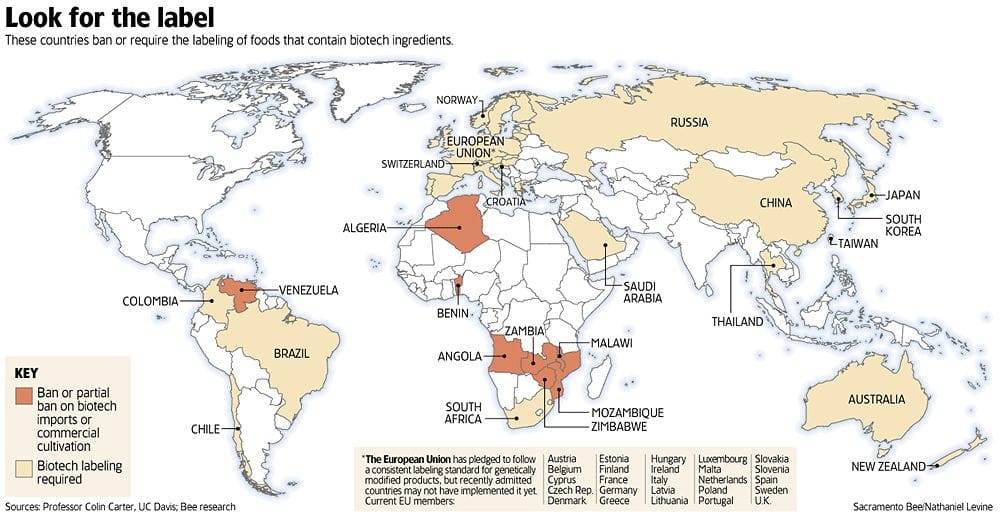
In addition to enacting labeling laws, certain countries have placed outright bans on the planting of GMO crops. Ireland, Switzerland, New Zealand, Austria, Sri Lanka, Greece, Hungary and Bulgaria are among the countries where no GMO is permitted to take root. As of mid-2011 only three counties in the United States had successfully banned the planting of GMO crops. The counties are Mendocino, Trinity, and Marin, all in California. Other counties in the United States have attempted to sanction similar bans, but all have failed.

In November, Californians will be able to vote on the Right to Know initiative, which if it passes, will be the country’s first law requiring the labeling of a wide range of genetically modified food. The law would allow consumers the knowledge of which of their foods have had their DNA artificially altered.

Certain companies currently make it a point to label their products Non-GMO, in a self-initiated attempt to inform their consumers. The unregulated labeling practices have received some backlash however. A class action lawsuit filed against Pepsico owned Naked Juice accused the company of using GMOs in their Non-GMO labeled products.

Whether or not GMOs are a threat to public health or blight to the environment is still a point of heated debate between scientists, activists, and politicians. The fact is however, that consumers have the right to full disclosure about what they are buying and eating so they are able to make informed decisions.

Adhere to the IVN etiquette

By posting a comment, you agree to adhere to our etiquette rules: No partisan attacks, no personal attacks, substantiate your sources, no self-promotion.

Contact IVN

Questions about this article or our coverage? Send us a message. A free IVN member account is required.

Message sent

Thanks, we’ll review it and get back to you if needed.

Message not sent

Sorry, something went wrong. Please try again.

Sign in to send a message

Messages are tied to your IVN member account. Signing in is free and takes a few seconds.

Republish this article

Republishing guidelines

Republish IVN articles for free. Independent Voter News articles may be republished online or in print under a Creative Commons BY-NC-ND 4.0 license, on these terms:

  1. Credit the author and IVN. Keep the byline ("By Author Name, Independent Voter News") and the attribution note at the end, which links to the original.
  2. Keep the meaning. You may update time and place references and apply your house style. You may trim for length, as long as the cuts don't change the meaning or misrepresent the author. Keep the headline. Mark any additions as your own (for example "Additional reporting by ...").
  3. Translations are welcome. Translate faithfully, add "Translated from English by [your outlet]", and tell us at editor@ivn.us.
  4. Keep the links, including the link to the original article.
  5. Keep the tracking image. The HTML includes a 1-pixel image that counts readers on your page. It collects no personal information.
  6. Photos and illustrations. Images credited to IVN may be used with this article only. Images credited to others (AP, Getty, Unsplash, Wikimedia and so on) stay under their owners' terms. Secure the rights or switch "Include images" off.
  7. Don't sell it. You can't sell our articles or sell ads specifically against them. Your normal site advertising is fine.
  8. No implied endorsement. Don't suggest that IVN or the author endorses you, your candidates or your causes, or that donations to you support IVN.
  9. Keep labels. Opinion or analysis pieces keep that label.
  10. Point search engines to the original. Where your CMS allows, set the canonical URL to the original IVN article.
  11. No bulk or automated republishing, and don't submit our articles to aggregators (Apple News, Google News, MSN) as your own.
  12. Corrections and removals. Update your copy when we correct it, and remove it promptly if we ask. We'll contact you at the email you give us.
  13. Questions or print republication: editor@ivn.us.

IVN staff: fill in who you're inviting above, then create the invite.

Preparing the article

U.S. Behind in Requiring the Labeling of GMOs

Choose a format
  • HTML
  • Email HTML
  • Markdown
  • Formatted (.docx)
  • Plain text
  • WordPress blocks
  • PDF
Choose a platform

Photos credited to others need their owners' permission.

To for

Republishing somewhere else? Questions? editor@ivn.us