Credit: realclearpolitics.com
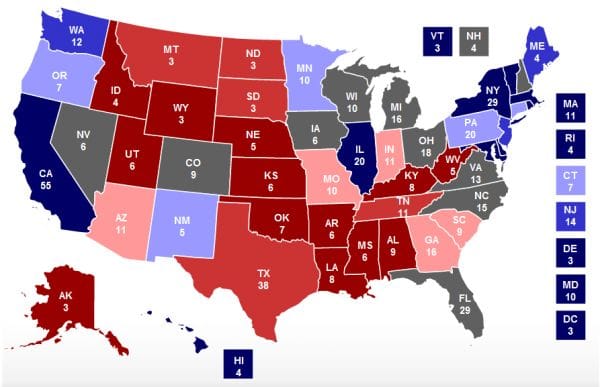
The presidential race is won by obtaining 270 of the 538 votes in the Electoral College. President Barack Obama and Republican candidate Mitt Romney are campaigning relentlessly, but much of their focus is on battleground/swing states. Each party has states that they can rely on to vote in their favor, but achieving 270 electoral votes requires reaching out to those undecided states.
To refresh memories, the Electoral College is a process by which we select our President. The number of electors is comprised of the 535 Congress members and 3 electors from the District of Columbia. Each state is given a number of electors proportional to their population and in the winner-take-all system, the number of electors goes to the candidate who wins the state-wide popular vote (except Maine and Nebraska, which use a form of proportional representation). It is not a form of direct democracy since the popular vote is not the determining count of the winner. Instead, electors are chosen to abide by the wishes of the voters of the state to cast the vote for president.
It is possible for a presidential candidate to win the election, but lose the popular vote. The last time we saw this happen was the 2000 presidential election between George W. Bush and Al Gore. The election came down to a recount in Florida where Bush won the state by 537 votes, but lost the national popular vote by 543,816 votes.
NBC's First Read currently has the Obama campaign at 237 electoral votes and the Romney campaign at 191 electoral votes. This leaves 110 votes available that could go either way. With current projections of the presidential election, Gov. Romney will arguably have a tougher time trying to reach the 270 finish line.
The NBC article concludes that if Gov. Romney takes the four swing states most likely to go to Republicans, he would still be short at 250 votes. These four states are North Carolina, Iowa, Florida, and Colorado. Virginia and Nevada are the next two states that are might favor Romney, but if he wins both he will still be one vote short at 269 votes.
Perhaps this is a race to 269 for the Romney campaign. In the case of a tie, 269-269 electoral votes, the House of Representatives breaks the tie. The current House has a Republican majority. RealClearPolitics.com (RCP) is projecting that Republicans will hold onto that majority with at least 229 seats after the elections.
Ezra Klein also discussed the NBC article in his blog on Washington Post. Klein acknowledged the findings but concluded that Ohio is Romney's determining state.
In a close race, Ohio is Obama’s firewall. For reasons no one quite understands — though everyone has their theories — Romney has had real trouble gaining traction there. That might change. There’s some evidence, actually, that it is changing. But without Ohio, Romney’s got a very difficult road to 270.
If we take a look at history, Ohio has only went to a losing presidential candidate once since 1944. Ohio went to Richard Nixon instead of John F. Kennedy in the 1960 Presidential election. Mathematically, whoever wins the 2012 election can do it without Ohio, but traditionally Ohio has sided with the winning candidate.
The only poll that showed Gov. Romney with a lead in Ohio was Purple Poll's August 2012 survey. The results showed the Republican candidate with a 2% lead over President Obama, and the poll was conducted after the vice presidential selection of Paul Ryan. However, the results were within their margin of error of +/-4.0 percent.
Wisconsin is now considered a close toss-up state since the selection of VP candidate Paul Ryan. Wisconsin is the state which Paul Ryan currently represents in the House. Polls conducted prior to the VP selection showed President Obama with a 6-point lead in the state. However, the latest poll in the state closed the gap between the candidates and has Obama at a 2-point lead.
Pennsylvania, which is recognized by RCP as a "lean Democrat" state recently had a Voter ID law upheld by the state's Supreme Court. Pennsylvania's House Minority Leader Mike Turzai was recorded stating that the "voter ID law will allow Governor Romney to win the state of Pennsylvania". The comment stirred controversy with opponents of the law. Despite whether the law is valid or not, if Gov. Romney does win the state, the path to 270 would look a bit easier for him.