Skip to content
Subscribe

The Fiscal Cliff and the Six-Month Plan

Published:

Credit: wtsp.com

Among the many political buzzwords that conquer headlines, "fiscal cliff" is one of the most prolific this election cycle. The fiscal cliff is a combination of the automatic federal budget cuts and tax hikes that would go into effect if Congress cannot author a deal concerning the matters. This would be set in motion for 2013 and would have serious economic implications for the nation. On Tuesday, Congressional leaders agreed to a six-month federal funding deal that would temporarily hold off long-term budgeting plans.

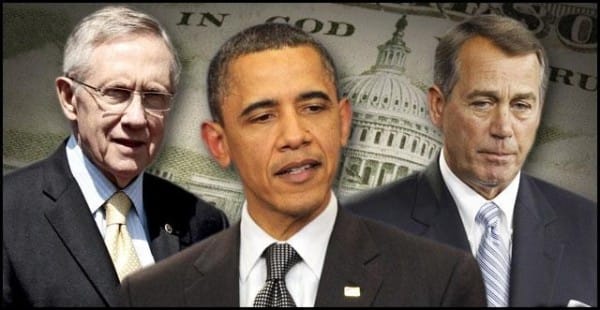
Senate Majority Leader Harry Reid and House Speaker John Boehner announced the deal, which was also coordinated with the consultation of President Barack Obama. The federal funding level is set to $1.047 trillion beginning in October 2012 through March 2013. While the deal is being drafted, Congress will not vote on it until September because of the August recess.

Republicans are hopeful that a more permanent budget could be crafted after the presidential election. The party hopes that candidate Mitt Romney will be at the head of budgeting plans by that time.

The fiscal cliff sets budgeting plans in the absence of a Congressional plan. Many fiscal policies will expire by the end of the year which make up a portion the consequences. The largest tax hikes would come from the expiration of the Bush tax cuts and the payroll tax cuts. The largest spending cuts would come from defense spending and non-defense discretionary spending. The spending cuts are also known as the budget sequestration. The result would be a 10% overall cut in defense and an 8% in non-defense.

While spending cuts and tax increases sound like a great idea, one must consider the potential economic impact. Some scholars have suggested "falling off the fiscal cliff" and then structuring plans from there. William Gale of the Brookings Institute is one propenent of this idea, saying

"[The fiscal cliff] is likely to hurt the economy in the short-run, but it would put the economy on a better long-term budget plan. It's a good overall stance for the country,Going over the cliff would give lawmakers both the opportunity to enact a budget deal because they would have more revenues and less spending already in the baseline and it gives them the incentive to enact a budget deal because they won’t like the structure of taxes and they won’t like the structure of spending."

The cliff would be tough for the United States to swallow. Unemployment is projected to rise 1.5% if the fiscal cliff is the end result and no plan is set in place before September 30th. A growth reduction of 3.9% in Gross Domestic Product is also projected. Spending cuts result in less funding for jobs and tax increases would hurt economic stimulation.

The plan only sets a funding amount for government. Discussions on extending or expiring the Bush tax cuts and payroll tax cuts will continue even if the plan is approved by Congress. Congress will begin their post-recess session in the middle of September. This six-month budgeting deal and the fiscal cliff will be the centerpiece for debate as the economy is the premier issue in this election cycle.

Adhere to the IVN etiquette

By posting a comment, you agree to adhere to our etiquette rules: No partisan attacks, no personal attacks, substantiate your sources, no self-promotion.

Contact IVN

Questions about this article or our coverage? Send us a message. A free IVN member account is required.

Message sent

Thanks, we’ll review it and get back to you if needed.

Message not sent

Sorry, something went wrong. Please try again.

Sign in to send a message

Messages are tied to your IVN member account. Signing in is free and takes a few seconds.

Republish this article

Republishing guidelines

Republish IVN articles for free. Independent Voter News articles may be republished online or in print under a Creative Commons BY-NC-ND 4.0 license, on these terms:

  1. Credit the author and IVN. Keep the byline ("By Author Name, Independent Voter News") and the attribution note at the end, which links to the original.
  2. Keep the meaning. You may update time and place references and apply your house style. You may trim for length, as long as the cuts don't change the meaning or misrepresent the author. Keep the headline. Mark any additions as your own (for example "Additional reporting by ...").
  3. Translations are welcome. Translate faithfully, add "Translated from English by [your outlet]", and tell us at editor@ivn.us.
  4. Keep the links, including the link to the original article.
  5. Keep the tracking image. The HTML includes a 1-pixel image that counts readers on your page. It collects no personal information.
  6. Photos and illustrations. Images credited to IVN may be used with this article only. Images credited to others (AP, Getty, Unsplash, Wikimedia and so on) stay under their owners' terms. Secure the rights or switch "Include images" off.
  7. Don't sell it. You can't sell our articles or sell ads specifically against them. Your normal site advertising is fine.
  8. No implied endorsement. Don't suggest that IVN or the author endorses you, your candidates or your causes, or that donations to you support IVN.
  9. Keep labels. Opinion or analysis pieces keep that label.
  10. Point search engines to the original. Where your CMS allows, set the canonical URL to the original IVN article.
  11. No bulk or automated republishing, and don't submit our articles to aggregators (Apple News, Google News, MSN) as your own.
  12. Corrections and removals. Update your copy when we correct it, and remove it promptly if we ask. We'll contact you at the email you give us.
  13. Questions or print republication: editor@ivn.us.

IVN staff: fill in who you're inviting above, then create the invite.

Preparing the article

The Fiscal Cliff and the Six-Month Plan

Choose a format
  • HTML
  • Email HTML
  • Markdown
  • Formatted (.docx)
  • Plain text
  • WordPress blocks
  • PDF
Choose a platform

Photos credited to others need their owners' permission.

To for

Republishing somewhere else? Questions? editor@ivn.us