Skip to content
Subscribe

Syria’s President, Bashar al-Assad, isn’t Going Anywhere

Published:

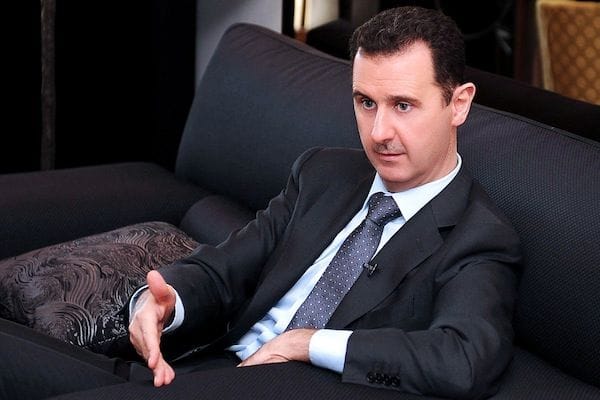
In an exclusive interview with Russia Today television in Damascus on Friday, Syria’s president, Bashar al-Assad, told reporters he has no plans to step down from his post – despite nearly 20 months of ongoing internal violence in criticism of his governing practices.

"I was not made by the West to go to the West or to any other country. I am Syrian, I was made in Syria, I have to live in Syria and die in Syria."

The president’s refusal to leave the country will likely do nothing to slow the nearly 20-month-old conflict, which anti-government activists say has left at least 36,000 dead, including thousands of government soldiers. A Turkish official at the government's crisis management center stated that –after a mass cross-border exodus on Friday— there are currently 120,000 Syrian refugees in Turkey.

The rising in this Middle Eastern nation took hold on 26 January 2011 in the streets of Al-Hasaka, when Hasan Ali Akleh doused himself with gasoline and set himself on fire.

It was a nod to an identical action that kicked off Tunisian protesting just one month before. In Syria it would be less than two months before the small reactionary demonstrations spiraled into a widespread, internal uprising (on March 15th) classifying the nation as a player in the Arab Spring.

While al-Assad acknowledges that his nation is certainly under attack, the Syrian head of state vehemently opposes any implication that the violence is a civil war.

"It is a new kind of war,” he told Russia Today, “terrorism through proxies, either Syrians living in Syria or foreign fighters coming from abroad. It is about terrorism and the support coming from abroad to terrorists to destabilize Syria. This is our war."

Still, rebel activity within Syrian borders persists. Free Syrian Army, the nation’s opposition forces, recently posted an online statement claiming its unit operation in Damascus had kidnapped the son of Rustam Ghazali, the head of military intelligence.

On Thursday, Syrian opposition members also met in Doha where they began exploring an initiative aimed at forming a rebel faction that could serve as a transitional government, should they defeat al-Assad’s army.

If al-Assad is willing to listen, this will come likely come as news to Syria’s unpopular president.

As Assad said, “if the Syrian people are against me, how can I be here?”

Adhere to the IVN etiquette

By posting a comment, you agree to adhere to our etiquette rules: No partisan attacks, no personal attacks, substantiate your sources, no self-promotion.

Contact IVN

Questions about this article or our coverage? Send us a message. A free IVN member account is required.

Message sent

Thanks, we’ll review it and get back to you if needed.

Message not sent

Sorry, something went wrong. Please try again.

Sign in to send a message

Messages are tied to your IVN member account. Signing in is free and takes a few seconds.

Republish this article

Republishing guidelines

Republish IVN articles for free. Independent Voter News articles may be republished online or in print under a Creative Commons BY-NC-ND 4.0 license, on these terms:

  1. Credit the author and IVN. Keep the byline ("By Author Name, Independent Voter News") and the attribution note at the end, which links to the original.
  2. Keep the meaning. You may update time and place references and apply your house style. You may trim for length, as long as the cuts don't change the meaning or misrepresent the author. Keep the headline. Mark any additions as your own (for example "Additional reporting by ...").
  3. Translations are welcome. Translate faithfully, add "Translated from English by [your outlet]", and tell us at editor@ivn.us.
  4. Keep the links, including the link to the original article.
  5. Keep the tracking image. The HTML includes a 1-pixel image that counts readers on your page. It collects no personal information.
  6. Photos and illustrations. Images credited to IVN may be used with this article only. Images credited to others (AP, Getty, Unsplash, Wikimedia and so on) stay under their owners' terms. Secure the rights or switch "Include images" off.
  7. Don't sell it. You can't sell our articles or sell ads specifically against them. Your normal site advertising is fine.
  8. No implied endorsement. Don't suggest that IVN or the author endorses you, your candidates or your causes, or that donations to you support IVN.
  9. Keep labels. Opinion or analysis pieces keep that label.
  10. Point search engines to the original. Where your CMS allows, set the canonical URL to the original IVN article.
  11. No bulk or automated republishing, and don't submit our articles to aggregators (Apple News, Google News, MSN) as your own.
  12. Corrections and removals. Update your copy when we correct it, and remove it promptly if we ask. We'll contact you at the email you give us.
  13. Questions or print republication: editor@ivn.us.

IVN staff: fill in who you're inviting above, then create the invite.

Preparing the article

Syria’s President, Bashar al-Assad, isn’t Going Anywhere

Choose a format
  • HTML
  • Email HTML
  • Markdown
  • Formatted (.docx)
  • Plain text
  • WordPress blocks
  • PDF
Choose a platform

Photos credited to others need their owners' permission.

To for

Republishing somewhere else? Questions? editor@ivn.us