Skip to content
Subscribe

Super PACs Unpopular with Americans Due to Unlimited Funding

Published:

Source: ABC/Washington Post Poll
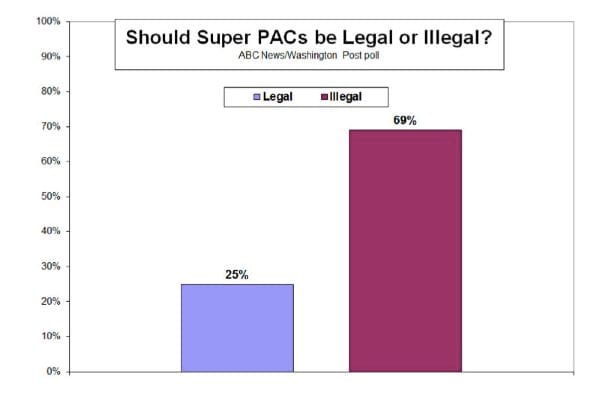
Almost 70% of Americans would ban Super PACs if given the chance, according to an ABC/Washington Post Poll. Several reasons for opposing “independent expenditure only committees” include the extremely deep pockets and glaring lack of oversight allotted to Super PACs. Organizations like American Crossroads, Restore our Future, and Priorities USA Action are not only tax-exempt and not required to immediately identify donors, but are able to spend money however they choose, so long as it does not coordinate with a specific candidate or party.

This leniency exists because organizations like Super PACs are categorized under the U.S. Internal Revenue Code title 25 paragraph 527. Also referred to as ‘527s’ Super PACs cannot ‘expressly advocate’ for a specific candidate/party or coordinate directly with them. Aside from those caveats, no regulatory controls exist to determine how Super PAC money is spent.

Opensecrets reports, “As of December 19, 2012, 1,285 groups organized as Super PACs have reported total receipts of $836,107,228 and total independent expenditures of $644,563,550 in the 2012 cycle.” This money has been largely spent on television commercials, but could easily end up being used for personal reasons.

There are no contribution limits for these committees, whereas limits do exist for candidates and their political action committees, currently at $2,500 and $5,000 respectively per individual. $117,000 is the total allowable limit for an individual to donate to political groups per election cycle, a far cry from Sheldon Addelson’s $150 million he donated to several Super PACs.

Although funds can’t be truly unlimited in a literal sense, the absence of contribution caps that exist for both the candidates themselves and traditional Political Action Committees require that more than one individual or small group of individuals invest in a political campaign.

Donations under $250 do not require disclosure by the FEC, but even massive contributions can, and have been, donated from companies that exist solely on paper, only to disappear days later. Recent efforts like the American Anti-Corruption Act would require immediate disclosure, within 24 hours, for political contributions over $10,000, but precedent set by the Citizens United case prevents any spending caps from being instituted. Only by overturning the Supreme Court's 5-4 decision in that case will ‘unlimited’ funding for Super PACs end.

Adhere to the IVN etiquette

By posting a comment, you agree to adhere to our etiquette rules: No partisan attacks, no personal attacks, substantiate your sources, no self-promotion.

Contact IVN

Questions about this article or our coverage? Send us a message. A free IVN member account is required.

Message sent

Thanks, we’ll review it and get back to you if needed.

Message not sent

Sorry, something went wrong. Please try again.

Sign in to send a message

Messages are tied to your IVN member account. Signing in is free and takes a few seconds.

Republish this article

Republishing guidelines

Republish IVN articles for free. Independent Voter News articles may be republished online or in print under a Creative Commons BY-NC-ND 4.0 license, on these terms:

  1. Credit the author and IVN. Keep the byline ("By Author Name, Independent Voter News") and the attribution note at the end, which links to the original.
  2. Keep the meaning. You may update time and place references and apply your house style. You may trim for length, as long as the cuts don't change the meaning or misrepresent the author. Keep the headline. Mark any additions as your own (for example "Additional reporting by ...").
  3. Translations are welcome. Translate faithfully, add "Translated from English by [your outlet]", and tell us at editor@ivn.us.
  4. Keep the links, including the link to the original article.
  5. Keep the tracking image. The HTML includes a 1-pixel image that counts readers on your page. It collects no personal information.
  6. Photos and illustrations. Images credited to IVN may be used with this article only. Images credited to others (AP, Getty, Unsplash, Wikimedia and so on) stay under their owners' terms. Secure the rights or switch "Include images" off.
  7. Don't sell it. You can't sell our articles or sell ads specifically against them. Your normal site advertising is fine.
  8. No implied endorsement. Don't suggest that IVN or the author endorses you, your candidates or your causes, or that donations to you support IVN.
  9. Keep labels. Opinion or analysis pieces keep that label.
  10. Point search engines to the original. Where your CMS allows, set the canonical URL to the original IVN article.
  11. No bulk or automated republishing, and don't submit our articles to aggregators (Apple News, Google News, MSN) as your own.
  12. Corrections and removals. Update your copy when we correct it, and remove it promptly if we ask. We'll contact you at the email you give us.
  13. Questions or print republication: editor@ivn.us.

IVN staff: fill in who you're inviting above, then create the invite.

Preparing the article

Super PACs Unpopular with Americans Due to Unlimited Funding

Choose a format
  • HTML
  • Email HTML
  • Markdown
  • Formatted (.docx)
  • Plain text
  • WordPress blocks
  • PDF
Choose a platform

Photos credited to others need their owners' permission.

To for

Republishing somewhere else? Questions? editor@ivn.us