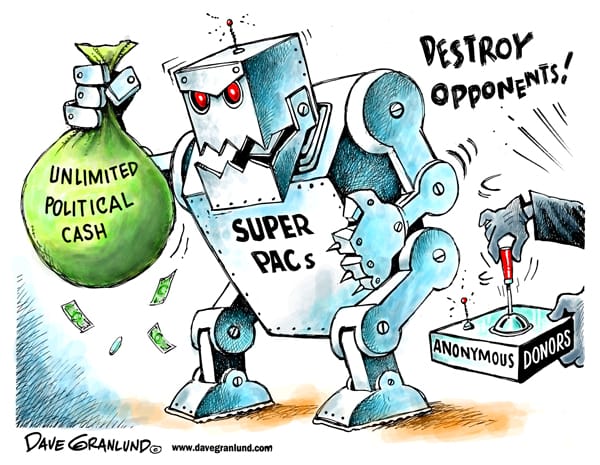
With campaign funding reaching all time highs, one might wonder who is contributing millions to aide, and often attack, presidential candidates. PACs and SuperPACs make donations from individuals seem minuscule in comparison. Upon inspection of the PACs that fund the Republican and Democratic campaigns, both contributing groups (who is spending) and total contributions (how much they are spending) seem reasonable, if not predictable.
President Obama’s largest contributions come mostly from unions and exceed no more than $2.3 million. Mitt Romney’s contributors include several major corporations, as well as funds raised by other politicians (these are known as leadership PACs). The largest contribution to that campaign falls right under $2 million. The latest campaign spending report notes $690 million raised for Barack Obama and $633 million raised for Mitt Romney, leaving a clear, and significant, discrepancy in PAC spending versus total funding.
However, a larger player looms in the background of all this. Super PACs come into play here, raising contributions in the tens of millions. Created under the federal court case SpeechNow.org v. Federal Election Commission, Super PACs are political action committees that may raise and spend unlimited amounts of money from corporations, unions, individuals, and associations.
The “Restore our Future” super PAC leads in total funds raised (in support of Mitt Romney), with an astounding $96,796,280 to date. The collective has received money from several different corporations, ranging from hedge funds to real estate companies, and even a Christian book distributor. Its largest individual donor is Sheldon Adelson, a casino and hotel magnate and prominent Israeli-American, who alone contributed just over $35 million to the Romney campaign. President Obama’s campaign is funded by no individual contributions in the tens of millions, but rather a higher volume of smaller, individual donations.
Interestingly, Green Party candidate Jill Stein rejects, and even condemns, the use of Super PACs, and only accepts individual donations. Dr. Stein’s campaign claims to “not accept special interest contributions with strings attached, namely from corporations…or the executives that employ them.”
Stein is also a proponent of publicly funded presidential campaigns in the future. She fervently opposes “corporate domination” of elections and highlights election reform as one of her goals if elected.
Super PACs in both campaigns highlight the interests of the high-profile individuals and corporations that are willing to bet so heavily on their man, and beg the question of motives to support. And while they play a vital role in funding the election for both Democrats and Republicans, they serve to reinforce bipartisanship and keep independents out of the spotlight.