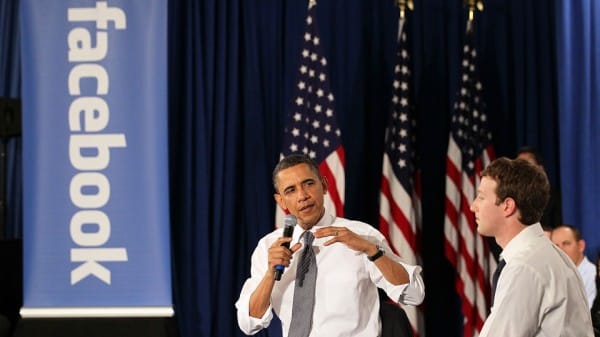
With growing questions about the prospects of long term continuity for Facebook and its record low stock prices, people are weighing in on the possibilities for the current most popular form of social networking. Prompted by one of Princeton University’s Center for Information Technology Policy’s fellows and Professor at the University of Washington, Slate recently published Phillip Howard's argument that the nationalization of Facebook will ultimately be for the greater good. And when Howard says “nationalization,” he means a public ownership with at least a majority share by the public sector at first. With time, Howard thinks that this “controlling interest” can be reduced given the restoration of trust by the public.
Howard’s three main points that would result by its nationalization are:
- Fix the company’s woeful privacy practices
- Allow the social network to fulfill its true potential for providing social good
- Force it to put its valuable data to work on significant social problemsThe post has been met with a lot of strong negative criticism including reason.com's Ed Krayeweski and Forbes' Adam Therier.
Howard argues that “Facebook is now public infrastructure, and it should be treated as such.”
Ed Krayeweski of reason.com’s “Hit & Run” blog, adamantly argues against this idea noting that “Facebook is not an institution, it’s a corporation (they’re people, too!) that provides a tool, social networking, which is arguably a cultural institution”. He also counters Howard’s point of Facebook’s global market dominance and a possibly outlandish idea that it is a form of colonization. Kreyeweski dispels this argument, providing stats from the questionable website “Internet World Stats” concluding that it “is exactly like colonization, except it’s not.”
Regardless of the two arguments, even if the global prevalence of Facebook is smaller than Howard leads on to be, the very idea that a U.S. based corporation has its hands in countries other than its own is necessary cause to consider the global implications.
In concluding his post, Krayeweski makes possibly the most poignant point in his argument; that “Governments tout transparency and accountability but regularly flout both. Perhaps more tellingly, 47 percent of Americans are more worried about their government knowing too much about their personal lives, with only 28 percent distrusting private companies more.”
Adam Therier, skeptical at the idea of a government owned Facebook, backs this claim up with 10 Reasons Why Nationalizing Facebook Would Be Ridiculous. He points out, "Government entities don’t have a good track record of protecting privacy", arguing that one could find countless amounts of privacy violations within many government agencies.
Therier, who claims Howard's proposition to be "a moronic and dangerous idea", does so upon the premise that Howard is implying Facebook to be used a "public" utility. Arguably the most interesting and valid point provided by the author of The Perils of Classifying Social Media Platforms as Public Utilities in his "10 Reason Why Nationalizing Facebook Would Be Ridiculous" is the simple rationalization that making Facebook a government entity is a hyper reaction to the company's problems There are far more reasonable and possibly better ways to deal with the problems internally, he argues, suggesting that nationalizing is an extreme solution to a common problem.
Although it seems unlikely that this process will actually occur (a reality Howard acknowledges in that he refers to his idea as a “nonstarter”) the concept is fascinating nonetheless. Yes, we have seen the rise (and fall) of sites to join the ranks of social media dominance, (i.e. Myspace, LinkedIn, and Twitter), but Facebook in particular has seen an unparalleled rise and stay with such a large user base. And because of this, the idea of nationalizing a social media site which admittedly at first, is a little off-putting, ultimately isn’t such a crazy idea. The intentions may be well made and the changes somewhat doable, but the idea of nationalizing Facebook, to me, is nothing more than a politicized social thought experiment.
Do you think the nationalization of Facebook is overstepping the role of the government in matters such as social media? And furthermore, although there is overall growing distrust of Facebook, does this translate into less or more distrust in the idea of government to regulate it?