Skip to content
Subscribe

Senate's 'Nuclear' Option Radiates Sensational Journalism

Published:

Senate Democrats made a controversial decision to alter the body's rules on a party-line vote Thursday morning. Senate Majority Leader Harry Reid called for a vote to pass new rules that would effectively prevent future Republican filibusters on presidential nominations. The rules passed, 51-48, with all Senate Republicans voting against them.
square

The vote does not come without cause. There have been more filibusters in Congress between 2009 and 2010 than there were in the three decades following WWII combined. The Senate filibuster has been the subject of reform efforts for several years. Just last year a similar discussion was taking place, but was stymied when a proposal brought by Senator Jeff Merkley to create a 'talking filibuster' failed to gain traction with Republicans in the legislature.

On the floor of the Senate, Senator Chuck Grassley (R-Iowa), called today's vote a "power grab" and vowed, "there will come a day when the rules are reversed."

One of the three Democrats who abstained, Carl Levin from Michigan, said, "Today, we are once again moving down a destructive path."

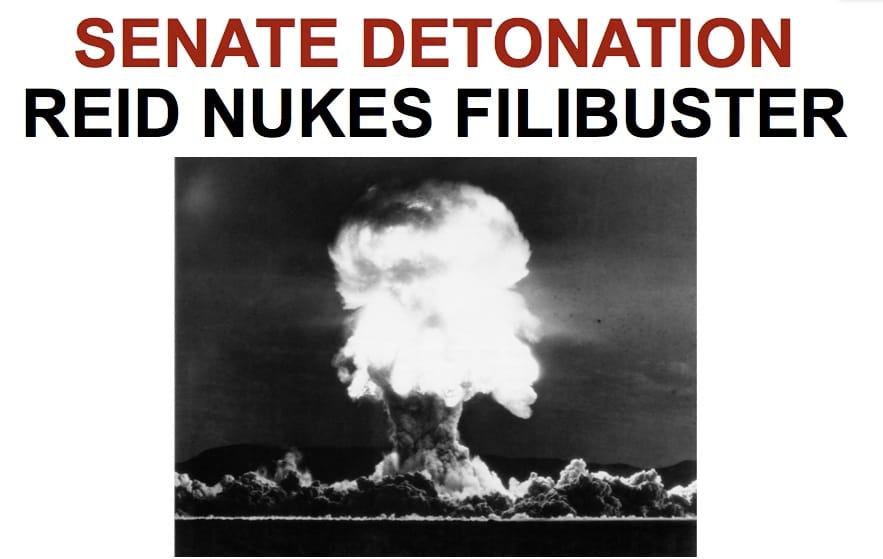
Consequently, the media's reaction has been to capitalize on the unprecedented vote with hyperbolic headlines, sidestepping the important discussion on what should be done to reform the filibuster into an apocalyptic doomsday story. Credit: Huffington Post
huffpo

The Huffington Post went so far as to post a picture of a nuclear bomb exploding with a headline 'Senate Detonation: Reid Nukes Filibuster.'  Breitbart went with 'Nuclear: Reid, Democrats Destroy Filibuster, 52-48' also with a picture of a nuclear explosion.

Much like the government shutdown, blame for the rules change will fall on partisan lines. Senate Democrats are arguing that the Senate Republicans brought the change on themselves for failing to "keep his word" as Senator Reid said. Conversely, the opposing side has argued that Senate Democrats are not respecting the minority's right to obstruct as guaranteed by law.

Although the vote should theoretically reduce the paralyzed state of the Legislative Branch, it is likely to have unintended consequences that will bleed over into other issues that confront Congress. At a time when the body is facing a 9 percent approval rating, another controversial vote on partisan lines can only serve to weaken the nation's quickly deteriorating confidence in Congress. Senator Mark Pryor (D-Arkansas) who also abstained in the vote, argued a similar point, "There's plenty of blame to go around... If one person blames the other side entirely, they're not being truthful."

Photo credit: Talking Points Memo

Adhere to the IVN etiquette

By posting a comment, you agree to adhere to our etiquette rules: No partisan attacks, no personal attacks, substantiate your sources, no self-promotion.

Contact IVN

Questions about this article or our coverage? Send us a message. A free IVN member account is required.

Message sent

Thanks, we’ll review it and get back to you if needed.

Message not sent

Sorry, something went wrong. Please try again.

Sign in to send a message

Messages are tied to your IVN member account. Signing in is free and takes a few seconds.

Republish this article

Republishing guidelines

Republish IVN articles for free. Independent Voter News articles may be republished online or in print under a Creative Commons BY-NC-ND 4.0 license, on these terms:

  1. Credit the author and IVN. Keep the byline ("By Author Name, Independent Voter News") and the attribution note at the end, which links to the original.
  2. Keep the meaning. You may update time and place references and apply your house style. You may trim for length, as long as the cuts don't change the meaning or misrepresent the author. Keep the headline. Mark any additions as your own (for example "Additional reporting by ...").
  3. Translations are welcome. Translate faithfully, add "Translated from English by [your outlet]", and tell us at editor@ivn.us.
  4. Keep the links, including the link to the original article.
  5. Keep the tracking image. The HTML includes a 1-pixel image that counts readers on your page. It collects no personal information.
  6. Photos and illustrations. Images credited to IVN may be used with this article only. Images credited to others (AP, Getty, Unsplash, Wikimedia and so on) stay under their owners' terms. Secure the rights or switch "Include images" off.
  7. Don't sell it. You can't sell our articles or sell ads specifically against them. Your normal site advertising is fine.
  8. No implied endorsement. Don't suggest that IVN or the author endorses you, your candidates or your causes, or that donations to you support IVN.
  9. Keep labels. Opinion or analysis pieces keep that label.
  10. Point search engines to the original. Where your CMS allows, set the canonical URL to the original IVN article.
  11. No bulk or automated republishing, and don't submit our articles to aggregators (Apple News, Google News, MSN) as your own.
  12. Corrections and removals. Update your copy when we correct it, and remove it promptly if we ask. We'll contact you at the email you give us.
  13. Questions or print republication: editor@ivn.us.

IVN staff: fill in who you're inviting above, then create the invite.

Preparing the article

Senate's 'Nuclear' Option Radiates Sensational Journalism

Choose a format
  • HTML
  • Email HTML
  • Markdown
  • Formatted (.docx)
  • Plain text
  • WordPress blocks
  • PDF
Choose a platform

Photos credited to others need their owners' permission.

To for

Republishing somewhere else? Questions? editor@ivn.us