Skip to content
Subscribe

Report Finds 113th Congress Most Divided in History

Published:

Credit: Brookings.edu
Credit: Brookings.edu

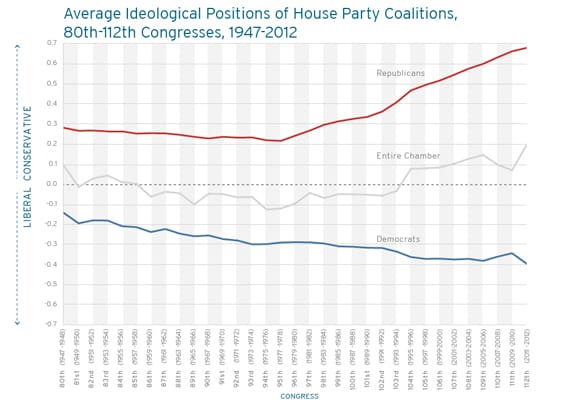
Republicans and Democrats in both houses of Congress are more divided than ever, according to a report titled, "Vital Statistics on Congress," published by the Brookings Institute.

The report documents ideological polarization of congressional coalitions from both parties since the 1940s. It shows the parties have evolved in opposite directions as time has progressed. While the Democratic Party has been become more liberal relative to where it was in 1948, the Republican Party has become more conservative at a much faster rate.

For about 30 years after the end of World War II, the alignment of both parties stayed fairly stable. In fact, House Republicans were on a liberal trend, albeit a slight one. That changed in 1980 when House Republicans started a trend towards greater conservatism.

The shift coincides with the election of Ronald Reagan in 1980 and the subsequent Reagan Revolution. Under the Reagan administration, conservative ideas became more mainstream. Conversely, the Democratic Party remained relatively stagnant in terms of ideology over the same period.

The movement towards conservatism became even more pronounced in 1994, a very important year for the Republican Party. The 1994 midterm elections were marked by sweeping Republican victories at both the state and federal level. Most notably, it was the first time Republicans had majority control of the House of Representatives since 1952.

Party leadership helps to explain these trends as well. Republican leaders emerged like Speaker of the House Newt Gingrich.  Shortly before that, Bill Clinton became the Democratic Party's frontman and the 42nd President of the United States.

The Republican trend toward conservatism has continued over the last decade. When combined with the Democrats’ slower movement towards liberalism, what has resulted is a starkly divided Congress.

As the two parties have moved further apart and inter-party cooperation has diminished, congressional approval ratings have plummeted. It could also help to explain the decline in membership in both parties, as well as the increase in those choosing to register with a third party or as an independent.

Adhere to the IVN etiquette

By posting a comment, you agree to adhere to our etiquette rules: No partisan attacks, no personal attacks, substantiate your sources, no self-promotion.

Contact IVN

Questions about this article or our coverage? Send us a message. A free IVN member account is required.

Message sent

Thanks, we’ll review it and get back to you if needed.

Message not sent

Sorry, something went wrong. Please try again.

Sign in to send a message

Messages are tied to your IVN member account. Signing in is free and takes a few seconds.

Republish this article

Republishing guidelines

Republish IVN articles for free. Independent Voter News articles may be republished online or in print under a Creative Commons BY-NC-ND 4.0 license, on these terms:

  1. Credit the author and IVN. Keep the byline ("By Author Name, Independent Voter News") and the attribution note at the end, which links to the original.
  2. Keep the meaning. You may update time and place references and apply your house style. You may trim for length, as long as the cuts don't change the meaning or misrepresent the author. Keep the headline. Mark any additions as your own (for example "Additional reporting by ...").
  3. Translations are welcome. Translate faithfully, add "Translated from English by [your outlet]", and tell us at editor@ivn.us.
  4. Keep the links, including the link to the original article.
  5. Keep the tracking image. The HTML includes a 1-pixel image that counts readers on your page. It collects no personal information.
  6. Photos and illustrations. Images credited to IVN may be used with this article only. Images credited to others (AP, Getty, Unsplash, Wikimedia and so on) stay under their owners' terms. Secure the rights or switch "Include images" off.
  7. Don't sell it. You can't sell our articles or sell ads specifically against them. Your normal site advertising is fine.
  8. No implied endorsement. Don't suggest that IVN or the author endorses you, your candidates or your causes, or that donations to you support IVN.
  9. Keep labels. Opinion or analysis pieces keep that label.
  10. Point search engines to the original. Where your CMS allows, set the canonical URL to the original IVN article.
  11. No bulk or automated republishing, and don't submit our articles to aggregators (Apple News, Google News, MSN) as your own.
  12. Corrections and removals. Update your copy when we correct it, and remove it promptly if we ask. We'll contact you at the email you give us.
  13. Questions or print republication: editor@ivn.us.

IVN staff: fill in who you're inviting above, then create the invite.

Preparing the article

Report Finds 113th Congress Most Divided in History

Choose a format
  • HTML
  • Email HTML
  • Markdown
  • Formatted (.docx)
  • Plain text
  • WordPress blocks
  • PDF
Choose a platform

Photos credited to others need their owners' permission.

To for

Republishing somewhere else? Questions? editor@ivn.us