Credit: San Diego Reader
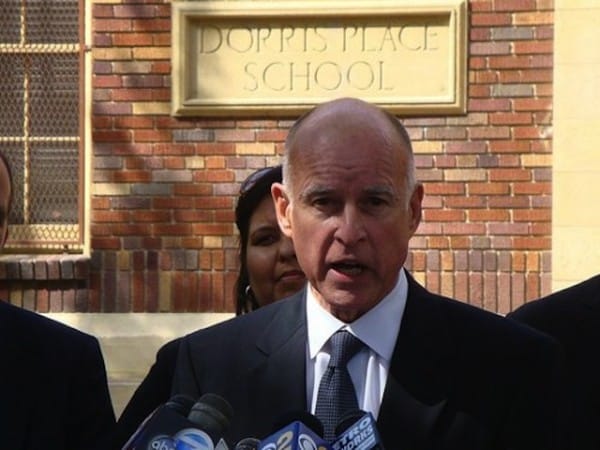
California's perpetual budget deficit will be a topic for voters to consider again this November. Proposition 30 at the center of Governor Jerry Brown's budget plans.
California has the second lowest credit rating in the union due its high rate of debt compared to the Gross Domestic Product. Even though California has endured drastic budget cuts over the past several years, the state currently faces a nearly $16 billion budget gap for the next fiscal year. Much of that deficit would be temporarily erased with the passage of Proposition 30.
The $92 billion budget passed by the state legislature and signed by Governor Brown in June included cuts for welfare benefits, Cal Grant college aid, a five percent reduction in state worker's pay, and the elimination of Healthy Families, a healthcare program for low-income children. If voters reject Proposition 30, a ballot initiative that increases taxes on annual income over $250,000 for seven years and increases the statewide sales and use tax by one quarter of a percent for four years, public schools, colleges and universities will also face $6 billion in cuts.
Since the economic crisis began in 2008, general fund spending in California has been cut from $103 billion down to $92 billion for the upcoming fiscal year. Funding for education has been on the decline since 2008 as well. California is now ranked 47th in the country in per-pupil spending on education at $8,667 per student. This is down from $8,852 last year, which ranked 43rd, and down from $9,863 in 2007-2008 when California ranked 23rd.
The economic crisis of four years ago has exposed the underlying, systemic issues facing the state. With the economy stagnating and revenue falling, California's system of direct democracy—legislating and budgeting partially through the ballot initiative process—has not been able to deal particularly well with perpetual multi-billion dollar budget gaps. The result has been a continuous cycle of painful budget cuts. Even if the voters pass Proposition 30, which is likely at this point, the state will continue to face harsh budget choices in upcoming fiscal years, barring a sudden, robust economic turnaround.
Rather than continue to plug its constant budget holes at the ballot box, the state needs a fundamental shift in the way it does business. Instead of continuing to rely on direct democracy, California needs drastic reforms to its system to enable the legislature, without the shackles of term limits, to plan and execute long-term, balanced budgets.
When voters decide on Proposition 30 in November, they'll be making a choice on whether they should pay more in sales tax and whether the wealthiest Californians should pay more in income tax, in order to avoid additional cuts to education.
Perhaps, on its own, raising taxes to pay for education makes sense. However, voters don't get to decide if it makes sense to continue to spend $4 billion more per year on prisons than on the UC system and state colleges, or on whether the state should continue to incarcerate so many people given the $45,000 per year it costs to incarcerate each prisoner. Without a holistic approach, the state's budget issues will continue to be mired in dysfunction.
Budgeting is a nuanced process that should be in the hands of the professional representatives Californians have elected. If voters are unhappy with the work of their legislators, they may choose to remove them from office in a later election.