 Shawn Griffiths
A new bill in the U.S. House called the Make Elections Great Again Act (MEGA) would enact new election rules right before the 2026 midterms. The legislation incorporates key provisions of the SAVE Act, but also targets ranked choice voting and mail-in ballots.
The MEGA Act includes the same proof-of-citizen requirements when registering to vote as well as the voter ID requirements found in the Safeguarding American Voter Eligibility (SAVE) Act. The GOP is leaning on the broad support voter ID laws have among voters.
They are not only supported by a majority of Republicans, but a majority of Democrats and independents as well.
"Americans should be confident their elections are being run with integrity — including commonsense voter ID requirements, clean voter rolls, and citizenship verification," U.S. Rep. Bryan Steil (R-Wis) said in a statement.
Opponents of the SAVE Act say the bill’s proof-of-citizenship requirements would burden eligible citizens who don’t have easy access to required documents or even married women whose last names no longer match their birth certificates.
Further, they argue that it would end up costing taxpayers more money as election administration budgets would need to rise to support new registration requirements.
The MEGA Act also bans ranked choice voting in federal elections, which is only used for U.S. House and Senate races in Maine and Alaska, and universal mail-in ballots – which is notable because these are two things President Donald Trump has railed against.
Trump has insisted that mail-in voting is corrupt and promised to lead a movement to ban it. “We’re going to end mail-in voting. It’s a fraud,” the president said in September. “Do you know what happens in California? It’s so corrupt. People get 5, 6 ballots mailed to them.”
“Republicans have to lead the charge,” Trump added.
There is no evidence to support the claim that any California voter has received up to 6 ballots in any given election. But California is 1 of 8 states (plus the District of Columbia) that automatically sends an absentee/mail-in ballot to registered voters.
California, Colorado, Hawaii, Nevada, Oregon, Utah (though not for long), Vermont, and Washington all have the type of universal mail-in voting that would be banned by the MEGA Act. Some states, like Colorado and Washington, conduct their elections entirely by mail.
Yet, both Colorado and Washington demonstrate how secure their elections are each cycle by highlighting all the mechanisms they have in place to ensure ballots are delivered, secured, counted, and audited.
Additionally, the MEGA Act bans ballot harvesting (something Trump has also mentioned), which occurs when a third party collects ballots on behalf of voters and delivers them. This includes political and partisan operatives.
And guess what? Ballot harvesting is legal in California.
While there is no evidence of widespread fraud connected to the practice in California, it does raise genuine concerns over the security of ballots collected – especially since the potential for fraud increases. This is evidenced by a case in North Carolina.
Ironically, a GOP operative was convicted of ballot tampering during the 2018 elections. The fraud was so egregious that it resulted in a do-over election. And while ballot harvesting is legal in California, it is a felony in North Carolina.
This is why conversations over election integrity deserve greater nuance. The current narrative says voters either have to completely believe Trump’s claims of rampant fraud in vote-by-mail states or reject it entirely by pretending partisan ops would never do such a thing.
Both approaches fail to find truth
It is also interesting to note that Trump encouraged the California GOP to defend their own ballot harvesting in court in 2020. While Democratic officials initially objected to the party’s use of drop boxes in that election, they did not enforce their cease-and-desist orders.
It is not the ballot collection state officials had a problem with – it is that the GOP claimed their drop boxes were official. When Republicans promised to change their collection tactics, Democrats backed off.
Trump also encouraged his supporters to vote by mail in 2024.
On the subject of ranked choice voting, Trump has accused the voting method of being fraudulent. He has also called it “one of the greatest threats to democracy.” But once again, this is an unsubstantiated claim.
During a July 2024 rally, Trump specifically took aim at Alaska’s use of ranked choice voting in the general election.
“You never know who won in ranked choice. You could be in third place and they announce that you won the election,” he claimed. “It's a total rigged deal. Just like a lot of other things in this country.”
Republican U.S. Rep Nick Begich won Alaska’s only House seat in 2024 under ranked choice voting, beating Democratic incumbent Mary Peltola. I doubt Begich would say his win was “fraudulent” or “rigged” even as he too opposes the new voting method.
So now, because Trump hates these reforms the House GOP is trying to ban them. However, while the MEGA Act may clear the U.S. House, it likely will face the same fate as the SAVE Act in the Senate, where no action has been taken to pass it.
Voters Say Party Primaries Are Breaking America – And Overwhelmingly Back Open Primaries as the Fix
Ahead of the 2026 primary season, which is set to begin on March 3, a new national survey finds Americans across the political spectrum agree: Party primaries are a major driver of political division, a reality long ignored in Washington.
Further, most people agree that opening primaries to all voters, including the 45% of the U.S. electorate that identifies as independent, is a practical reform to fix a broken system.

The poll, conducted by RealClear Opinion Research in partnership with Emerson Polling and sponsored by the Unite America Institute, shows 59% of voters say party primaries contribute to political division, while 71% support requiring states to hold open primaries.
Support for open primaries spans party lines:
- 79% of Democrats
- 70% of independents
- 65% of Republicans
The RealClear Opinion Research survey was conducted between January 9-11, and included 1,500 active registered voters.
Among a list of potential reforms, open primaries ranked as the top solution respondents believe would reduce polarization.
“Party primaries weren’t written into the Constitution, but today they’re fueling the partisanship our founders warned about,” said Unite America Executive Director Nick Troiano.
Two hundred and fifty years into the American experiment, voters are sending a clear message: our democracy is neither representative nor responsive to the will of the people. Primaries are the biggest solvable problem fueling division and dysfunction today — and voters across the political spectrum back open primaries as a practical fix.”
Unite America is a philanthropic venture fund that invests in nonpartisan election reform, particularly efforts to implement all-candidate and all-voter nonpartisan primary systems. In 2024, it contributed to a number of reform campaigns across the U.S.
The findings come as Americans prepare for a primary season defined by a striking lack of competition. Research from numerous sources, including the Cook Political Report, find that 9-in-10 U.S. House seats are safe for one party or the other.
In fact, Cook’s latest report rates 399 of 435 (92%) House districts as safe for one of the two major parties – meaning the real contest happens in the primary, while the general election is considered more of a formality.
When respondents were told that most elections are effectively decided in primaries, 81% said this reality is a problem.
For millions of voters, that problem is compounded by closed primary rules that prevent them from participating at all. The survey finds:
- 84% say it’s a problem that closed primaries in 16 states limit or bar 16.5 million independent voters
- 89% say low midterm primary turnout is a problem
- 52% say primaries are broken and need to change
Together, the data paints a picture of an electoral system that shuts out large portions of the electorate while empowering a narrow slice of highly partisan voters to choose most of the country’s leaders.
These poll results come not long after the Independent Voter Project conducted the largest poll of independent voters in California, who are registered No Party Preference. In a state that uses a nonpartisan primary model, independents want to keep and expand on it.
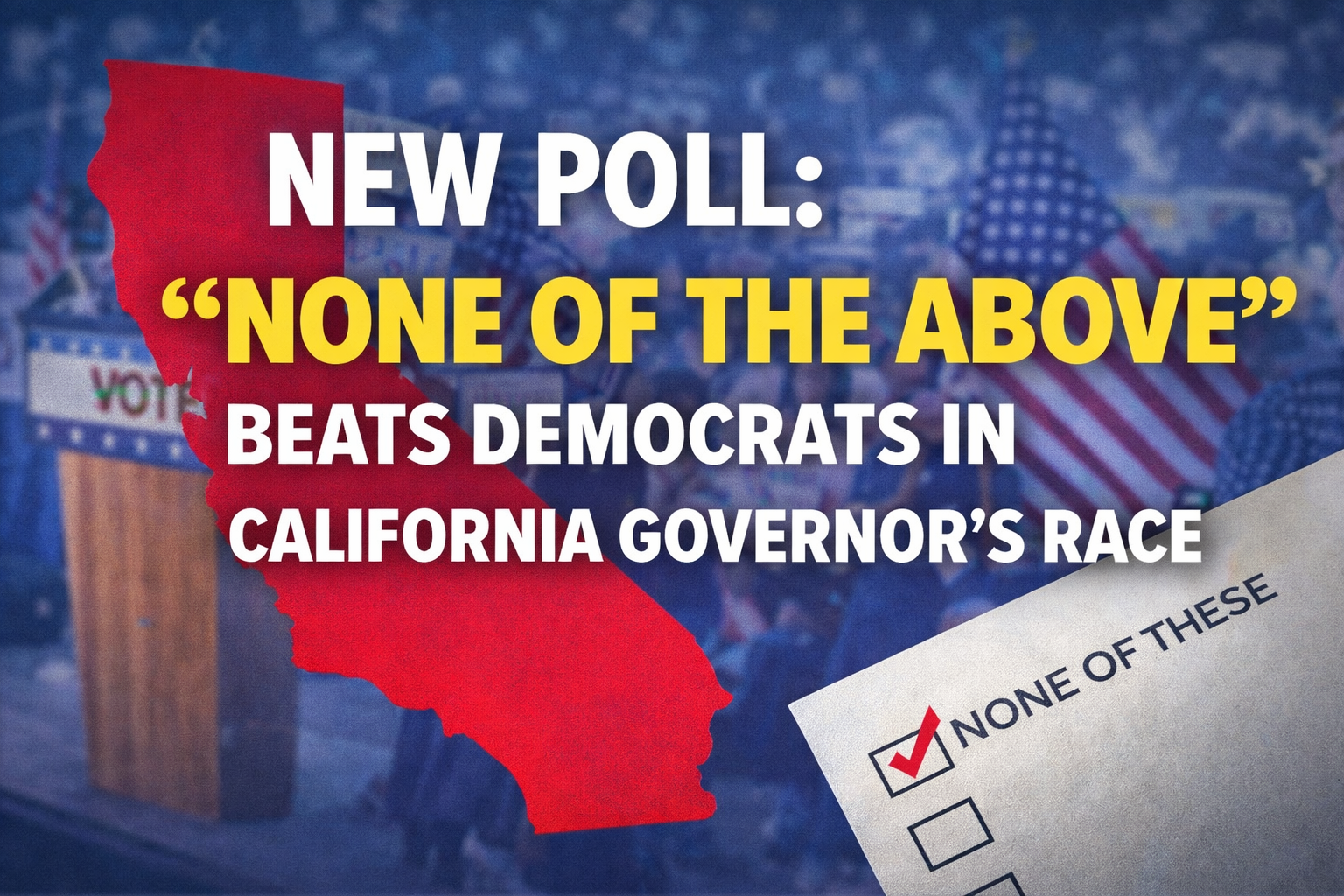
Of the more than 1,700 independent voters IVP surveyed, 74% said they want California to keep a nonpartisan primary system in which all voters and candidates, regardless of party affiliation participate on a single ballot.
Only 14% said the state should return to a closed primary system. Additionally, 52.5% of statewide respondents said they support more choice elections that would advance 5 candidates to the general election and use ranked choice voting to determine the winner.
This is proof that not only do voters want a taxpayer-funded elections process that treats all voters equally, but when they get to vote in such a system, they want to keep it.
RealClear Opinion Research also found that public frustration with primaries mirrors broader dissatisfaction with government performance. Seven-in-ten respondents said Congress is not effectively addressing major problems such as cost of living, immigration, and healthcare.
Rather than calling for ideological compromise, voters appear focused on changing incentives so elected officials are rewarded for solving problems instead of catering to party bases.
- 73% agree open primaries would produce better candidates who appeal to a majority of voters
- 72% agree open primaries would help produce a Congress that better represents the people and can tackle big problems
“Voters aren’t asking for politicians who compromise on their principles — they’re asking for a Congress that can get things done,” Troiano said. “Open primaries are a practical way to change the incentives so candidates are rewarded for governing, not punished.”
The latest polling data from organizations like IVP and Unite America show that election reform is no longer the niche issue it used to be. More and more voters are connecting the dots between incentives under an election model and legislative priorities.
There is now a mainstream voter demand for fairer, more competitive elections and equal participation – regardless of party affiliation.
There are a handful of primary reform initiatives trying to get on the November ballot in 2024, including proposals in Nevada, Oklahoma, and Oregon – the latter two including Top Two nonpartisan primary reform.
In Alaska, reformers have to fend off another effort to repeal the state’s unique Top Four system with ranked choice voting in the general election. Opponents failed to defeat it in 2020, failed to repeal it in 2024, and now they are trying again.
Unite America told IVN that they will focus on Alaska this year as well as efforts through litigation and in legislatures to close primaries. The group says it supports the reform initiatives trying to make it on the ballot, but could not comment on the extent of that support.
New Lawsuit Claims ‘Biased’ and ‘Inaccurate’ Language Used for Alaska Ballot Measure to Repeal Popular Reforms
We have seen it in Missouri. We have seen it in Oregon. Now, a lawsuit has been filed challenging a ballot measure title (for proposal 24ESEG) written by Alaska election officials that is biased against more choice reform.
Attorney Scott Kendall, who authored the state’s 2020 reform package that included a Top Four primary, ranked choice voting in the general election, and requires dark money disclosure, says the Alaska Division of Elections is using “biased” and “Inaccurate” language.
“I think (Alaskans) should know that the ballot language that has been offered by the Division of Directions is materially inaccurate, and in some cases, says the measure does the opposite of what it does, and it omits very significant changes the measure will make,” he said.
Kendall is representing AFL-CIO President Joelle Hall, state Sen. Cathy Giessel (R-Anchorage), and former Juneau City Councilmember Barbara Blak in a lawsuit organized by Alaskans for Better Elections – which spearheaded the 2020 reforms.
The plaintiffs take issue with the state-approved ballot title for 24ESEG in 2026: “An Act Restoring Political Party Primaries, Single-Choice General Elections, and Campaign Finance Rules.”
The problem? The measure doesn’t restore campaign finance rules. It eliminates them – specifically dark money disclosure requirements on donors and recipients for contributions over $2,000 and from groups that receive more than 50% of their funding from outside Alaska.
The previous attempt to repeal Top Four and ranked choice voting excluded the new campaign finance rules. But in 2026, opponents are trying to get rid of the entire reform package.
The lawsuit notes:
The proposed measure (24ESEG) would not ‘restore,’ ‘bring back,’ or add even a single campaign finance rule to Alaska’s statutes. Rather, 24ESEG would fully repeal a litany of campaign finance disclosure requirements, and eliminate enhanced fines.”
It is worth noting that the reform package in 2020, which was designated Ballot Measure 2, was opposed by then-Lt. Gov. Kevin Meyer and the Division of Elections, which challenged it on the state’s single-subject rule in court. They lost.
Still, there are officials in positions of power who oppose these reforms approved by voters and want to return to a system that hands the voting rights of 60% of the electorate registered independent over to private political parties.
In addition, campaign finance reform is one of the most popular systemic changes campaigns can pursue, as shown in the Independent Voter Project’s latest survey. It is easy to see how ballot language that says campaign finance rules will be “restored” will have an effect.
Even when the measure does the exact opposite.
The lawsuit also asserts that the language state officials use for 24ESEG downplays the role private political parties would play in deciding who can vote and run in taxpayer-funded primaries if the state returns to a closed partisan system.
“Granting major political parties in Alaska the power to disenfranchise voters for primary elections is neither mentioned, nor even implied, in the proposed ballot language,” the plaintiffs argue.
The most important question is: why not? If repeal passes, independent voters will go from being able to freely vote in primary elections for any candidate they want, regardless of party, to being treated like second-class voters.
And again, they are the majority in Alaska.
Oklahoma Open Primaries Initiative May Soon Be Certified for the 2026 Ballot
I reported earlier this week that the campaign for Oklahoma State Question 836 filed over 200,000 signatures to certify an all-candidate and all-voter nonpartisan primary for the November ballot.
The measure needs 172,993 valid signatures to qualify for the general election.
Yes on 836 wrapped up signature gathering amidst a severe winter storm, which forced event cancellations and complicated transportation of the petitions to Oklahoma City. The campaign is confident it has enough extra signatures.
“This campaign started with everyday Oklahomans talking about ways we could make our government more accountable and more responsive to the people,” said Margaret Kobos, Founder and CEO of Oklahoma United, the non-profit that helped launch the initiative.
That conversation has now become a statewide movement for reform, and I could not be prouder of the volunteers, donors and staff who got us to this point.”
The secretary of state’s office now has to verify the signatures.
Quick Takeaways
- In Virginia, Circuit Court Judge Jack Hurley Jr. ruled that a proposed constitutional amendment that would allow the state’s Democratic majority to join the mid-cycle gerrymandering war was illegal. Hurley wrote that the amendment technically violated a state law that requires such a proposal to be passed at least 3 months before a general election. It was initially proposed a week before statewide elections in October 2025. The judge also called adding the amendment to a special session a "a blatant abuse of power." Redistricting supporters accused state Republicans of court-shopping for a favorable ruling and promised to appeal.
- Delegates Lily Qi (D) and Stuart M Schmidt (R) have introduced a bill in the Maryland Legislature to open the state's primary elections to independent voters. The bill proposes a semi-open primary system that requires party members to vote in their respective party's primary but allows independent voters to pick the party ballot of their choice. It is similar to the system adopted by the New Mexico legislature in 2025.
- Open Primaries President John Opdycke penned an exclusive op-ed on IVN with Independent Veterans of America Founder and President Paul Rieckhoff about the Gallup report that shows 45% of Americans now self-identify as Americans. Party insiders quickly came out to make their standard “independent voters aren’t real” argument, which has not only been proven to be incorrect but is an intentional effort to prevent another Ross Perot from rising.