
 Shawn Griffiths
As February wrapped up, it was reported that President Donald Trump had nominated two Republicans for the Federal Elections Commission after 10 months of the agency being unable to perform its basic functions.
The FEC is tasked with rulemaking, enforcement, and investigation into potential violations of federal campaign finance and election law. Yet even with the nominations it could take weeks or months for new members to take their positions
Meanwhile, the US enters a midterm election cycle in which billions of dollars have already been spent. This means there is effectively zero federal oversight into the flow of cash going into and out of campaigns, political action committees, and the parties.
Not that there was much of it when the agency had the quorum it needed to be active. As previously explained on IVN, the FEC has increasingly become paralyzed by the same hyper-partisanship that has consumed the nation’s politics.
 Shawn Griffiths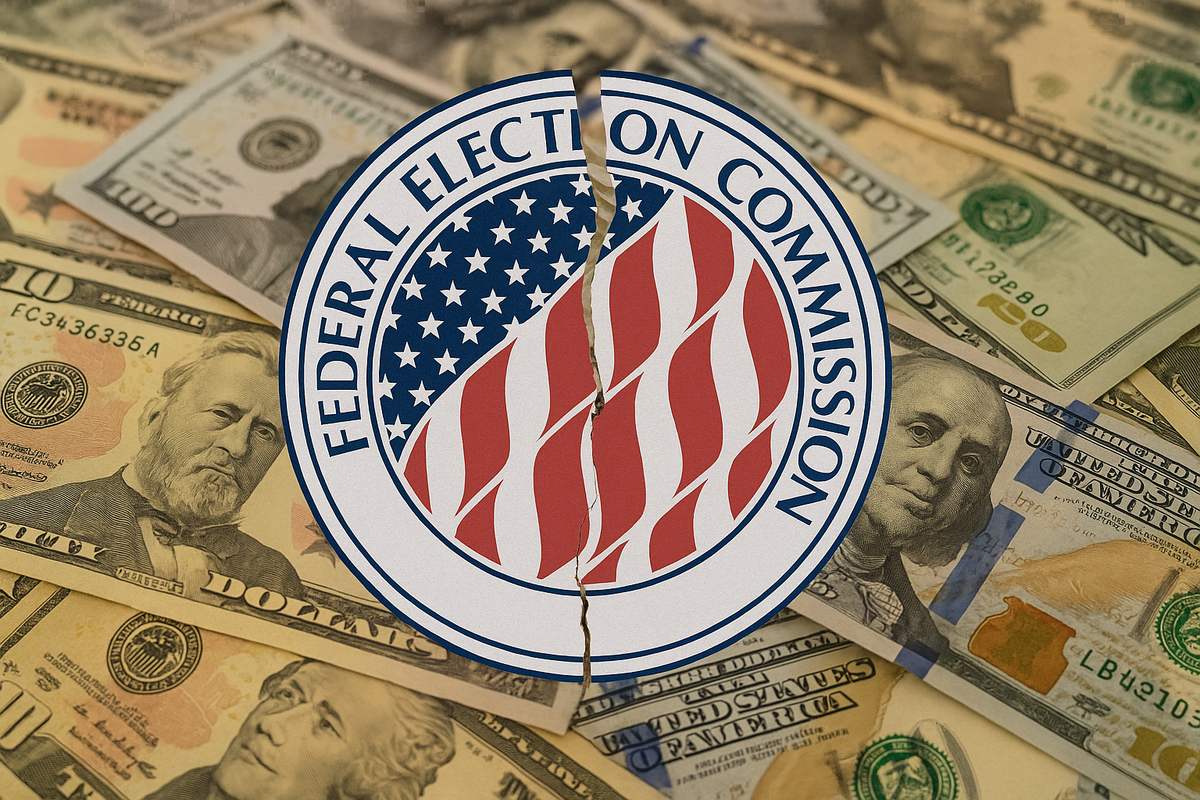
Still, for anyone concerned about political operatives or monied interests abusing the system, whether by exploiting loopholes or outright breaking the law – this story should be of particular interest.
In May 2025, Republican Allen Dickerson left the FEC, resulting in the agency losing its quorum. A month prior, Sean Cooksey – also a Republican – resigned and President Donald Trump fired FEC Chair Ellen Weintraub, a Democrat.
Both Cooksey and Weintraub now work for lobbying groups.
The agency needs a minimum of 4 members to conduct its most critical functions, including voting on the outcome of investigations, conducting audits, and punishing campaign finance law violators.
That is, if commissioners can agree a law was broken.
With these 3 out, the FEC lost its ability to do any of these things. Then, in October, Republican Trey Trainor also resigned from the agency, leaving only 2 members.
This explains why Trump nominated two Republicans – Ashley Stow and Andrew Woodson. Their confirmation will give the agency the quorum it needs to function, but there is no telling how long this will take.
Trainor’s 2017 nomination by Trump took 976 days to confirm.
Even if there is a speedier confirmation process, the commissioners will face a massive backlog. And, because there will only be 4 members, decisions on any of these enforcement cases will require all commissioners to be on the same page.
The likelihood of this happening is slim.
Prior to its shutdown, the FEC saw an increase in cases that resulted in deadlocked decisions split along party lines. Democrats accuse Republicans of not enforcing the law, while Republicans accuse Democrats of weaponizing the agency.
The result – in an agency designed to be evenly split between Republicans and Democrats – is inaction.
With Trump’s nominees, the makeup would be two Republicans and two Democrats. And if Trump tried to fire another Democrat, the FEC would once again lack quorum.
So, for anyone wondering who is enforcing federal campaign finance laws in the 2026 midterms… the answer is no one. And that is not likely to change even if new commissioners are confirmed.
Indiana Becomes 19th State to Ban Ranked Choice Voting, Despite No City or County Using It
In the final week of February, Indiana Gov. Mike Braun signed a bill into law that bans the use of ranked choice voting in city, county, and state elections. Ironically, while heavily supported by Republicans, the party used RCV during its 2020 state convention.
Specifically, the law states elections “may not be determined by ranked choice voting” and a “candidate may not be nominated for or elected to an office by means of ranked choice voting.”
Braun’s signature makes Indiana the 19th state to ban ranked choice voting, including:
- Alabama,
- Arkansas,
- Florida,
- Idaho,
- Iowa,
- Kansas,
- Kentucky,
- Louisiana,
- Mississippi,
- Missouri,
- Montana,
- North Dakota,
- Oklahoma,
- South Dakota,
- Tennessee,
- Utah,
- West Virginia, and
- Wyoming
Ranked choice voting gives voters the option to rank candidates in order of preference. And while opponents often like to say the reform is confusing to voters, it is the same as ranking food preferences.
Most RCV jurisdictions in the US use the instant runoff method that eliminates the last place candidate if no one gets a majority of first-choice selections. Their voters’ next choices are then applied to the tabulation.
Subsequent elimination rounds are conducted as needed until a single candidate has a majority of the vote.
Supporters of the Indiana bill argued that ranked choice voting is too complex and increases election costs. They further argue that it violates the principle of “one person, one vote,” though each voter only gets a single vote that counts toward the results.
Opposing lawmakers argued that the priorities of the legislature are misplaced, noting that the state already doesn’t use ranked choice voting. “We should be focusing on bills that get us out from the bottom in terms of voter participation,” said state Sen. J.D. Ford.
Indiana’s ranked choice voting ban goes into effect on July 1.
Meanwhile, New York Town Adopts Ranked Choice Voting to Settle Voting Rights Lawsuit
While ranked choice voting is getting banned in the Midwest, the Town of Newburgh, New York, agreed to adopt a proportional form of ranked choice voting to settle a lawsuit that alleged black and hispanic voters were unable to elect candidates of their choice.
Six plaintiffs filed a lawsuit against Newburgh following the passage of the John R. Lewis Voting Rights Act of New York (NYVRA) in 2022. They asserted that the town’s at-large voting system violated voter rights and protections under the law.
In response, the town argued that the NYVRA violated the Fourteenth Amendment of the US Constitution. On November 7, 2024, the state Supreme Court 9th Judicial District agreed and ordered that the law be struck down entirely.
Following appeal from the plaintiffs, the Second Division (which is another component of New York’s Supreme Court, Appellate Division) reversed the decisions made by the previous court, sending it back for further proceedings.
Ultimately, the town and plaintiffs entered into negotiations that resulted in the settlement to use proportional ranked choice voting, which on top of allowing voters the option to rank candidates allocates seats based on level of support.
Advocates argue that it will more accurately reflect community preferences.
“I am elated; justice was served today” said Plaintiff Ernest Tirado. “Now we can get representation in the Town of Newburgh.”
As a result of the settlement, Newburg will become the first jurisdiction in New York to adopt proportional ranked choice voting. However, this is not the first town in the US to adopt its use following a voting rights lawsuit.
Eastpointe, Michigan, became the first municipality in its state to use ranked choice voting after the DOJ sued it under Section 2 of the Voting Rights Act. The suit alleged that the city's elections suppressed the voices of black voters.
Independent documentary filmmaker Grace McNally made a short film about it. In this case, the DOJ determined that ranked choice voting could be a remedy to violations of the VRA and other voting rights laws.
Los Angeles Commission Recommends City Use Ranked Choice Voting
On February 26, the Charter Reform Commission of Los Angeles made a list of recommendations for the city, one of which was that LA should implement ranked choice voting for its elections going forward.
The adoption of ranked choice voting would require changing the LA City Charter, which means it needs to be approved by voters. The next step is for the city council to decide what recommendations to put on the June ballot.
“The Charter Commission took a big step in empowering Los Angeles voters,” said Michael Feinstein, a former mayor of Santa Monica and a Green Party candidate for secretary of state.
The Independent Voter Project polled LA County independent voters on their view of more choice elections, which includes using ranked choice ballots following a nonpartisan primary. Over 60% said they’d support such a system.
 Shawn Griffiths
What this means for representation in the city remains to be seen. As previously mentioned, there are different ways to implement ranked choice voting – especially in a city as large as Los Angeles.
Stay tuned for more on this story on IVN.
In Other Reform News
- New research from Cambridge University shows that California’s nonpartisan Top Two primary system creates more meaningful competition in elections and contested races in districts that historically would be considered safe for one party or the other. While these districts can have general elections with two candidates from the same party, these elections are now “substantially” more competitive than they were under the closed primary system used before Top Two. This is because it is no longer an easy victory for a single candidate of the majority party.
- Legacy media is turning to IVN co-publisher and the author of California’s Top Two nonpartisan system, the Independent Voter Project for its expertise in the independent and reform spaces. The New York Times featured IVP’s recent polling on the California governor’s race. ABC talked with IVP general counsel Chad Peace on the surge of independent voters, which was picked up by the CBC in Canada. Peace was also featured on several podcasts to talk about the impact Top Two has had on competition and representation, as well as the expansion to more choice elections.
- The better elections group Open Primaries released the Declaration of Independents, a sweeping public statement that frames the exclusion of independent voters from taxpayer-funded elections as the unfinished business of 1776. This comes as the US celebrates its 250th birthday. Millions of independent voters will be shut out of critical taxpayer-funded primary elections this year that will decide 95% of congressional elections. The Declaration demands that elections be open to all voters and the equal treatment of independent voters in elections, polling, debates, and media coverage. Open Primaries will send the document – signed by independent voters – to the two major parties on July 4.
- The campaign trying to repeal nonpartisan primaries and ranked choice voting in Alaska have sued the state’s Division of Elections over the ballot language used for its measure – which is the second attempt at repeal. The argument from those who want repeal is that the language suggests the measure will do things it won’t and that repeal will simply return Alaska elections to the system the state used before ranked choice voting (while omitting that it also would re-implement closed primaries). Those fighting the repeal effort have also sued over the measure’s language, arguing that it suggests it will restore campaign finance regulations when it would, in fact, eliminate them.