 Independent Voter Project
The Independent Voter Project (IVP) released a new poll this week on the hotly contested California governor’s race and several other issues that impact voters, including affordability, immigration enforcement, corruption in government, and more choice election reform.
 Ethan Handelman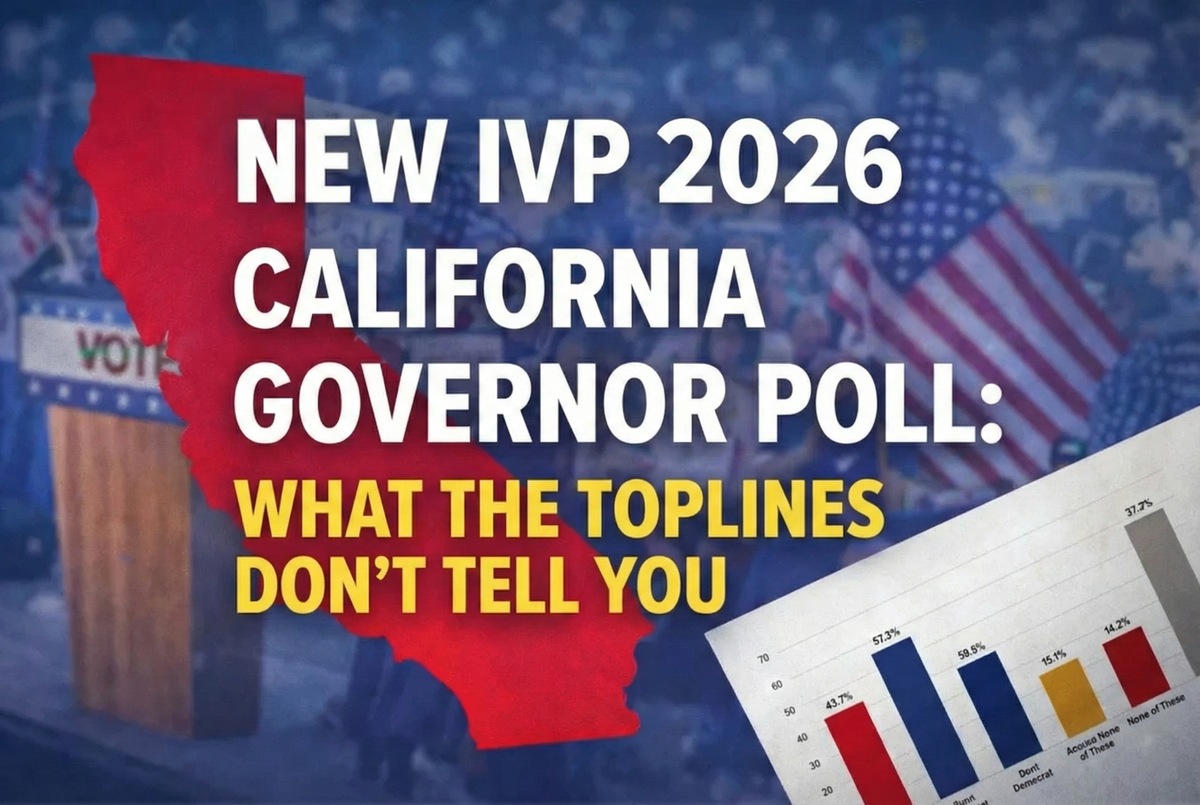
It didn’t take long for our poll to get noticed not only in Sacramento, but all the way over on the East Coast where the New York Times featured it alongside other reputable pollsters like Emerson College and the Public Policy Institute of California.
But it isn’t just the New York Times turning to us for our expertise in the independent voter space. We have also been featured on ABC News, the CBC in Canada, and a host of podcasts like State of Gold, Maximum Libertarian, and the My First Party podcast in Australia.
Overcrowded Candidate Field in California Proves We Need More Choice Reform in Elections
In an interesting twist, none of the polls featured by the New York Times – including ours – show a Democrat leading the crowded gubernatorial field in deep blue California. Instead, they show either Steve Hilton or Chad Bianco (two Republicans) in the front-runner spot.
Most pollsters use a “likely voter model” to produce toplines on candidate positions and partisan alignment. But we looked deeper in the wide-open race that could have unintended consequences with so many Democrats splitting the vote.
What if two Republicans advance out of the nonpartisan primary in a state where GOP membership makes up only a quarter of the registered electorate? Despite this prevalent narrative rearing its head in the media, it’s an unlikely outcome.
However, as the parties and their candidates continue to approach the Top Two nonpartisan primary as if they are running under the closed primary system in place prior to 2012, it’s not an impossible outcome.
The nonpartisan Top Two primary we successfully passed under Proposition 14 in 2010 opens the taxpayer-funded elections process to all voters and candidates, regardless of party. It then narrows the public field of candidates to the top two vote-getters in the general election.
This can produce outcomes in heavily partisan districts where two Democrats advance or two Republicans, but what it also does is give the political minority in those areas a greater say in which Democrat wins or which Republican wins.
Thus, candidates need to be able to appeal beyond their party’s base support to win.
IVP’s chief legal strategist Chad Peace was featured on the State of Gold with Jon Slavet to discuss Top Two and explain this impact, particularly in overcrowded candidate fields like in the governor's race where no one knows what will happen.
“This is the largest example of how the unintended consequences can play out,” Peace said. “Then the question goes, how do you improve while maintaining an open primary?”
To solve this, we have engaged with the reform community to develop a "more choice" system – and what we came up with was moving to a Top Five system. This will protect the voting rights of independent voters and deliver more candidate choices in the general election using ranked choice ballots.
There is one thing we know for sure: Independent voters overwhelmingly want to keep nonpartisan open primaries. Our polling proves it. And few California voters oppose advancing more choice to the general election.
The last thing independent voters in California want is to once again be among the millions of citizens across the country that are disenfranchised by closed primary systems.
There are over 24 million independent voters in the US that are shut out of taxpayer-funded primary elections that effectively decide more than 90% of all elections. And this number will grow as voters increasingly distrust the hyper-partisan narratives from both major parties.
The option they are given is: Join a party or don’t vote.
This is why we started the nationwide legal fight against closed primary systems by challenging New Jersey's closed primaries – which shut out half of the state's electorate – back in 2015. We believe the right to vote should not be conditioned on joining a private political corporation…
A sentiment most voters in California and across the US agree with.