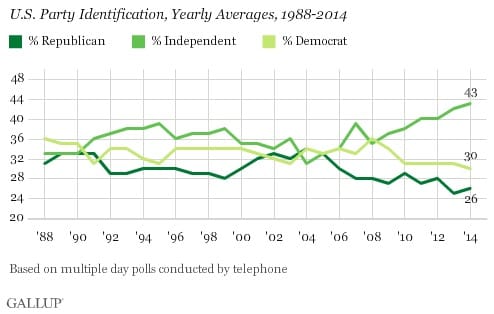
The two major political parties received another blow on Wednesday, as a recent Gallup poll revealed that a record-high number of Americans (43%) now self-identify as independent.
This represents a drastic increase from 2008, when 35 percent of Americans identified as independent, suggesting that the growth is not only rapid, but will continue.
The growth primarily comes at the expense of the Democratic Party, which fell from 36 percent to 30 percent in just 6 years. Republican identification dropped from 28 percent to 26 percent in the same time period.
This should come as no surprise to voters or politicians. Americans have repeatedly made it clear that they cannot be defined as either red or blue. A majority of voters believe “neither party in Congress is the party of the American people,” and a whopping 81 percent believe that Congress is out of touch.
Consistently, Congress has received abysmal approval ratings from voters, reaching a low of 8 percent in the beginning of 2014. Jon Stewart even went so far as to compare Congress to herpes.
And for the first time in the history of Gallup polling, government, Congress, and politicians ranked as the number one problem facing the United States in 2014.
As speculated by Gallup:
"Given historical trends, 2015 could bring a new record, as the percentage identifying as independents typically increases in the year before a presidential election.”