Jeremy Gruber
A major constitutional challenge to Oregon’s closed primaries is no longer just a courtroom fight - it is now a growing public debate across the state.
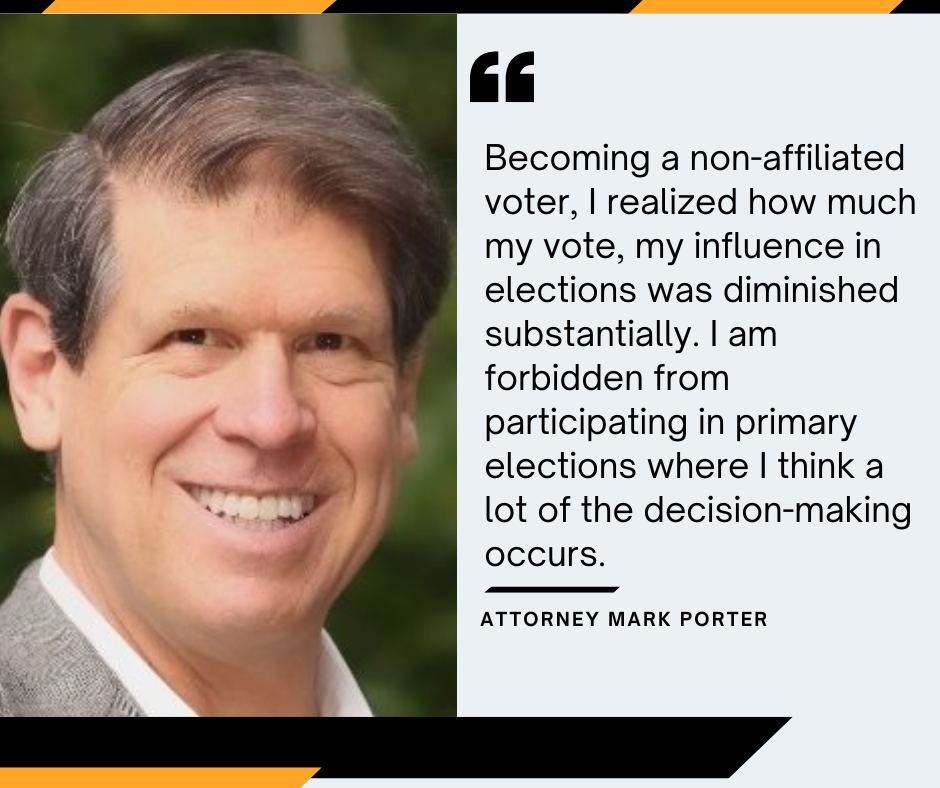
After Open Primaries filed an amicus brief drafted by me to the Oregon Court of Appeals supporting the brief filed by plaintiffs Mark Porter and Our Primary Voice, the case has gained major visibility in multiple outlets. That coverage was followed by wider attention in political reporting, radio discussion, digital commentary, and social media, where independent voters and reform advocates have been amplifying the stakes of the case. As Porter declared in bringing the suit:
At the center of the lawsuit is a simple but consequential constitutional question: Can the state require citizens to join a private political party in order to vote in a public election?
Our brief argues that it cannot.
It makes a legal argument rooted in both voting rights and freedom of association. The Constitution protects the right to join a political party, but it also protects the right not to join one. The state should not be allowed to condition access to a taxpayer-funded public election on party membership.
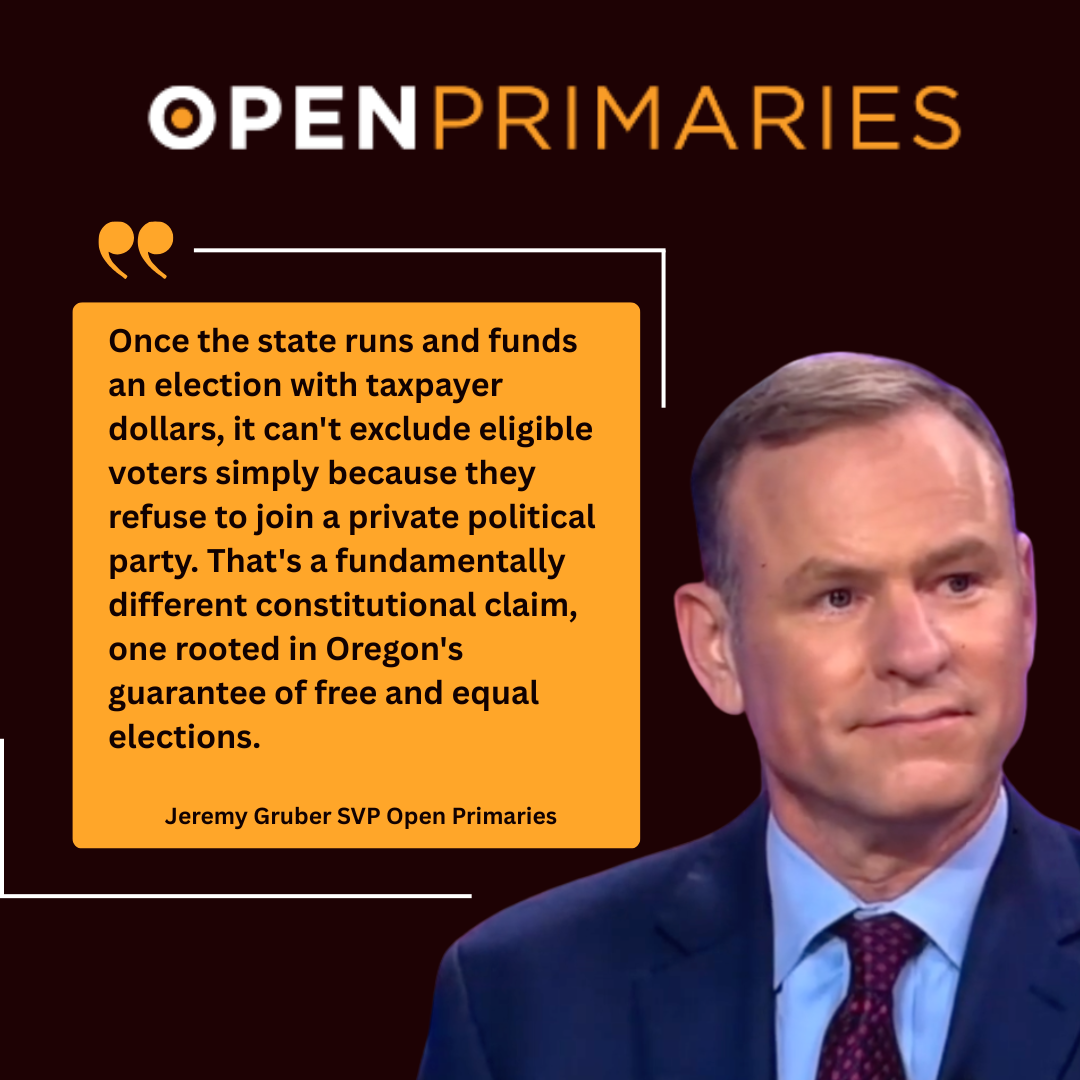
The brief also challenges the longstanding assumption that party primaries are purely private affairs. In Oregon, as in many states, primaries are created by state law, administered by public officials, funded by taxpayers, and used to nominate candidates for public office. In many communities, they are the elections that matter most. Excluding voters from that process is not simply a party rule - it raises a serious constitutional problem. As I noted:
The attention this case is receiving shows that the argument is breaking through. What began in Oregon is now helping frame a broader national debate about whether public elections belong to all voters or only to party members.
Want to learn more? Open Primaries is building the nation's first coordinated litigation platform dedicated to primary reform and independent voter rights with cases across the country.
OPEN PRIMARIES AT NCSL – Conversations and Connections
The National Conference of State Legislatures held its Annual Summit in Chicago this week and Open Primaries was there. Cathy Stewart, National Organizing Director and Bree Doldron, National Organizer manned the Open Primaries booth, joined by Open Primaries board member, David Cherry who lives in the Windy City.
They spoke with legislators, staff members and voters from across the country about the need for independent voters to have full voting rights.
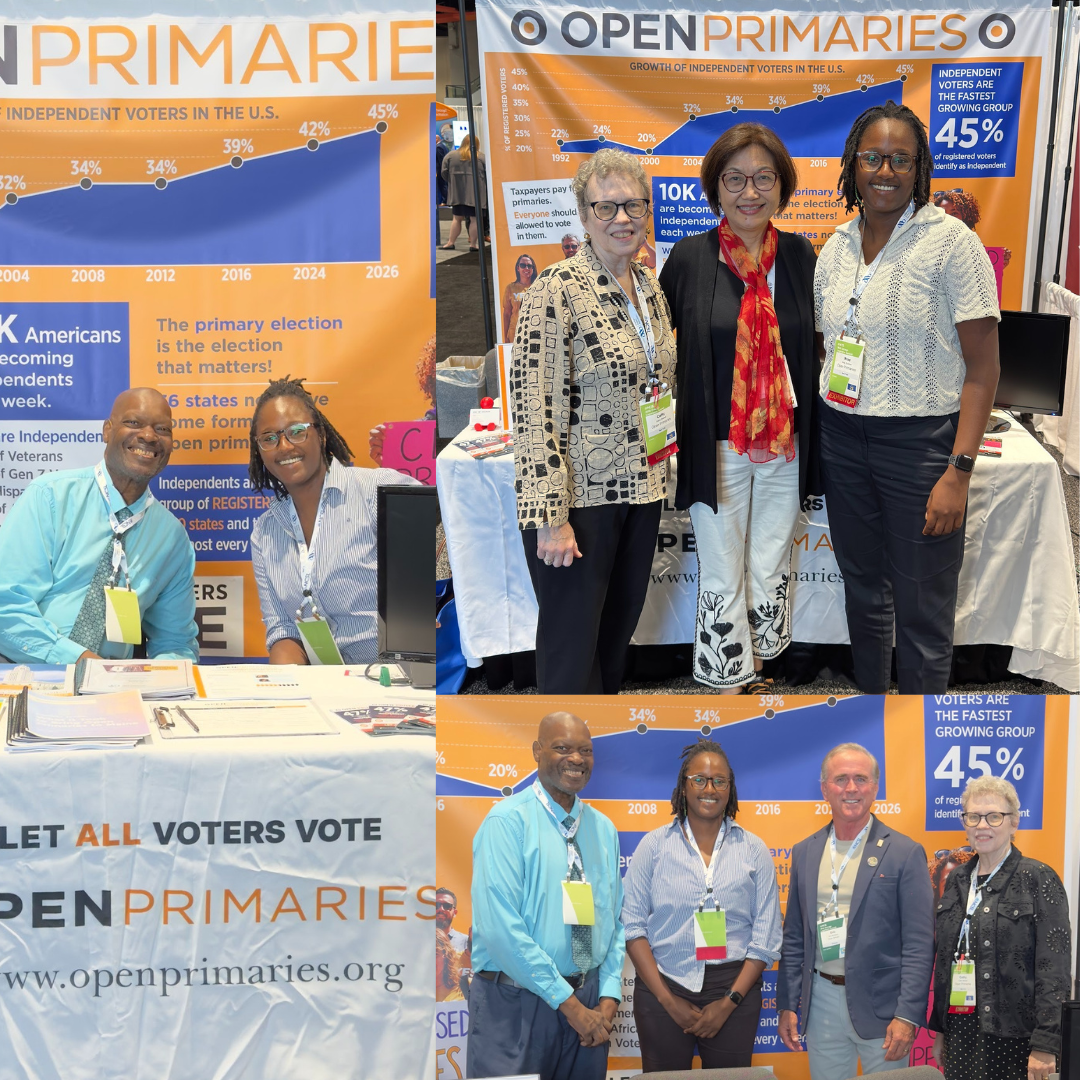
The team spoke with legislators from Washington, Alaska, and Maine who shared the positive impact of open primaries in their state. Check out Washington Rep. Lisa Parsley’s comments below; and Hailey Pucker who shared the perspective of an independent voter in CO.
The team had the chance to talk with African American legislative leaders in South Carolina and Alabama, where the open primary system is coming under attack and how this would negatively impact their communities.
Del. Lily Qi stopped by and shared a message about her commitment to continuing to advance legislation to open the primaries in MD to over one million independents.
Delaware State Sen. Eric Buckson and his wife Jennifer also visited the booth. Sen. Buckson was a Senate cosponsor of HB 188, a bill to open the primaries that passed the House of Representatives this spring. Sen Buckson is hopeful about the prospects for the bill in the next session. Jennifer Buckson is an independent and has never been able to vote for her husband in the primaries!
We had the opportunity to talk with legislators, staff and voters from Hawaii to West Virginia to Connecticut about who independent voters are, the growing movement for open primaries, and the importance of all voters having equal voting rights in public primaries. There were spirited discussions, curiosity and many new connections made.
What We’re Watching
Changing the National Narrative
This week, OP President John Opdycke joined the Politics Guys podcast to discuss the tension between the rise of independent voters and dominance of “dogwhistle” politics. It’s a great interview. And in case you missed it, John appeared on Meet the Press, The Chuck Toddcast, Takeout with Major Garrett, and 535 News to discuss the growing primary reform movement.
Campaign Updates
Who’s Afraid of Open Primaries?
This week, New York Open Primaries.showed that our campaign is doing exactly what it needs to do: forcing public officials and political insiders to confront an issue they have avoided for far too long.
City Council Speaker Julie Menin spoke favorably about opening the system, but stopped short of taking a formal position. That alone is a sign of progress. The pressure is building, and the political establishment can no longer ignore the 1.2 million independent voters shut out of the elections that so often decide who governs New York City.
Mayor Zohran Mamdani, meanwhile, said he is "content" with New York City's closed primary system. That is a remarkable position for someone who claims to oppose entrenched political interests and fight for ordinary people. As the American Enterprise Institute’s Howard Husock notes this week, “one might think that Mayor Zohran Mamdani has less than zero in common with Republicans in Oklahoma, Tennessee, Kansas, Idaho, and Florida. Yet they share a common approach to elections: excluding independent voters from party primaries. One could even call it disenfranchising independents.”
The Working Families Party is also being forced into the open. For years, WFP worked to block open primaries while avoiding public accountability on the issue. Why? Because open primaries threaten the insider influence they have built as a small but powerful special interest in Democratic Party politics. When a group of roughly 20,000 fights to keep 1.2 million independents locked out, it is fair to ask who they really speak for.
The campaign is heating up, the silence is breaking, and every week brings more momentum.
Join the campaign, sign the petition, and help us open New York City's primaries at New York Open Primaries.
What We’re Reading
How Voters Become “The Boss” Again
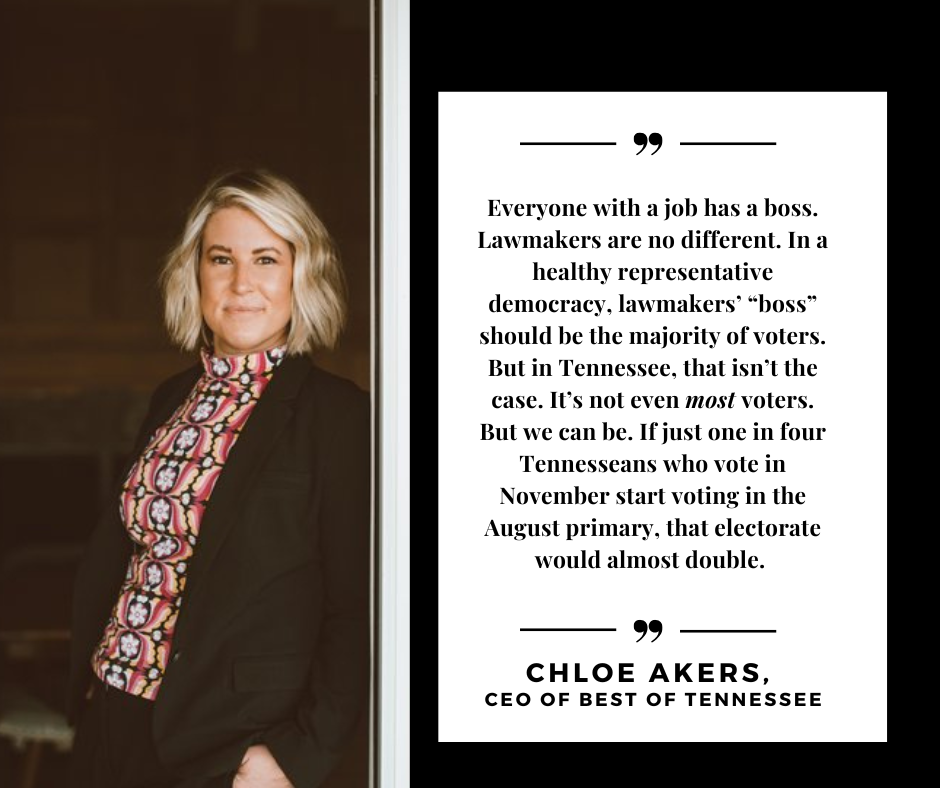
As the founder of Best of Tennessee, Chloe Akers has spent the last several years asking a simple but powerful question: Who do our elected officials really answer to? Her work has focused on helping Tennesseans understand that the state's most consequential elections often happen long before November, when far fewer voters participate. In this week’s feature, Chloe explains how low-turnout primaries have shifted political accountability away from the majority of voters-and why showing up in the primary may be the single most important step Tennesseans can take to make their voices matter again. As Chloe notes:
Fast Takes
ICYMI: A Declaration for America’s 250th Birthday
For the Fourth of July, Open Primaries marked America’s 250th birthday by releasing the Declaration of Independents-a call to affirm that political rights belong to citizens, not parties. The piece celebrates the growing independent movement while highlighting a basic democratic principle: every voter deserves an equal voice in taxpayer-funded elections.
Independent voters from across the country have now joined together in a powerful spoken-word performance of the Declaration of Independents. Check it out!
Activities and Events
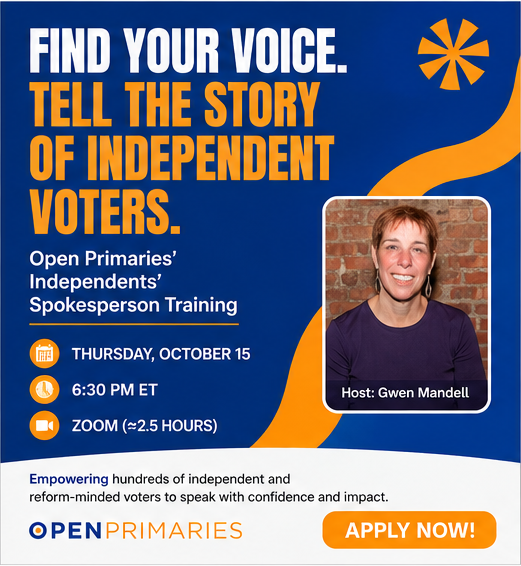
Become a Stronger Voice for Independent Voters
Independent voters are the largest and fastest-growing group in American politics—but too often their voices go unheard.
Open Primaries Independents' Spokesperson Training is designed to help independent and reform-minded Americans communicate with confidence, tell their stories effectively, and become stronger advocates for open, inclusive elections.
Join us on Thursday, October 15 at 6:30 PM ET for an engaging Zoom training featuring storytelling, communications coaching, and practical tools you can use immediately.
Applications are now open, but space is limited.