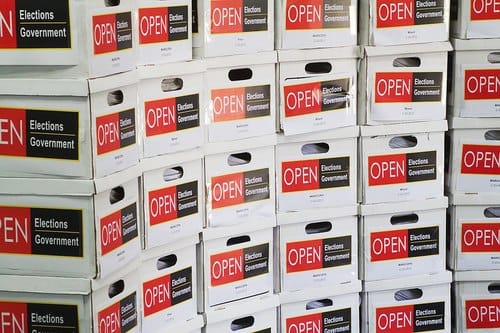
Opening briefs are due today in the Arizona Supreme Court appeal case for supporters and opponents of the Open Elections/Open Government initiative. The challenge comes after a Superior Court judge found the ballot measure violated Arizona's separate amendment rule by combining the issues of a non-partisan open primary and public financing of party elections.
The issue at hand is whether a key clause in the initiative language which specifies party officers may be elected, “but no such procedures shall be paid for or subsidized using public funds“, is a separate issue from open primaries, warranting its own ballot measure and thus violating a constitutional rule against "log-rolling".
From the perspective of the Open Elections/Open Government Act supporters, the finance issue is a natural outcome from implementation of a new open primary system. In non-partisan elections, they argue, the taxpayers should not be expected to continue funding elections for party officer seats, like precinct leaders.
"If the initiative passes, it is entirely up to how they would like to run elections. They can gather signatures, set up online voting, hold a convention," says Open Government committee member and co-author of the Open Elections/Open Government Act, Karen Schroeder. "The key point is Arizona independents should not have to pay for that."
"1 in 3 Arizona voters are independents. It's very unfair to expect those voters to fund partisan primary elections," she adds.
The appeal process in Arizona's Supreme Court will be expedited, with a decision expected by the end of the month.
Architects of the initiative always expected a court challenge from stanch opponents of an open primary, especially from the political parties. It is a shrewd move, as Schroeder predicts legal fees for the other side will likely run $50-$100,000, as opposed to $1 million or $2 million spent on a fall campaign against the measure.
"They knew they had to try to block us in court because they realize what we are doing is very popular. It's overwhelmingly supported by voters," says Schroeder.
The court's ruling will be an all-or-nothing deal. There is no avenue to excise or amend the initiative at this point. Arizona requires the language of ballot measures to be included and available while collecting signatures. Any changes would invalidate previously gathered signatures, which the group spent months and a substantial amount of money to achieve.
Ironically, had the Open Elections/Open Government Act been legislatively referred, Arizona's lawmakers would be permitted to fix it. Regular citizens, on the other hand, do not have that luxury.
Yet, if the court decides to rule unfavorably for Open Elections/Open Government, organizers are undeterred on the need for reform of the system.
"It's not unusual for initiatives to need more than one election cycle to be successful," says Schroeder, adding in the worst case scenario, "We learn from that and come back next election cycle."
"We're not going anywhere. This is an extremely important issue," she says.