Skip to content
Subscribe

November 14 General Strike Across Europe

Published:

photo: Álvaro Garcia (El Pais) Tens of thousands gather at the plaza de Colón in Madrid, Spain
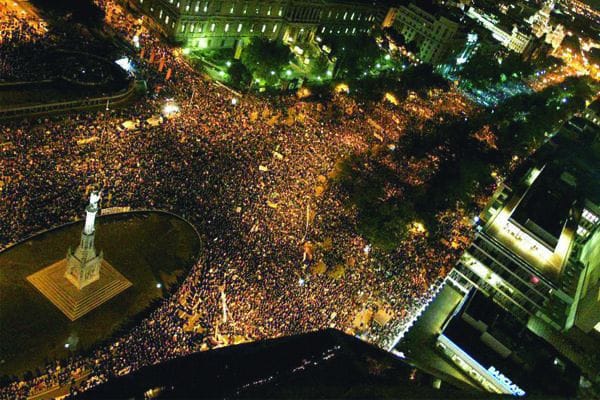
Workers and the unemployed alike coordinated a multi-national protest on November 14th spanning Portugal, Spain, Greece, Italy, Belgium, and France. Several smaller demonstrations took place in Germany, Denmark, and Britain.  The Guardian estimated the number of attendees in the millions as the protesters marched into the night.

Primarily coordinated by the European Trade Union Confederation, the November 14 general strike across Europe grounded flights, halted trains and other transit services, and culminated in several violent skirmishes between protesters and riot police in Portugal, Greece, and Spain -- the countries hit hardest by imposed austerity measures.

Though each country faces slightly different challenges with Germany's austerity demands, the European Debt Crisis has pervaded the region. Spain in particular is facing a possible fine or further austerity requirements if it is unable to produce a budget plan that reduces its deficit down to 3 percent of GDP by 2014. It is currently projected to be 6.3 percent for 2012.

On the heels of the protests, European Commissioner for Economic and Monetary Affairs, Olli Rehn made this statement yesterday:

"Spain has adopted sizeable measures of fiscal consolidation to restore confidence to its public finances and these measures amount to around 5¼% of GDP in 2012 and to 2¼% of GDP in 2013. The estimated annual improvement in the structural balance this year and next year is in line with the effort required in the Council recommendation... The Commission's view is that no further steps in the excessive deficit procedure of Spain are needed at present. However, the measures announced so far for 2014 fall short of what is required by the revised Council recommendation."

Critics of the austerity program charge that forced budget cuts have worsened unemployment and deepened an already brutal recession. The European Commission reports an average unemployment rate of 11.6 percent among the countries that utilize the Euro as their currency. Greece and Spain are the highest at 25.1 percent and 25.8 percent, respectively.

A much awaited troika report compiled by the European Commission, the European Central Bank, and the IMF, is likely to provide greater clarity for the Eurozone, in particular Greece, going forward. Civil unrest will continue to bubble as many indicators suggest that most austerity measures will remain in place, especially for countries like Greece, Spain, Portugal, Italy, and Ireland.

Tweets about "#n14"

Adhere to the IVN etiquette

By posting a comment, you agree to adhere to our etiquette rules: No partisan attacks, no personal attacks, substantiate your sources, no self-promotion.

Contact IVN

Questions about this article or our coverage? Send us a message. A free IVN member account is required.

Message sent

Thanks, we’ll review it and get back to you if needed.

Message not sent

Sorry, something went wrong. Please try again.

Sign in to send a message

Messages are tied to your IVN member account. Signing in is free and takes a few seconds.

Republish this article

Republishing guidelines

Republish IVN articles for free. Independent Voter News articles may be republished online or in print under a Creative Commons BY-NC-ND 4.0 license, on these terms:

  1. Credit the author and IVN. Keep the byline ("By Author Name, Independent Voter News") and the attribution note at the end, which links to the original.
  2. Keep the meaning. You may update time and place references and apply your house style. You may trim for length, as long as the cuts don't change the meaning or misrepresent the author. Keep the headline. Mark any additions as your own (for example "Additional reporting by ...").
  3. Translations are welcome. Translate faithfully, add "Translated from English by [your outlet]", and tell us at editor@ivn.us.
  4. Keep the links, including the link to the original article.
  5. Keep the tracking image. The HTML includes a 1-pixel image that counts readers on your page. It collects no personal information.
  6. Photos and illustrations. Images credited to IVN may be used with this article only. Images credited to others (AP, Getty, Unsplash, Wikimedia and so on) stay under their owners' terms. Secure the rights or switch "Include images" off.
  7. Don't sell it. You can't sell our articles or sell ads specifically against them. Your normal site advertising is fine.
  8. No implied endorsement. Don't suggest that IVN or the author endorses you, your candidates or your causes, or that donations to you support IVN.
  9. Keep labels. Opinion or analysis pieces keep that label.
  10. Point search engines to the original. Where your CMS allows, set the canonical URL to the original IVN article.
  11. No bulk or automated republishing, and don't submit our articles to aggregators (Apple News, Google News, MSN) as your own.
  12. Corrections and removals. Update your copy when we correct it, and remove it promptly if we ask. We'll contact you at the email you give us.
  13. Questions or print republication: editor@ivn.us.

IVN staff: fill in who you're inviting above, then create the invite.

Preparing the article

November 14 General Strike Across Europe

Choose a format
  • HTML
  • Email HTML
  • Markdown
  • Formatted (.docx)
  • Plain text
  • WordPress blocks
  • PDF
Choose a platform

Photos credited to others need their owners' permission.

To for

Republishing somewhere else? Questions? editor@ivn.us