
 Shawn Griffiths
SAN DIEGO, Calif. - In recent election cycles, a third of registered California voters have participated in the state’s nonpartisan Top Two primaries. This is higher than most states, but there are still noticeable participation gaps, especially among independent voters.
Several variables factor into this gap, including the continued reliance candidates have on partisan networks to campaign. They only speak to party members and pretend that independent voters have no direct power in June.
They do – a lot of power, if they vote.
Another reason is that party operatives are confusing voters registered as “No Party Preference.” There are independent voters in California who believe or are told that they have to join a party in order to vote.
This is not true for nearly all elections in California. It is, however, true for presidential primaries because the state maintains a semi-closed primary system for these taxpayer-funded preference elections.
To be clear: California voters can participate in every state primary election in 2026, regardless of their party affiliation (or lack thereof). This is because elections for state executive, legislative, US House, and US Senate use the nonpartisan Top Two system adopted by voters under Proposition 14 in 2010.
Every voter gets the same ballot and can choose any candidate they want. No one is locked out.
When Independent Voter posted a series of videos about primary turnout on its Facebook page, the comments revealed a startling reality: Many voters think California’s semi-closed presidential primary rules apply to the 2026 midterm elections.
They don’t.
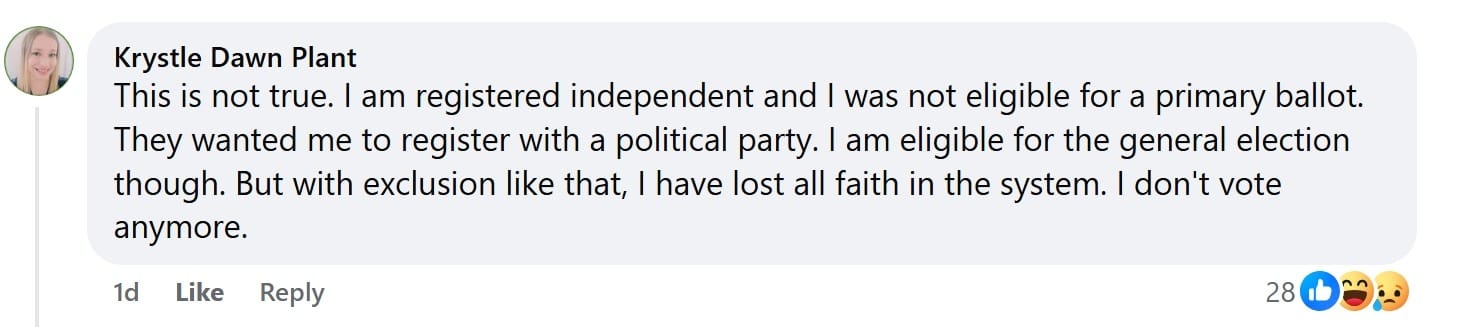
Facebook user Crystal Dawn Plant said, “they wanted me to register with a party.” Voters do not have to register with a party to receive a nonpartisan Top Two ballot. They can be registered however they want and they will still receive the same ballot.


The Independent Voter Project (IVP), a co-publisher of IVN, has warned for over a decade now that the way California conducts its presidential primaries is confusing for voters. There are multiple reports and documented proof that it does.
The comments left on Independent Voter’s Facebook page just add further evidence.
 Kaia Los Huertos
Here’s How It Works In Presidential Primaries
Under the state’s presidential primary rules, the parties decide whether to allow voters registered as No Party Preference to participate in their nomination process. The Democratic, Libertarian, and American Independent Parties allow it.
The Republican, Green, and Peace and Freedom Parties do not. But even Democratic operatives and canvassers tell voters they should go join the party so that they are not given a provisional ballot.
On top of navigating a system that says independents can vote here, but not vote there, and if they try to vote in this primary they will be turned away, this adds more confusion.
IVP challenged the state’s continued use of semi-closed primaries for presidential contests, going so far as petitioning the US Supreme Court. It even offered a legislative solution: a "public ballot" option for voters who didn't want to join a party.
This solution was offered with the understanding that the Republican and Democratic Parties reserve the right to decide what votes count in the presidential nomination processes. They can even ignore their own party’s primaries and caucuses (and have in recent elections).
Shawn Griffiths
Read more about IVP’s efforts here.
Yet, neither the secretary of state nor the legislature acted. As a result, millions of voters are left confused each presidential election cycle. As IVN discovered, this confusion extends into midterm elections because some voters are not receiving the right information.
There Are No Strings in 2026 – Only Freedom of Choice
In the 2026 midterms, there are no party primaries. Republicans appear on the same ballot as Democrats, and the major party candidates appear alongside minor party and No Party Preference candidates.
When voters review the ballot they receive in the mail (which all registered California voters get), they can choose any candidate, regardless of the voter’s affiliation or that of the candidate. This is the freedom the nonpartisan open primary system offers.
Shawn Griffiths
Republican and Democratic operatives are aligning their interests to repeal the Top Two primary system and go back to a closed system that will lock out millions of California voters. They argue, in part, that Top Two is confusing for voters.
But what is confusing about nonpartisan primaries? Voters do not have to navigate party registration requirements or wonder if a party will allow their participation. There are no strings or conditions attached to their eligibility.
The only confusion comes when voters are convinced they have to join a party because they voted in the last presidential primary and they were forced to traverse the maze of party restrictions and rules that bar them from meaningful choice.
Or because they are being told they have to by campaigns or canvassers. Don’t be led astray.
California voters do not have to register with a party to cast a meaningful vote in 2026. They have the freedom to choose whomever they want in the elections that matter most.